It's not all doom and gloom.
For one thing, not working means you have a great deal of freedom to do other stuff! And get paid for it! Small artwork commissions, the odd science workshop, a bit of admin and co-ord for other events...it all adds up. I branched out into cards and postcards for sale (admittedly nothing much has come of this yet, but then I was always lousy at marketing!). Mum and I went back to Loch Awe. There was the long Xmas break - no need to rush back north despite the weather. The only problem is knowing what day of the week it is when you don't have some sort of structure to your life. I drift into a nocturnal kind of schedule if left to my own devices (definitely a night owl rather than a lark!) ...which isn't so bad in the depths of winter when you don't see much sun anyway, but I do have to keep an eye on my tendency to suffer from SAD.
And - to put it bluntly - I was bored!
So when Richard the Reserve Manager asked if I'd be interested in a part-time job as administrator for the local reserves, I nearly bit his hand off.
So it's official. I'm back at Strathbeg in a paid capacity for the third time in my (post-RAF) life, dealing with the bits of paperwork that otherwise would keep the rest of the staff from doing what they should be doing out in the field. Which suits me fine! The view from the office is better, for one thing - my 'birds seen from my window' list stands at 16, (it's a small window at the back of the building) including great spotted woodpecker and sparrowhawk. There is always something going on, and for the first time in ages, I'm not working on my own. At the end of the day, I can wander over to the Visitor Centre, do a bit of bird watching and admire the work the Konik ponies are doing controlling the rough grass (and watch the first of the foals galloping about).
It's pretty good, really.
Showing posts with label Reserve. Show all posts
Showing posts with label Reserve. Show all posts
Friday, 28 June 2013

Saturday, 7 May 2011
Home on the Range
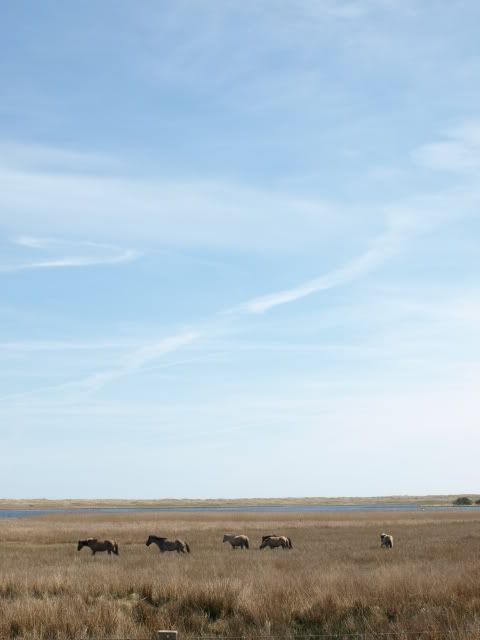
We have ponies! Well, the RSPB has them really, but we all feel quite proprietorial about them. They are Konik horses, strictly speaking, brought in to help manage the rough grazing in the marshes and improve conditions for breeding waders. They are quite a long way from the Visitor Centre, and are rather elusive, seeming to like hiding amongst the gorse bushes, so when we got the opportunity to go to see them (after a very early start on the last goose count) we clambered into the reserve truck and bounced off over the fields.

There are eight, four fillies and four geldings, and they are quite young, and still in their fluffy winter coats. They were basking in the sun, and seemed less than impressed at the disturbance, but posed nicely before heading off into the marsh to continue the hard work of eating.

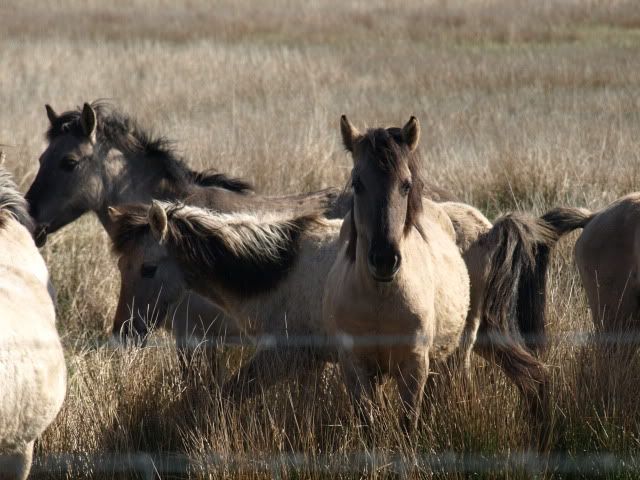
There are eight, four fillies and four geldings, and they are quite young, and still in their fluffy winter coats. They were basking in the sun, and seemed less than impressed at the disturbance, but posed nicely before heading off into the marsh to continue the hard work of eating.
Sunday, 27 February 2011
Turning Seasons
Getting up at an unearthly hour to count the geese every month can sometimes be a bit of a trial, but there are some things that make it worthwhile - the song of a skylark, giving it laldy somewhere overhead in the darkness before dawn; groups of roe deer grazing along the field margins, coming within twenty yards before catching sight or smell of the car, and bolting away into the sunrise, or leaping over the fences with astonishing grace; a flight of whooper swans skimming low over the wood and straight over the car, 'whoong-ing' to each other as they pass overhead. And of course, the geese, in their thousands, rising from the loch and the Low Ground where they have been roosting and feeding to head out into the dawn in search of more food, building strength for the new breeding season.
And the sunrise... each early morning this year, the sun rises a little bit further north. In mid-January, it rose in a scarlet and fuchsia glory behind the Rookery Wood. This morning, it was a full hands-width further round, beyond the airfield; pink filigree lighting the clouds before the gold-on-blue brilliance made using my binoculars a distinctly unsafe business. It marks the changing seasons as much as the snowdrops that flourish in the damp woodlands, or the sudden appearance of lambs, which pop up as if hatching from the turnips their mothers are feeding on. (Or are they helping them to hatch? My passing aliens might suspect so.) Spring is finally showing signs of returning.
And one day I'll figure out how to stick a video into a blog post without have to do it separately!
And the sunrise... each early morning this year, the sun rises a little bit further north. In mid-January, it rose in a scarlet and fuchsia glory behind the Rookery Wood. This morning, it was a full hands-width further round, beyond the airfield; pink filigree lighting the clouds before the gold-on-blue brilliance made using my binoculars a distinctly unsafe business. It marks the changing seasons as much as the snowdrops that flourish in the damp woodlands, or the sudden appearance of lambs, which pop up as if hatching from the turnips their mothers are feeding on. (Or are they helping them to hatch? My passing aliens might suspect so.) Spring is finally showing signs of returning.
And one day I'll figure out how to stick a video into a blog post without have to do it separately!
Tuesday, 12 October 2010
Eye to the Telescope
Where did summer go? The last few swallows - late fledgelings of the last broods - are gathering themselves together, eating as much as they can before the long haul south. The geese have been arriving, dropping in in large numbers, whiffling down from the north to land in their old familiar fields. The rain continues to encourage the snails in my garden...
At this rate it'll be next year before I can blog this year.... so I've decided to do things out of order.
It's fifty years since someone had the bright idea of counting the geese, to see how many pass through and overwinter, and to find out how well they are breeding. 0545 on Sunday morning found Mum and me lurking on the edge of our usual field, waiting for the sun to come up, and the flocks to head out to feed. Naturally, things didn't go according to plan. It was about an hour before we could see more than the vague outline of the landscape, and the geese decided to have a Sunday morning lie-in, which left us feeling rather envious. By about 1000, only about seven thousand had left, and the rest were hanging about on the fields.
Which means taking a different approach to counting.
Back to the Visitor Centre, and set up with a telescope trained on the dense mass of grey-feathered bodies packed in 'tight as ticks on a hedgehog' on the Low Ground marsh, and in the grazing fields beyond. Counting is in clumps of five, rather than strings of twenty, and can only be a 'best guess' - how do you account for the rise and fall of the land, or the awkward geese that hide behind the gorse bushes?
I entertain thoughts of air traffic control - 'All geese in field 59 please proceed to the runway, take off and circle before landing again.' They are so much easier to count in the air!
My eyes ache by the time I'm done, and the traditional goose-count egg-and-bacon sandwich is very welcome as we tally up the count.
It's looking like a funny year. Although there were a lot of geese to begin with, most seem to have gone further south, with only 16-17,000 remaining at what is usually the peak time. Signs and portents? Or just geese being awkward?
Ah well. See what next month brings!
At this rate it'll be next year before I can blog this year.... so I've decided to do things out of order.
It's fifty years since someone had the bright idea of counting the geese, to see how many pass through and overwinter, and to find out how well they are breeding. 0545 on Sunday morning found Mum and me lurking on the edge of our usual field, waiting for the sun to come up, and the flocks to head out to feed. Naturally, things didn't go according to plan. It was about an hour before we could see more than the vague outline of the landscape, and the geese decided to have a Sunday morning lie-in, which left us feeling rather envious. By about 1000, only about seven thousand had left, and the rest were hanging about on the fields.
Which means taking a different approach to counting.
Back to the Visitor Centre, and set up with a telescope trained on the dense mass of grey-feathered bodies packed in 'tight as ticks on a hedgehog' on the Low Ground marsh, and in the grazing fields beyond. Counting is in clumps of five, rather than strings of twenty, and can only be a 'best guess' - how do you account for the rise and fall of the land, or the awkward geese that hide behind the gorse bushes?
I entertain thoughts of air traffic control - 'All geese in field 59 please proceed to the runway, take off and circle before landing again.' They are so much easier to count in the air!
My eyes ache by the time I'm done, and the traditional goose-count egg-and-bacon sandwich is very welcome as we tally up the count.
It's looking like a funny year. Although there were a lot of geese to begin with, most seem to have gone further south, with only 16-17,000 remaining at what is usually the peak time. Signs and portents? Or just geese being awkward?
Ah well. See what next month brings!
Monday, 11 February 2008
Wind of Change
So what gives with this weird weather? It’s been odd for the last four years or so – and where it’s becoming noticeable is with the geese. Today was the regular goose count – normality (for some ten years or so) for January and February has been around 8,000. Regular wintering population in the area. They don’t tend to start building up for another month or so, on their way back to the breeding area in Iceland. But last year, January ran to 20,000, dropping back to normal in February, and this year January was around 18,000 and today we checked in about 24,500… now January can be accounted for in that there was horrible weather in the Central Belt, so we probably hadtheir geese, from Vane Farm and Montrose Basin, and maybe even from further south, Morecambe Bay and even the Wash. But it hasn’t been so bad in the last week or so – so where have they all come from? They don’t seem to stick around during the day; the reserve staff were surprised to see so many. And it isn’t our counting – if anything we undercounted – I was on my own on the usual station, and dealing with a wide front of geese all at once, so if I missed some it wouldn’t have been surprising. (even us old hands get ‘augh, me head's on fire’ moments!)
So what’s with the weather?
The first flying thing I saw this morning, once it stopped being impenetrably dark, was a midge. It was not alone. This is February, for gods’ sake – we shouldn’t have midgies!!! The roe deer, and most of the ducks, are getting frisky – this is normal….but we should have been freezing our socks off even in our thermal underwear, not boiling gently because of the same! There is even a Little Egret on the reserve, and has been for the last month or so – notionally, a Mediterranean bird!
I’ve lived here since 1985. There is absolutely no doubt in my mind that the weather has changed in that time. Snow has shifted from January to March (ooh, I hope not - there is too much to do in March this year), February has got warmer, November windier, and the whole of the winter wetter and dreicher… I could go on.
We are doing something to the climate, whatever the nay-sayers claim. The Earth has, historically, warmed and cooled; this much is true, it’s all to do with wobbling around its axis, but the speed with which it changes seems to be increasing. We should, apparently, being an inter-glacial period, coming up from the depths of cold and the frost fairs of Olde London, when the Thames froze over, and this much I can accept, but should it be happening so fast we can see it year on year?
Wherever you look, someone is making capital out of ‘climate change,’ ‘global warming,’ (and wouldn’t it sound more ominous as ‘global heating’? Warming sounds far too cosy, to me!) and all the various bells and whistles attached to these emotive phrases. One half says it’s dire and dreadful, and the other half says it’s natural and normal – sit back and enjoy the warmer summers! (And to hell if you’re flooded out!)
But do we really want bluetongue disease in our livestock when the winters stay too mild to kill the insect vectors, and to lose ptarmigan and snow buntings from Cairngorm? All of this seems pretty certain, as far as it goes at the moment. Next come malarial mosquitoes in Kent….
The thing is, we don’t understand exactly what’s going on, and how what we’re doing affects it, all we can say is we are doing something, and it may be too late to stop. But maybe, just maybe, we can slow it down until we know more. One of the arguments against reducing CO2 emissions is that by the time it’s a threat, technology will soon be able to sort the problem out. (Thank you for your insight, Mr GW Bush!) But in a race like this, which one will come first – the technology, or the irrevocable damage? Why can’t we help the developing countries, trying to make progress (and understandably narked when we, from our technologically superior (?) criticise their less-developed technology) by giving them the assistance they need to bypass the ‘bad old days’; is the ‘dog in the manger’ race to economic/monetary supremacy worth our future?
The Earth will survive. It does that, very well. It’s just that, like the dinosaurs, and the trilobites, and the giant dragonflies, we may find it won’t support us any more. And I, for one, don’t blame it.
So what’s with the weather?
The first flying thing I saw this morning, once it stopped being impenetrably dark, was a midge. It was not alone. This is February, for gods’ sake – we shouldn’t have midgies!!! The roe deer, and most of the ducks, are getting frisky – this is normal….but we should have been freezing our socks off even in our thermal underwear, not boiling gently because of the same! There is even a Little Egret on the reserve, and has been for the last month or so – notionally, a Mediterranean bird!
I’ve lived here since 1985. There is absolutely no doubt in my mind that the weather has changed in that time. Snow has shifted from January to March (ooh, I hope not - there is too much to do in March this year), February has got warmer, November windier, and the whole of the winter wetter and dreicher… I could go on.
We are doing something to the climate, whatever the nay-sayers claim. The Earth has, historically, warmed and cooled; this much is true, it’s all to do with wobbling around its axis, but the speed with which it changes seems to be increasing. We should, apparently, being an inter-glacial period, coming up from the depths of cold and the frost fairs of Olde London, when the Thames froze over, and this much I can accept, but should it be happening so fast we can see it year on year?
Wherever you look, someone is making capital out of ‘climate change,’ ‘global warming,’ (and wouldn’t it sound more ominous as ‘global heating’? Warming sounds far too cosy, to me!) and all the various bells and whistles attached to these emotive phrases. One half says it’s dire and dreadful, and the other half says it’s natural and normal – sit back and enjoy the warmer summers! (And to hell if you’re flooded out!)
But do we really want bluetongue disease in our livestock when the winters stay too mild to kill the insect vectors, and to lose ptarmigan and snow buntings from Cairngorm? All of this seems pretty certain, as far as it goes at the moment. Next come malarial mosquitoes in Kent….
The thing is, we don’t understand exactly what’s going on, and how what we’re doing affects it, all we can say is we are doing something, and it may be too late to stop. But maybe, just maybe, we can slow it down until we know more. One of the arguments against reducing CO2 emissions is that by the time it’s a threat, technology will soon be able to sort the problem out. (Thank you for your insight, Mr GW Bush!) But in a race like this, which one will come first – the technology, or the irrevocable damage? Why can’t we help the developing countries, trying to make progress (and understandably narked when we, from our technologically superior (?) criticise their less-developed technology) by giving them the assistance they need to bypass the ‘bad old days’; is the ‘dog in the manger’ race to economic/monetary supremacy worth our future?
The Earth will survive. It does that, very well. It’s just that, like the dinosaurs, and the trilobites, and the giant dragonflies, we may find it won’t support us any more. And I, for one, don’t blame it.
Sunday, 9 December 2007
Splashing About
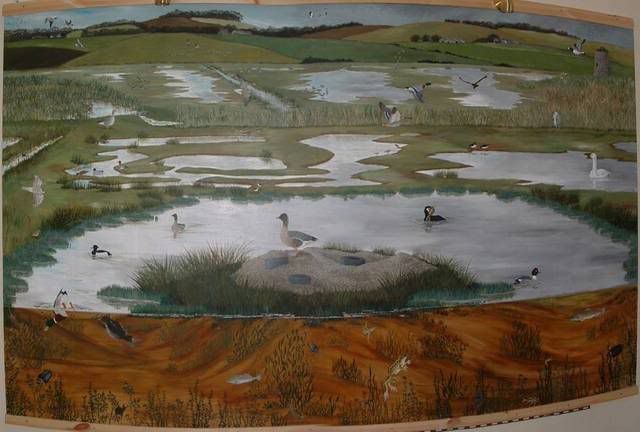
Well....there are those who wanted to see what I was painting down at the RSPB reserve.....
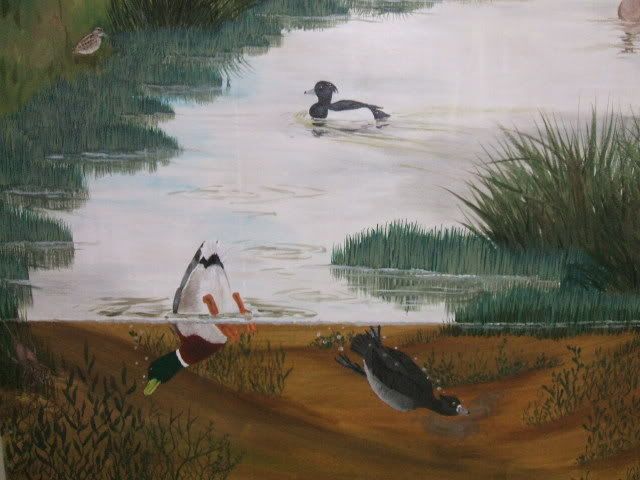
the idea is that it's what you might see out of the window at that time of year, (including underwater) the picture done so far being winter. (Summer is to be done in the depths of this winter.... hmm...will this make me feel warmer when I'm doing it?)
Anyway, here it is - a patchwork version of the whole thing, and a couple of 'highlights'...


this is the bit to the right that you can't see..

...enjoy!
the idea is that it's what you might see out of the window at that time of year, (including underwater) the picture done so far being winter. (Summer is to be done in the depths of this winter.... hmm...will this make me feel warmer when I'm doing it?)
Anyway, here it is - a patchwork version of the whole thing, and a couple of 'highlights'...
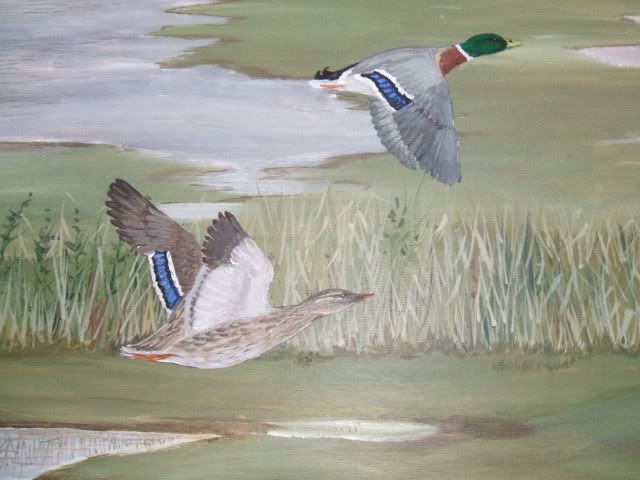
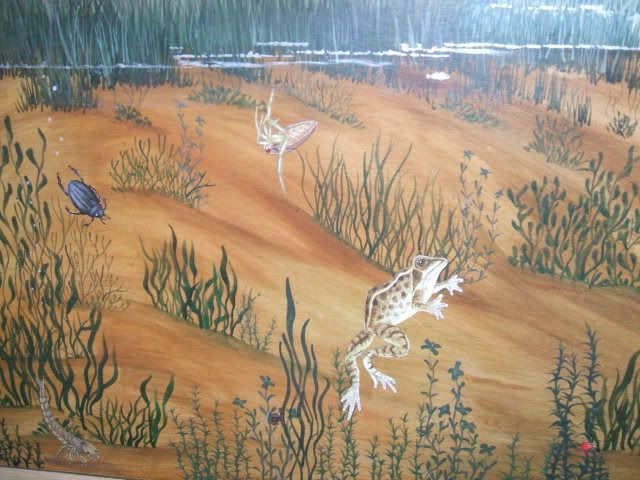
this is the bit to the right that you can't see..
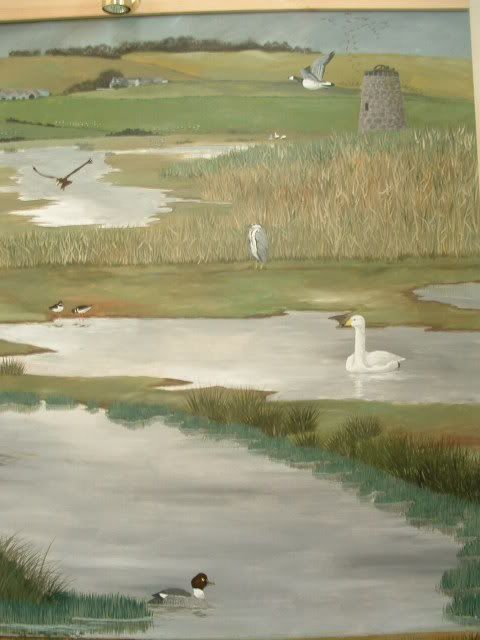
...enjoy!
Tuesday, 7 August 2007
Whale Tale
I was just getting the paints sorted out for the next section of the picture I’m doing for the RSPB reserve, when the Reserve Manager appeared at the door.
‘There’s a minke whale in the harbour at Fraserburgh.’
What could I do but down tools and go see…..?
You may well have seen this in the national news – young minke whale followed a fishing boat into the harbour and got stuck. (If you were looking closely (hi Sue!!), you may even have seen me on the evening news report, one of the many watchers on the quayside.) I was in two minds about going to see it – these things nearly always end up in tears, and I didn’t want to be a voyeur on a sad tale. On the other hand, I did want to see it – I didn’t believe that it could actually be in the harbour itself. But it was.
Standing on the quay, we watched as the whale circled the harbour pool, coming up to breathe every four minutes or so. It didn’t seem too stressed, though there would be no food for it. There were no ship movements as the big pelagic trawlers were tied up, though this may have confused the sonar picture. Why couldn’t it find the gap and the way out to sea?
One of the gang went off to find out what was happening. Apparently, on the entry to the Balaclava Basin (the bit of the harbour in question), there is a concrete ‘lip’ – at low water there is about 3 metres of water over this, and chances are the whale’s sonar was bouncing back off the lip and making it think there was no way out. To make matters worse, if it got over the lip, the harbour wall was straight ahead, leading off left at an angle towards the open sea, but a sonar picture could well seem to show no exit.
The whale circled. A couple of grey seals wandered in, to see what all the fuss was about – they sometimes get fed from the quayside, so possibly thought their luck was in. They made their way out with no problem, but the whale kept going round and round. I had a real sinking feeling about this. I perched on a set of steps by one of the fish warehouses, and felt slightly sick.
Nothing to be done. High water wasn’t until mid-afternoon, and there would be attempts to lure it out then. So I went back to painting rushes, reeds and reflections, and kept an ear on the news. One of our regulars reported sighting larger whales feeding off Rattray Head.
The first attempt failed. I watched familiar faces crop up on the news reports, explaining the plans to help. The whale started to look weary – the dorsal fin started to droop. I began to think this would go the way of so many recent whale encounters in Britain.
Thankfully, I was wrong.
It took several days and a lot of effort, but as you’ll probably know, the whale escaped safely to sea. What wasn’t on the news was that I paid for my prurient curiosity – in perching on the steps of the warehouse, I got at least ten ant bites. That’ll teach me.
‘There’s a minke whale in the harbour at Fraserburgh.’
What could I do but down tools and go see…..?
You may well have seen this in the national news – young minke whale followed a fishing boat into the harbour and got stuck. (If you were looking closely (hi Sue!!), you may even have seen me on the evening news report, one of the many watchers on the quayside.) I was in two minds about going to see it – these things nearly always end up in tears, and I didn’t want to be a voyeur on a sad tale. On the other hand, I did want to see it – I didn’t believe that it could actually be in the harbour itself. But it was.
Standing on the quay, we watched as the whale circled the harbour pool, coming up to breathe every four minutes or so. It didn’t seem too stressed, though there would be no food for it. There were no ship movements as the big pelagic trawlers were tied up, though this may have confused the sonar picture. Why couldn’t it find the gap and the way out to sea?
One of the gang went off to find out what was happening. Apparently, on the entry to the Balaclava Basin (the bit of the harbour in question), there is a concrete ‘lip’ – at low water there is about 3 metres of water over this, and chances are the whale’s sonar was bouncing back off the lip and making it think there was no way out. To make matters worse, if it got over the lip, the harbour wall was straight ahead, leading off left at an angle towards the open sea, but a sonar picture could well seem to show no exit.
The whale circled. A couple of grey seals wandered in, to see what all the fuss was about – they sometimes get fed from the quayside, so possibly thought their luck was in. They made their way out with no problem, but the whale kept going round and round. I had a real sinking feeling about this. I perched on a set of steps by one of the fish warehouses, and felt slightly sick.
Nothing to be done. High water wasn’t until mid-afternoon, and there would be attempts to lure it out then. So I went back to painting rushes, reeds and reflections, and kept an ear on the news. One of our regulars reported sighting larger whales feeding off Rattray Head.
The first attempt failed. I watched familiar faces crop up on the news reports, explaining the plans to help. The whale started to look weary – the dorsal fin started to droop. I began to think this would go the way of so many recent whale encounters in Britain.
Thankfully, I was wrong.
It took several days and a lot of effort, but as you’ll probably know, the whale escaped safely to sea. What wasn’t on the news was that I paid for my prurient curiosity – in perching on the steps of the warehouse, I got at least ten ant bites. That’ll teach me.
Sunday, 18 March 2007
Happy Mother’s Day
‘You have got to admit,’ I say to Mum, as we peer out into the gloom through the windscreen, ‘there are not many mothers that get to celebrate Mother’s Day like this.’
‘Hmmm.’ she sounds singularly unimpressed.
It’s 5.30 in the morning, in the dark, and there is a howling gale blowing from the north-west. Somewhere out in the dark, there are geese….. yes, it’s counting time again, and here we are, waiting for take-off!
A harsh rattle of sleet hits the back of the car, and the sky grows a bit lighter, lowering stratus clouds flying away above us, dumping their load of precipitation as they pass. At about 6.00 a.m. a few geese can be made out struggling through the murk, fighting a strong head wind that blows them straight back to the loch, where they give up and land again. The rooks and jackdaws are enjoying the wildness, tumbling and diving in the wind, but little else seems to be happy about it. Three roe deer cross the field, pausing to check out the car parked in the middle before springing easily over the fence and heading for the shelter of the Badger Wood. The wind rocks the car, and a gusting veil of snow reduces the visibility to a few hundred metres. I wipe the condensation from the windscreen and crack open the side-window a few millimetres. The howl of the gale is too loud to hear what is happening among the geese that I know are out there, but cannot see. I put the window back up. We spread a blanket across our knees to try and stay warm, burrowing into our fleece jackets and pulling woolly hats low on our heads. In a gap between snow-showers, a few more geese try to make their escape, wheeling around overhead only to be blown back again. One or two groups of very determined birds actually manage to make it, heading out to forage.
The snow has built up on the window on Mum’s side of the car, blocking her view. We slide down the window to clear it, and a small drift falls in, onto her lap. A car pulls up behind us.
‘This is ridiculous!’ Vicky sticks her head in through the rear door ‘we’re abandoning it for today. Breakfast back at the farmhouse!’
We are not sorry to retreat.
Later, after bacon butties, we go over to the visitor centre to see if we can see anything. The field to the left of the centre is full of geese, packed in tight, heads tucked down into feathers or feeding in a desultory manner on the grass. Fortunately, the winter has been so mild (until today!) that it hasn’t stopped growing, and they can find a decent meal. The few ducks visible are tucked well in under the banks and in the reeds. There’s no sign of the visiting sea eagle; it’s either sensibly tucked down somewhere out of the storm, or – if it’s tried to fly – is probably halfway to Norway by now.
Before we finally go home, we call in at Kinnaird Head to watch the gannets wheeling and diving offshore. The sea is a mass of white-marbled slate green, foam whipping off every ripple and crest, breaking over the rocks, spume flying through the air. A couple of scoter duck, black against the whiteness, battle their way rounds the point. An eider rides the surge, white on grey. As we drive round the harbour, a large bull grey seal bobs up in the sheltered water, safe in his refuge. We take the hint, and go home.
‘Hmmm.’ she sounds singularly unimpressed.
It’s 5.30 in the morning, in the dark, and there is a howling gale blowing from the north-west. Somewhere out in the dark, there are geese….. yes, it’s counting time again, and here we are, waiting for take-off!
A harsh rattle of sleet hits the back of the car, and the sky grows a bit lighter, lowering stratus clouds flying away above us, dumping their load of precipitation as they pass. At about 6.00 a.m. a few geese can be made out struggling through the murk, fighting a strong head wind that blows them straight back to the loch, where they give up and land again. The rooks and jackdaws are enjoying the wildness, tumbling and diving in the wind, but little else seems to be happy about it. Three roe deer cross the field, pausing to check out the car parked in the middle before springing easily over the fence and heading for the shelter of the Badger Wood. The wind rocks the car, and a gusting veil of snow reduces the visibility to a few hundred metres. I wipe the condensation from the windscreen and crack open the side-window a few millimetres. The howl of the gale is too loud to hear what is happening among the geese that I know are out there, but cannot see. I put the window back up. We spread a blanket across our knees to try and stay warm, burrowing into our fleece jackets and pulling woolly hats low on our heads. In a gap between snow-showers, a few more geese try to make their escape, wheeling around overhead only to be blown back again. One or two groups of very determined birds actually manage to make it, heading out to forage.
The snow has built up on the window on Mum’s side of the car, blocking her view. We slide down the window to clear it, and a small drift falls in, onto her lap. A car pulls up behind us.
‘This is ridiculous!’ Vicky sticks her head in through the rear door ‘we’re abandoning it for today. Breakfast back at the farmhouse!’
We are not sorry to retreat.
Later, after bacon butties, we go over to the visitor centre to see if we can see anything. The field to the left of the centre is full of geese, packed in tight, heads tucked down into feathers or feeding in a desultory manner on the grass. Fortunately, the winter has been so mild (until today!) that it hasn’t stopped growing, and they can find a decent meal. The few ducks visible are tucked well in under the banks and in the reeds. There’s no sign of the visiting sea eagle; it’s either sensibly tucked down somewhere out of the storm, or – if it’s tried to fly – is probably halfway to Norway by now.
Before we finally go home, we call in at Kinnaird Head to watch the gannets wheeling and diving offshore. The sea is a mass of white-marbled slate green, foam whipping off every ripple and crest, breaking over the rocks, spume flying through the air. A couple of scoter duck, black against the whiteness, battle their way rounds the point. An eider rides the surge, white on grey. As we drive round the harbour, a large bull grey seal bobs up in the sheltered water, safe in his refuge. We take the hint, and go home.
Wednesday, 9 August 2006
It's not quite International Rescue...
Our local nature reserve is having a bit of work done.
Over time, willow scrub has encroached on a lot of the marshland, and the nineteenth-century canalisation of the burn that runs into the loch has resulted in the water becoming eutrophic - full of nitrate run-off from the surrounding farmland and from the ‘deposits’ of the thousands of geese that spend the winter here. Years of rough weather have eroded the islands in the loch, reducing the available nesting space for terns and other seabirds. With only two sluices, controlling the water flow through the site is difficult, and there are permanently flooded areas where it would be better to have seasonal changes in water level.
Recent grants from the Heritage Lottery Fund and from the EU have enabled much of this to be put right, and improved; new sluices and changes to the topography of the main wet grassland areas will enable the water levels to be controlled more precisely, to enable ideal grass and invertebrate conditions for spring nesting waders, such as redshank and lapwing, and winter grazing for the geese. The burn is being diverted to run on its old course, winding through reedbeds; this has the advantage of slowing down the flow, trapping the silt and nitrates in the reeds, preventing them reaching the loch, and providing better habitat for other waterbirds such as bittern and marsh harrier. Ultimately, the loch can be cleaned up and water quality improved. There will be better access to hides and improved disabled provision. All in all, a major project and one that will have significant and positive impact on the reserve.
Of course, all this work has to be done whilst taking care of the marshland - so it’s taken some pretty specialised machinery. Two of the original islands have been reinstated, by means of a very ingenious monorail system which transported reinforcing edging and gravel out into the loch in a matter of days before being taken down with little or no impact on the ground. All the remaining machinery is ‘big footprint’ stuff - wide tyres to spread the load and cut down on soil compaction and compression, and the schedule carefully organised so that scrub is taken up and burned on site in a specialised burner, before the ash goes on the surrounding fields as fertiliser, the cutters and burner making a slow and precise progress through the old willows. It has been planned like a military campaign, trying to get it done in before the birds return in autumn. Naturally, there is some disturbance now, but the terns on the island in front of the visitor centre haven’t been put off (over 130 pairs nested this year), and the moorhens seem to be multiplying faster than ever! With the resident ducks in eclipse - all are brown and growing new feathers - Mum refuses to try and sort them out while they are like this, (she says it’s just too much effort) so we went just to see how the work was progressing from the vantage point of the visitor centre.
For a Saturday afternoon, it was still busy. A bulldozer was remodelling the wet grassland area in front of the centre, shoving the soil (to the evident delight of the gulls who were picking it over for worms and other wee beasties) into a big heap, which was being loaded by a digger into a tipper truck, which took it elsewhere in the field where the levels need building up. Scrub cutters were busy, away to the right by the lochside, where the burner was doing its job. Another digger was busy to the left, several fields away on the other side of the burn, cutting the new channel, and yet another parked in the field beyond that, attracting the attention of the cows. The burn itself runs from left to right at the back of the field directly in front of where we were sitting. Much of the willow scrub to the right has vanished, leaving clear views across to the old wind pump tower. Another cutter, truck and a quad bike were parked at the back of this field, near the burn.
We played ‘Spot the Machinery’ for a while, and idly tried to sort Arctic from Common terns. After about twenty minutes of this, we were contemplating going home for tea, when the driver of the parked cutter returned, got into his vehicle and went to do some work on the willows by the burn to the left of the field. This is an area bounded by reedbeds and willow scrub, rather narrow where the bank of the burn runs at the bottom of another field, and required taking the cutter across the top of one of the sluices. He hadn’t been there long, and we wanted to see how the machine worked, so we watched through binoculars, agreeing that he seemed to be at a somewhat precarious angle.
The long arm of the cutter waved about a bit, hauled a few bushes out, and then waved in a more uncertain fashion. The machine looked to be well down the bank by the burn. After a minute or two, the cutter arm appeared again swinging round and we got the feeling that it was trying to get purchase on the top of the bank. This was complicated by a nearby fence-line and another field of cows. The driver got out and jogged back towards the other machinery at work in front of us.
‘He’s got it stuck’ says Mum.
The driver of the bulldozer parked his machine, got out, and walked back to the cutter with the original driver. They stood around for a while, scratching their heads and inspecting it. The ‘dozer driver had a go at getting it out of the ditch, and failed. Meanwhile, the drivers of the tipper and the digger parked their machines, and wandered over to have a look. There was more head scratching.
The digger driver went back, and carefully drove his machine up close to the cutter, and seemed to be rearranging the cut scrub to try to provide less slippery footing. This didn’t work. The ‘dozer driver had ago at the same, with similar lack of success. More scratching of heads. A mobile phone was put to use. At this point, the tipper driver and the digger driver took the quad bike down to join the rest of the incident. There were now four of them, standing around the cutter. Evidently the power of head scratching wasn’t working.
The pair on the quad vanished, somewhere into the willows. Evidently they crossed the burn somewhere higher up, as the quad appeared some time later on the far side (with only one of them on board) and headed up the field to the parked digger. Then a white van appeared from behind the willows, and headed up the field at speed; when it stopped for the driver to open the gate and get out onto the farm track , we could see it was driven by the tipper driver. He took off at speed down the farm track towards the area where the machinery is generally parked when not in action.
‘Wonder where he’s off to?’ we said. ‘Shall we stay and see if they get it out?’
The digger driver collected the other digger driver (who had been sitting in his cab) and headed in the direction of the gate. No sooner had they got there than the white van came back, and both vehicles set off for the incident site.
Now there were five men, all stood around, looking at the cutter and scratching their heads. The original driver of the cutter got out a camera to take some pictures. The second digger driver now got into the stranded cutter, and the ‘dozer driver assumed control of the digger. The tipper driver brought the quad bike round, and hitched a chain from the digger to the cutter, before beating a hasty retreat. With much effort and a cloud of diesel smoke, the digger began to move backwards. The arm of the cutter waved around precariously again, and the original driver took more photos, before waving instructions about avoiding the fence. The importance of this was obvious, as the cows in the field were, by now, gathering to see what was happening. The digger continued to move backwards.
Slowly, majestically, and in another cloud of diesel smoke, the cutter emerged from the ditch.
I don’t know if they heard the cheering and applause from the visitor centre.
Over time, willow scrub has encroached on a lot of the marshland, and the nineteenth-century canalisation of the burn that runs into the loch has resulted in the water becoming eutrophic - full of nitrate run-off from the surrounding farmland and from the ‘deposits’ of the thousands of geese that spend the winter here. Years of rough weather have eroded the islands in the loch, reducing the available nesting space for terns and other seabirds. With only two sluices, controlling the water flow through the site is difficult, and there are permanently flooded areas where it would be better to have seasonal changes in water level.
Recent grants from the Heritage Lottery Fund and from the EU have enabled much of this to be put right, and improved; new sluices and changes to the topography of the main wet grassland areas will enable the water levels to be controlled more precisely, to enable ideal grass and invertebrate conditions for spring nesting waders, such as redshank and lapwing, and winter grazing for the geese. The burn is being diverted to run on its old course, winding through reedbeds; this has the advantage of slowing down the flow, trapping the silt and nitrates in the reeds, preventing them reaching the loch, and providing better habitat for other waterbirds such as bittern and marsh harrier. Ultimately, the loch can be cleaned up and water quality improved. There will be better access to hides and improved disabled provision. All in all, a major project and one that will have significant and positive impact on the reserve.
Of course, all this work has to be done whilst taking care of the marshland - so it’s taken some pretty specialised machinery. Two of the original islands have been reinstated, by means of a very ingenious monorail system which transported reinforcing edging and gravel out into the loch in a matter of days before being taken down with little or no impact on the ground. All the remaining machinery is ‘big footprint’ stuff - wide tyres to spread the load and cut down on soil compaction and compression, and the schedule carefully organised so that scrub is taken up and burned on site in a specialised burner, before the ash goes on the surrounding fields as fertiliser, the cutters and burner making a slow and precise progress through the old willows. It has been planned like a military campaign, trying to get it done in before the birds return in autumn. Naturally, there is some disturbance now, but the terns on the island in front of the visitor centre haven’t been put off (over 130 pairs nested this year), and the moorhens seem to be multiplying faster than ever! With the resident ducks in eclipse - all are brown and growing new feathers - Mum refuses to try and sort them out while they are like this, (she says it’s just too much effort) so we went just to see how the work was progressing from the vantage point of the visitor centre.
For a Saturday afternoon, it was still busy. A bulldozer was remodelling the wet grassland area in front of the centre, shoving the soil (to the evident delight of the gulls who were picking it over for worms and other wee beasties) into a big heap, which was being loaded by a digger into a tipper truck, which took it elsewhere in the field where the levels need building up. Scrub cutters were busy, away to the right by the lochside, where the burner was doing its job. Another digger was busy to the left, several fields away on the other side of the burn, cutting the new channel, and yet another parked in the field beyond that, attracting the attention of the cows. The burn itself runs from left to right at the back of the field directly in front of where we were sitting. Much of the willow scrub to the right has vanished, leaving clear views across to the old wind pump tower. Another cutter, truck and a quad bike were parked at the back of this field, near the burn.
We played ‘Spot the Machinery’ for a while, and idly tried to sort Arctic from Common terns. After about twenty minutes of this, we were contemplating going home for tea, when the driver of the parked cutter returned, got into his vehicle and went to do some work on the willows by the burn to the left of the field. This is an area bounded by reedbeds and willow scrub, rather narrow where the bank of the burn runs at the bottom of another field, and required taking the cutter across the top of one of the sluices. He hadn’t been there long, and we wanted to see how the machine worked, so we watched through binoculars, agreeing that he seemed to be at a somewhat precarious angle.
The long arm of the cutter waved about a bit, hauled a few bushes out, and then waved in a more uncertain fashion. The machine looked to be well down the bank by the burn. After a minute or two, the cutter arm appeared again swinging round and we got the feeling that it was trying to get purchase on the top of the bank. This was complicated by a nearby fence-line and another field of cows. The driver got out and jogged back towards the other machinery at work in front of us.
‘He’s got it stuck’ says Mum.
The driver of the bulldozer parked his machine, got out, and walked back to the cutter with the original driver. They stood around for a while, scratching their heads and inspecting it. The ‘dozer driver had a go at getting it out of the ditch, and failed. Meanwhile, the drivers of the tipper and the digger parked their machines, and wandered over to have a look. There was more head scratching.
The digger driver went back, and carefully drove his machine up close to the cutter, and seemed to be rearranging the cut scrub to try to provide less slippery footing. This didn’t work. The ‘dozer driver had ago at the same, with similar lack of success. More scratching of heads. A mobile phone was put to use. At this point, the tipper driver and the digger driver took the quad bike down to join the rest of the incident. There were now four of them, standing around the cutter. Evidently the power of head scratching wasn’t working.
The pair on the quad vanished, somewhere into the willows. Evidently they crossed the burn somewhere higher up, as the quad appeared some time later on the far side (with only one of them on board) and headed up the field to the parked digger. Then a white van appeared from behind the willows, and headed up the field at speed; when it stopped for the driver to open the gate and get out onto the farm track , we could see it was driven by the tipper driver. He took off at speed down the farm track towards the area where the machinery is generally parked when not in action.
‘Wonder where he’s off to?’ we said. ‘Shall we stay and see if they get it out?’
The digger driver collected the other digger driver (who had been sitting in his cab) and headed in the direction of the gate. No sooner had they got there than the white van came back, and both vehicles set off for the incident site.
Now there were five men, all stood around, looking at the cutter and scratching their heads. The original driver of the cutter got out a camera to take some pictures. The second digger driver now got into the stranded cutter, and the ‘dozer driver assumed control of the digger. The tipper driver brought the quad bike round, and hitched a chain from the digger to the cutter, before beating a hasty retreat. With much effort and a cloud of diesel smoke, the digger began to move backwards. The arm of the cutter waved around precariously again, and the original driver took more photos, before waving instructions about avoiding the fence. The importance of this was obvious, as the cows in the field were, by now, gathering to see what was happening. The digger continued to move backwards.
Slowly, majestically, and in another cloud of diesel smoke, the cutter emerged from the ditch.
I don’t know if they heard the cheering and applause from the visitor centre.
Subscribe to:
Posts (Atom)
