Showing posts with label weather. Show all posts

Monday, 20 August 2012

Slow Boat Up the Severn

(Stourport Ring - Week One - 30th June to 6th July)

We seem to have got into a habit of getting a bigger boat each year....although nb 'Silver Dove' is supposed to be the same class as last year's nb 'Lady Carol', she's actually three feet longer. No idea why! There is a bit more at the stern for sitting, which pleased Mum, and more at the front too, which was nice.
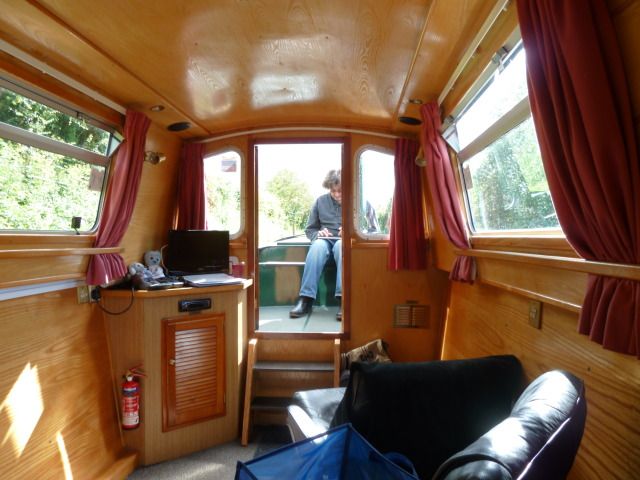
There are a few other differences in fit-out; for one, she's the mirror layout, and secondly – she doesn't have a hatch, which is a little bit of a shame! However, given the weather, it would probably have been closed most of the time!
For it has been wet...
Exceedingly wet.
A month or so ago, there were closures of canals to conserve water. When we picked up 'Dove', the man at Tardebigge Wharf said that the Severn had been closed to traffic because of flooding. Several boats that had gone out on week-long trips had gone down to Worcester and had then just come back, unable to complete the Stourport Ring. With a fortnight, we stood a better chance of being able to wait until conditions improved. Well, we hoped so!
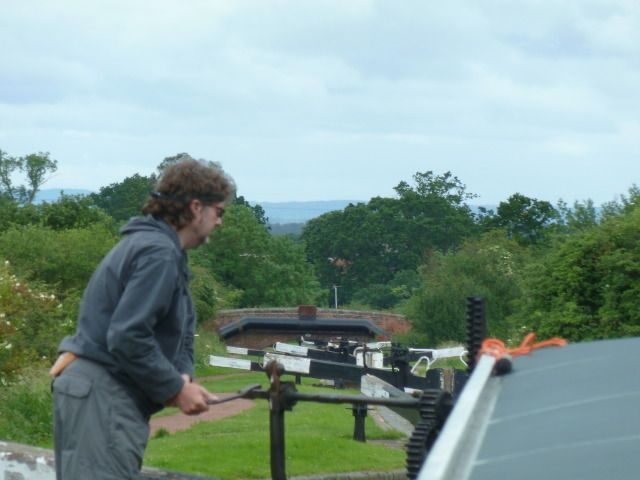
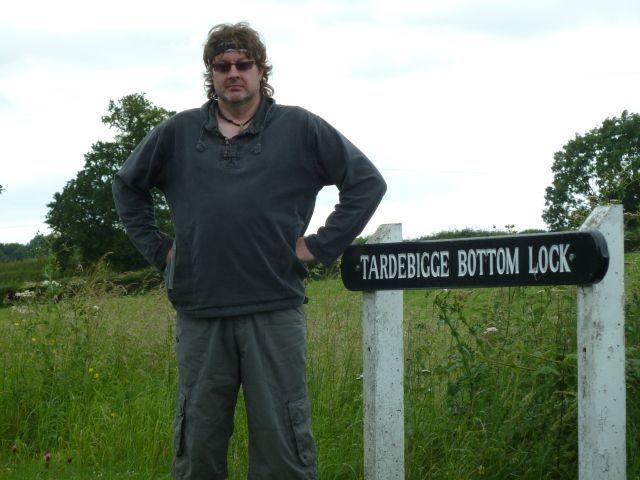
Going clockwise, the trip starts with a tunnel, and the Tardebigge Locks – all 29 of them. Not exactly an enticing prospect for the first evening, so with fingers crossed we aimed for a spot just downstream of the Top Lock for an overnight mooring. One soggy tunnel and our first lock later, and we found a spot with no trouble at all. Which struck me as a little odd, unless everyone else had just given up on going up the river...

It took us five hours to get down the Tardebigge, refining our locking technique and making sure my steering was up to scratch (or not-scratch, rather), and a late lunch was followed by the 6 Stoke Locks, and 6 Astwood Locks.
Six miles, 41 locks, and we are 290 feet lower than last night! Fortunately, a lot of the locks were set in our favour, so we didn't have to do a lot of waiting for them to fill. The scenery is rural, fields, trees, sheep and cows, a distant hilltop manor house and regular chiffchaffs calling from the trees. For regular followers of our travels, the first 'tree-I've-been-dragged-through' of the holiday was an oak. There were some rather nice lock-keepers' cottages, including one with the most gloriously scented pale pink roses over the door, which wafted waves of perfume as I descended into the depths of the lock. The towpath was very busy, with dogwalkers, cyclists, hikers singly and in groups, one lady on a mobility scooter carrying a bargepole like a jouster's lance, who was working locks in a most peculiar manner, kids, parents, old folks, a British Waterways man on a quad bike - but on the canal, there were very few boats. The pub at Hanbury Wharf was practically empty, according to Drew. Most odd.
Incidentally – there are, as we know, horse and dog 'whisperers'. We suspect that Mum may secretly be a 'duck mumbler'.... 
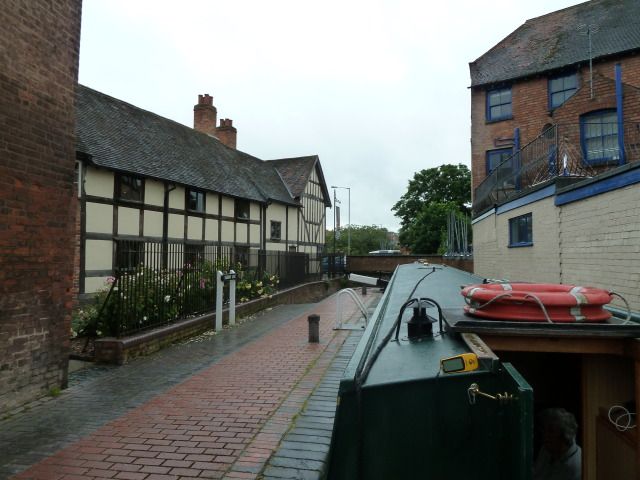
The canal south of Hanbury is quite narrow, a result of a profligation of reeds and many overhanging trees, which makes for things getting interesting when passing/meeting the few other boats on the water (one guy said to us, as we moved aside to let him go by, 'looks like you're mowing the lawn!' - he, of course, had the clear water...). The rain came down hard as we headed for Worcester, and despite hats and ponchos sluicing the water off us, it still managed to find its way down necks and sleeves and soaked up trouser legs. Didn't make sense to stop for lunch and dry out between sets of locks only to get soggy again, so we pushed on, to an overnight mooring in the security of Worcester Marina, a shore party expedition to the supermarket, and investigations on the state of the river.
The following morning, with reports that things were OK, we set off through the city. Quite interesting, with Civil War connections.and bridges decorated with pikes and helmets.
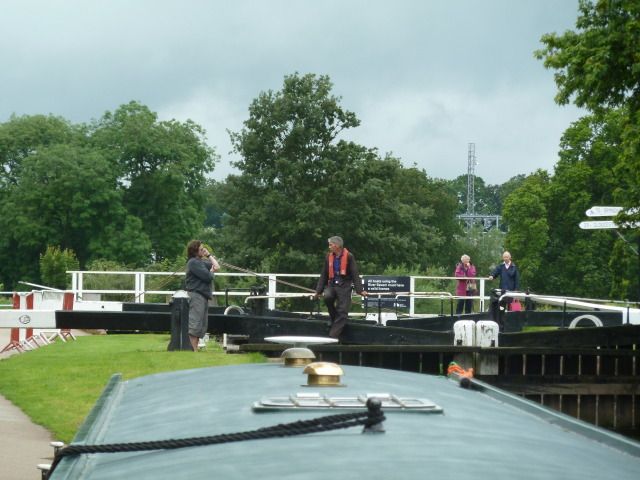
Diglis Basin is really rather posh – lots of warehouse conversions and waterfront apartments- and there are two broad beam locks leading to the river, which can take two narrowboats at a time. Naturally, there were two going down ahead of us, so the assistance of a helpful BW man in operating the huge gates was very welcome. The water gauge was at amber, but only just, so it looked reasonable.
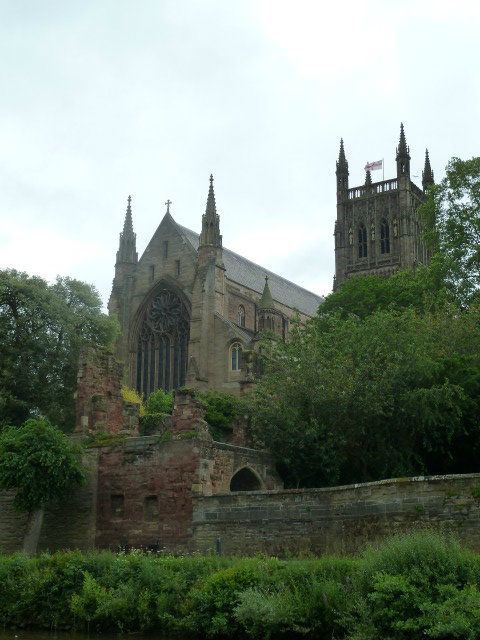
 
We took a big sweeping turn out onto the river, and pointed ourselves upstream. The river was quite smooth and reasonably calm, with no signs of debris coming downstream, and the city waterfront past the cathedral was lovely.

Against the current we were making around 3.5 miles an hour, compared to craft coming the other way, which must have been doing around 8 mph! Beyond the edge of Worcester, past the rowing clubs, the banks were thickly wooded, and it took only a small stretch of the imagination to turn them into rainforest sweeping down to the edge of an Amazonian tributary... the weather added some verisimilitude to the fantasy!
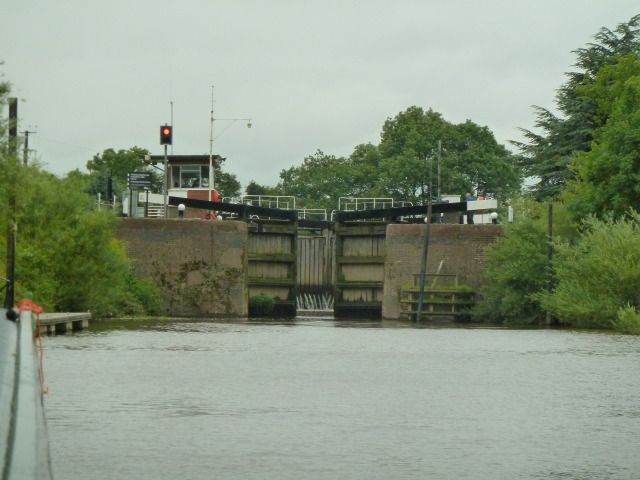
There are three locks on this stretch of the Severn; Bevere, Holt and Lincomb; huge caverns of concrete with automatic gates, operated by lock-keepers. The boater is guided in by a series of signal lights; you slip a rope (fore and aft) around a steel cable fixed into the side of the lock, which stops you rattling about like a pea in an oil drum, the gates close and you rise swiftly to the top. The gates open and you head on your way; it's all very efficient.

Huge weirs run beside the locks, protected by floating barriers. I stayed up front to deal with the ropes, and got a whole new perspective on the river, amidst the swallows and sand martins swooping past on either side. We spotted a couple of kingfishers on the way – well, Drew and I did, Mum as usual was looking the other way....
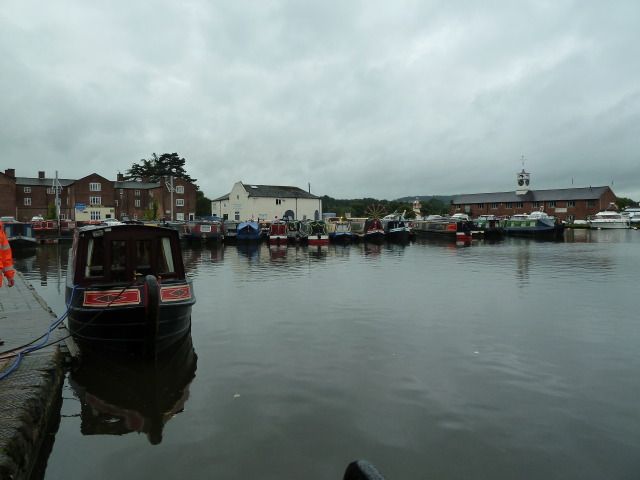
We pulled into the pontoon at Stourport so Drew could check out the entrance to the basin. A very, very narrow set of two staircase locks, with an awkwardly angled pound between them (you can just pass another boat, but I was glad that I didn't have to!) adding weight to my theory that if anyone can put a camel through the eye of a needle, it's a narrowboat wrangler! Handed over control to Drew to pick our way through the marina, all pontoons and moorings and boats, and people trying to be helpful telling us where we needed to go, which distracted us slightly and made it harder to get where we already knew we needed to be!

This was followed by ditherers at the waterpoint (if you pull up alongside a pontoon, and don't say anything, it does look more like mooring-up than 'we're waiting for the water point', you know, folks).
Now on the Staffs & Worcs Canal, we moored up for the night just by the Black Star pub, and were set upon by a swan. Her mate and cygnets took no notice of us, (looked more embarrassed than anything, to tell truth) but she worked her way along the full length of the hull attacking with beak and feet and wings, until Drew finally gave her a gentle shove-off with the blunt end of the boat-hook. She had another go when we left in the morning, and I can only think she could see her reflection in the paint; there was certainly a little less paint when we made our escape!
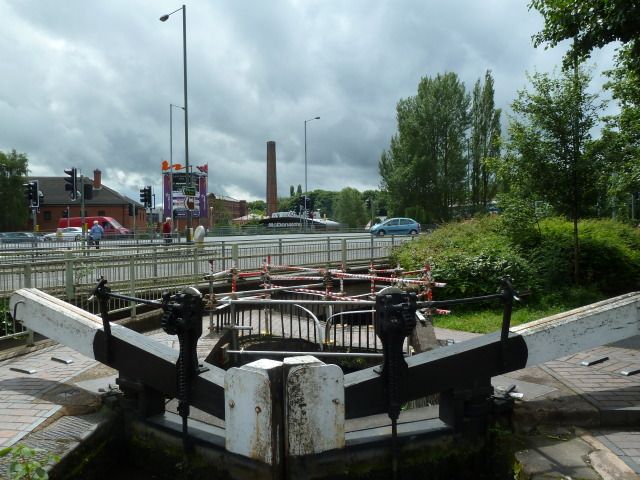
Kidderminster is rather bland; all the old carpet factories have been replaced by the boring boxes of modern industrial estates. The lock rises from an underpass below a roundabout into the environs of the town church, which is rather nice, and there are handy supermarkets beside the canal,which we availed ourselves of. Naturally, when a shore party is sent out, it rains heavily!

North of the town, the rural creeps back in, lush and green with some huge trees, and much of the canal is cut through the native sandstone, which appears here and there in waterscarred outcrops.
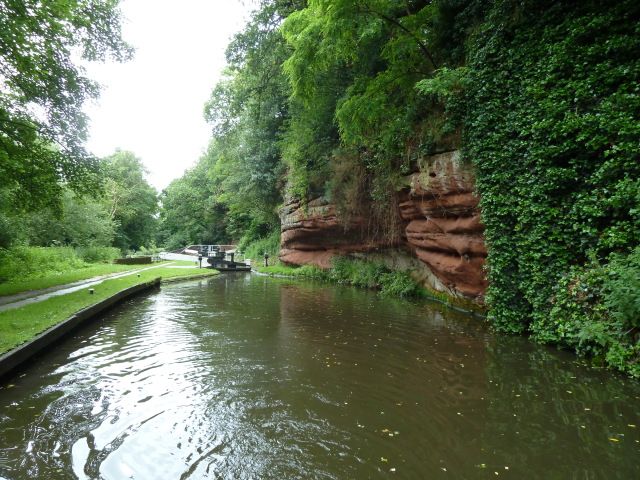
The weather improved the following day, which helped with the 18 locks we went through. We decided that, having got up river without losing any time, we had leeway to take a side-diversion up towards Aldersley, which lies at the bottom of the Wolverhampton Flight; we passed through these on our Birmingham trip in 2007, and it's always nice to complete a circuit!
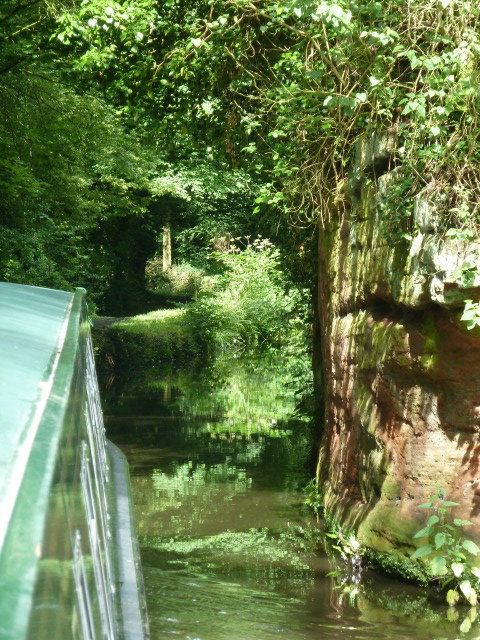
The sandstone outcrops grew larger, miniature cliffs overhung with ivy and ferns, and the land remains green and lush and – generally – empty. We did see herds of black and white horses, though, which is always nice, and a canal trip requirement, and the locks, although spread out, remained individual and interesting. Botterham is a small staircase of 2, Bumblehole is below a small slanted bridge and is itself slightly on the squint, so is interesting to get into, and then comes Bratch!
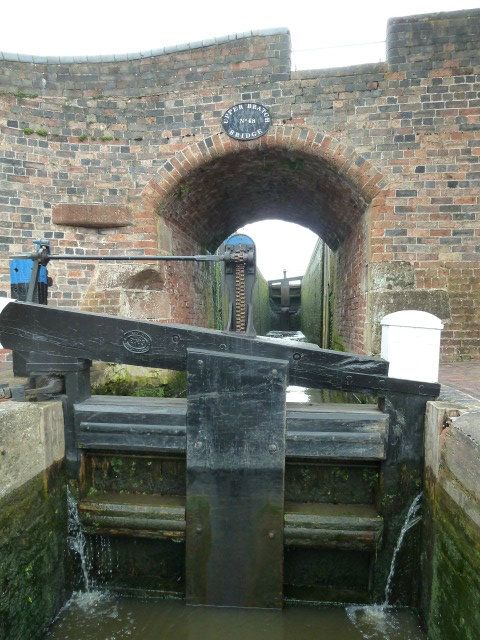


It's 3 locks, and fascinating. It looks like a staircase, but it isn't; each chamber has gates top and bottom, with a pound between the locks. But the pounds are tiny – or appear so – only the width of the overhead footbridge, and not long enough for a boat! Apparently the magic happens behind the hedge, where there are side pounds and culverts which feed the water through.

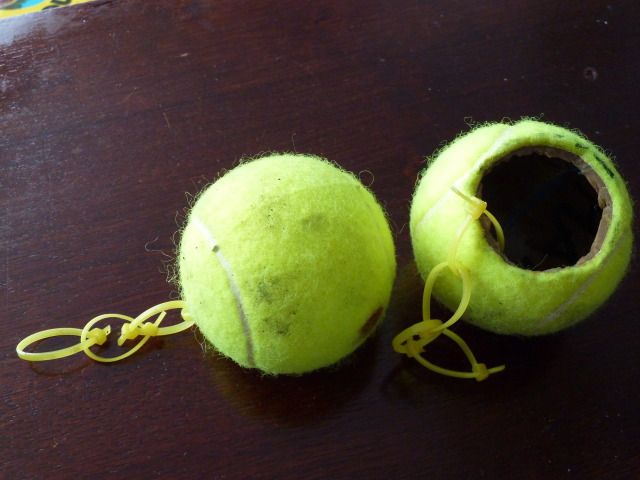
The lock keeper (who has a rather attractive octagonal office) keeps you right about which paddles to raise/lower and which gates to open – from a driving point of view, it IS like a staircase, as you go directly from one lock into the next. Ended the day at a rather soggy mooring near Wightwick, and first use of the mooring-spikes, which put into action my patent mooring-spike markers/buffers – tennis balls cut to fit over the top of the spike and fixed on with cable ties. Works well, but I don't think it's had the 'passing dog' test yet.
Today we discovered 'Ground Whales' - they lie in wait below the ground paddles of a lock and blow out – 'whoosh' - to soak the unsuspecting lock-wrangler....
The seventh day of the trip saw the heavens open, and so much water fell that I'm surprised we didn't see a passing Ark. Serious rain. We did 3 miles, and 3 locks, turned round at Aldersley junction, went back through the last lock, and decided we'd had enough. Moored on a muddy bank beside a growing puddle, and spent an afternoon drying out and generally loafing. We're halfway through the holiday, and although there has been some decent weather, the general trend is sogginess.

Sunday, 27 May 2012

Litter and Lobsters

The weather has been - to say the least - changeable recently, with places that ten days ago had four inches of snow now basking in temperatures in the high 20s...yesterday we had the same temperature here in the north-east corner of Scotland as in Darwin, Australia.
Which meant that, for once, our spring beach clean-up wasn't a total washout! Eight valiant volunteers, armed with litter-pickers and rubbish bags, set about doing a wee bit of tidying up at Fraserburgh. I was in charge of refreshments, explaining what we were doing to the bemused general public, and recording all the various items found : in two and a half hours, we got at least 990 individual items, including 13 disposable barbecues. Two-thirds of what was collected was 'visitor related' rubbish (i.e. not thrown-overboard/fishing waste/sewage-related...you get the idea). 
It was also a great opportunity for a spot of people watching... The sudden shock of the sunshine must go straight to the brains of folks up here, immediately disabling all thoughts of sensible clothing and sunscreen - the skimmed-milk skin of the average punter is immediately exposed to the UV rays to the greatest extent possible. Which results in a preponderance of lobster-pinkness as the pallid flesh is rapidly grilled to the broiling-point. I found myself wincing at the thought of how they would feel tomorrow, and slightly self-satisfied that I had blathered on the new Factor 30, half-price and supposedly with a 'golden sheen'.  Being of a pallid persuasion, I need all the help I can get.
Crowds (well, in our terms "crowds" - at least 100 people!) made their way to the beach, with all the accoutremonts of the British holidaymaker - windbreaks, buckets and spades, frisbees and beach games tumbling out of overpacked bags, trolley-loads of beer and barbecue equipment (I feel our clean-up efforts will be un-noticeable by tomorrow morning), and over-excited children.  There was a background soundtrack of screams as said children ran into the sea, to suddenly halt as the water reached a critical level and yelp 'IT'S COLD!!!!' before running back to the beach, where their doting parents pointed them back at the water to repeat the exercise. They breed them tough up here. This is the North Sea, after all, and it's only May.
The cafe did a roaring trade. An idiot on a jet ski roared from one end of the bay to the other. Offshore, the crab boats went about their business, followed by hopeful gulls. Soggy, sandy, barefoot children trailed after harrassed parents back to the car park.
I recorded the next sheet of findings on the laptop, looked at my arms to check I wasn't burning and made a Horrible Discovery.
Far from a 'golden sheen,' the damn sunscreen makes your skin sparkle. I mean, really glitter. Like disco gel. Like a freakin' cut-price vampire.... I retreated into the deep shade of the van, and prayed for clouds....


Saturday, 4 December 2010

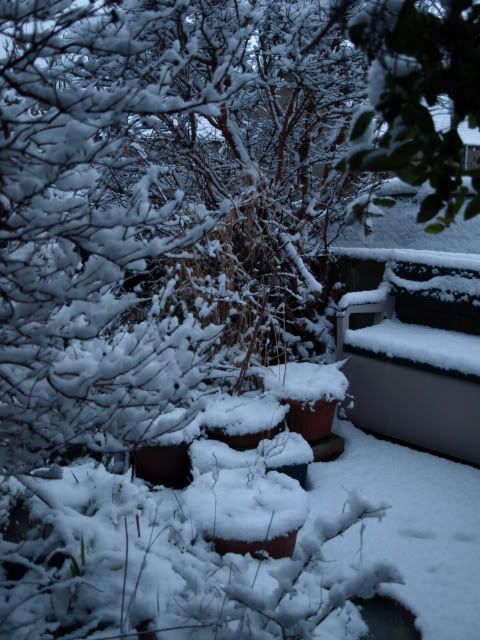
Snow Laughing Matter....

As usual, we are surprised by the British weather. This time, it's really caught us out, and there's not a thing we can do about it. However much grit we stocked up with, however much we polished up the snowploughs, traffic havoc was going to be the result when that much snow drops in that short a time. What bites now is how long it is taking to restore some semblance of order.


But it's pretty. It's like M*x F*ctor super-smooth foundation for the landscape - that fresh-as-a-daisy 24 hour slap advertised by some vapid bimbo. 'Get the Scotland Look'...
But I do want it to go away before Xmas.

Saturday, 30 October 2010

Notes from the Lochside

The far side drifts in and out, grey veils of misty rain swirling across the still water. The robin darts onto the deck, grabs a piece of something from the birdfood scattered on the railings and vanishes again, only to return in a flurry of wings to send an inquisitive chaffinch packing. Falling leaves look like small birds flying to the ground; as the rain grows heavier, the drops hit the remaining foliage, drawing the eye – was that another bird?
No, just a bouncing leaf.
A bedraggled great tit, feathers askew, lands on the bird table and tucks into the birdcake, caution and hunger in equal measure as the bird looks over its shoulder for predators then returns to its feast. More arrive, great tits, blue tits and the occasional coal tit. For a while it looks like a game of feathery billiards, each bird that lands on a feeder sending the previous incumbent bouncing off in another direction, to the table, or the hanging coconut shell, or the debris scattered below on the decking, none willing to share their position. Gradually they settle down and seem to become more tolerant, and even the robin slacks off his sentry duty.
A flash of yellow catches my eye and makes me look twice at the bird that's just arrived. Smaller than the chaffiches, with a deeper notch in the tail - female siskin. Another joins her, and finally a male arrives, smart in black, green and yellow.
The loch slowly reappears, punctuated by a small group of cormorants, their flight low and purposeful, heading southwest. Mallards squabble at the water's edge. The far side emerges as the rain eases off, a tapestry of green and brown and russet. The trees are beginning to turn colour; as if someone is tweaking the hue and intensity settings.
For a brief half-hour, the skies clear, and the birds, strange to relate, vanish.
Then the drizzle returns, and the far side starts to disappear once more.

Saturday, 22 November 2008

Loch & Awe

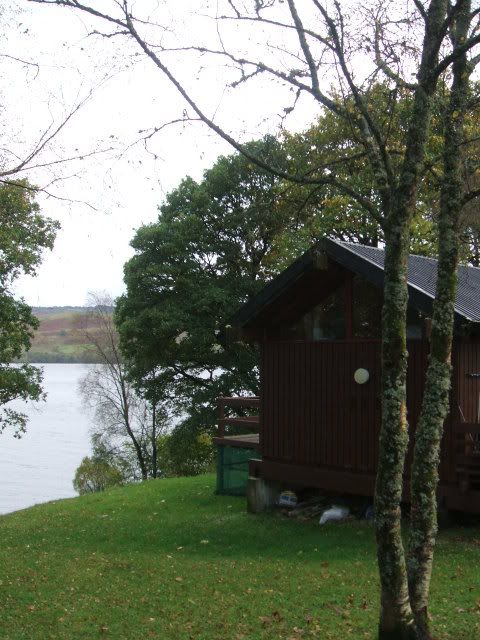
Autumn, changing colours and the hint of oncoming winter.... what do you do? Sounds like a good time to take a break, relax and go on holiday, which is what Mum and I did in October. Some years ago we went to a Forestry Commission site at Loch Awe, which got sold off - this year we found that some of the cabins were again for rent - (have a look here) - so we decided to go back, and so glad we did!

This is the cabin, overlooking the loch....


It's compact, cosy, very reasonably priced, and fully heated!
We didn't expect the weather to be good - and were not disappointed - it chucked it down on a regular basis - when we woke up, the loch was usually calm and still, the wind picked up during the day becoming quite fierce by nightfall. Nevertheless, one morning I woke to the sound of thunder so loud that I thought it was blasting at a nearby quarry - the blast reverberated through me as I lay in my bunk, and the sound of the rain on the roof was deafening! But the cabin was snug, and we had a great deal of pleasure just watching the rain, and the loch rising...at least a foot during the week...

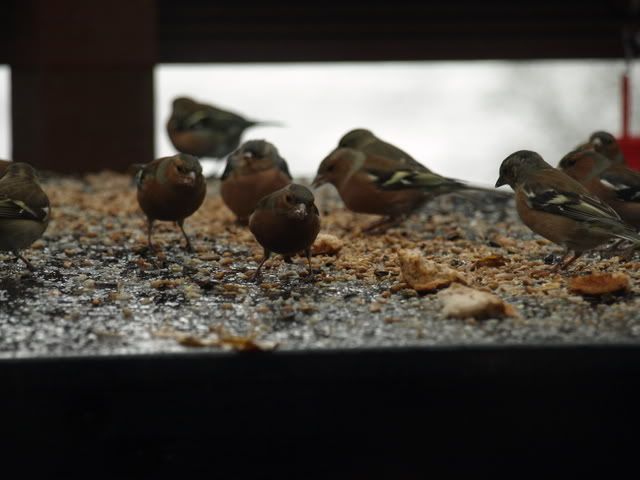
We put out bird-feeders, as we'd done in the past, (and had on one visit attracted a pine marten)and were soon discovered by the locals - I don't think I've ever seen so many coal tits, chaffinches, great tits, and blue tits - who soon proceeded to eat us out of house and home....


There were also siskins, a wren, and a robin who appeared to be the only vegetarian robin I've ever encountered - we got in some mealworms for him which were studiously ignored in favour of breadcrumbs..

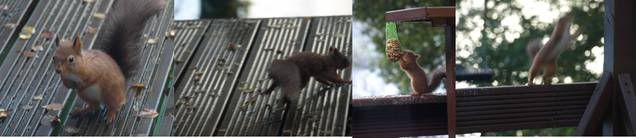
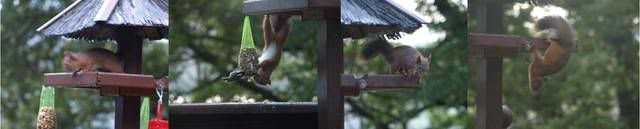
The most striking visitor to the feeders was a red squirrel, who appeared on the second day, and then came back every day - several times a day on occasion. The peanuts were the main focus of his attention, but he paid visits to the sunflower seeds, and checked out the whole deck in case he'd missed something.


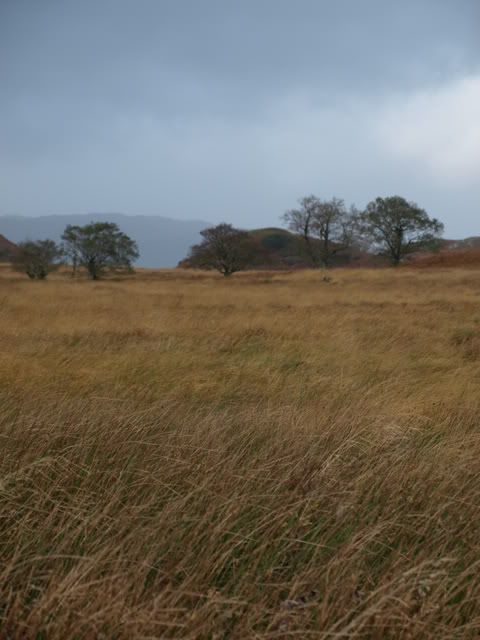
The weather meant we stayed in the cabin quite a lot - which was excellent, as it meant we got to see all the visitors - but we still managed to get out and about on a few occasions - through Kilmartin Glen with its standing stones and burial mounds (the ancient heart of the kingdom of Dalriada) down to Crinan - across the Moine Mhor (Great Bog) Nature Reserve


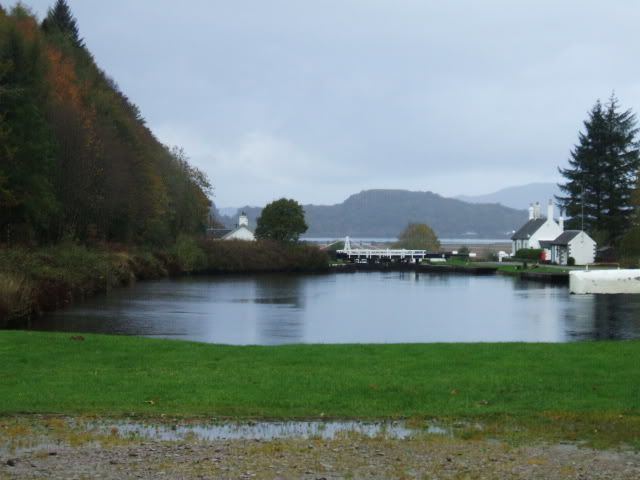
...and the Canal itself, with the huge locks that connect the inner loch to the sea and formed the basis for much of the trade in the early part of the 20th century - the heart of 'Para Handy' country.


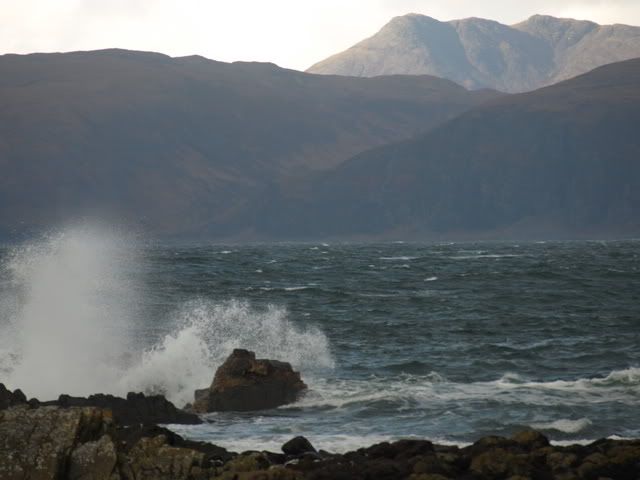
We went down through the islands to Seil and Easdale (and managed to flatten the car battery by leaving the lights on whilst having lunch!)where the wind was whipping the sea up.


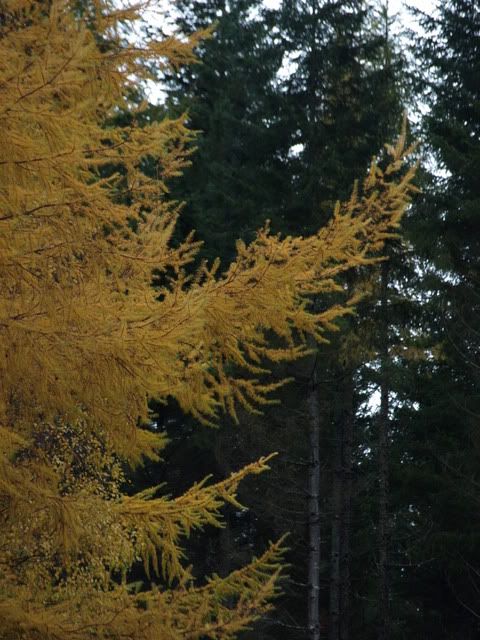
We stayed at the cabin for a week - utterly relaxing, quite enchanting, and rather soggy! Wet, mossy forests, sudden storms, and the glorious reds, golds and bronzes of autumn bracken and leaves. We came home through some of the wettest weather - floods in Oban and the higher end of Speyside round Laggan, where the autumn colours were still developing.


The trees were thick with lichen - a good indicator of clean air, and strange in its own right...


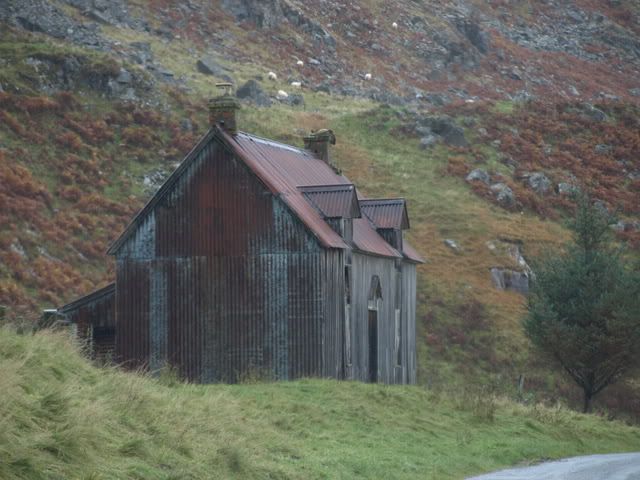
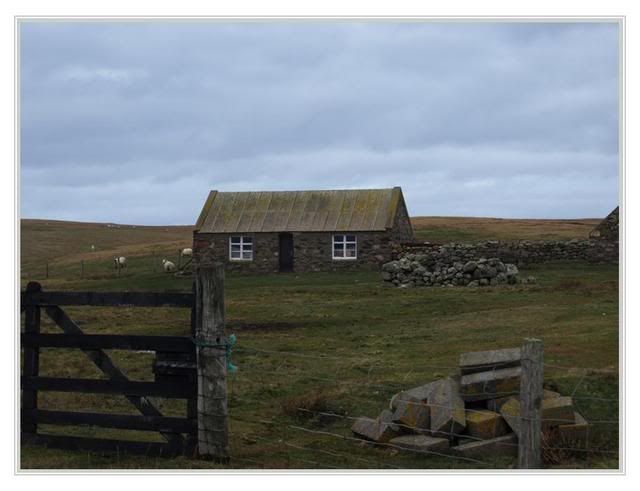
We side-tracked towards the headwaters of the Spey (defeated by floods) but paused at this old house, before finally heading for home, and fish and chips.


Loch Awe....Wet it may have been, but I'd utterly recommend it as an out-of-the way spot for relaxation!

Monday, 11 February 2008

Wind of Change

So what gives with this weird weather? It’s been odd for the last four years or so – and where it’s becoming noticeable is with the geese. Today was the regular goose count – normality (for some ten years or so) for January and February has been around 8,000. Regular wintering population in the area. They don’t tend to start building up for another month or so, on their way back to the breeding area in Iceland. But last year, January ran to 20,000, dropping back to normal in February, and this year January was around 18,000 and today we checked in about 24,500… now January can be accounted for in that there was horrible weather in the Central Belt, so we probably hadtheir geese, from Vane Farm and Montrose Basin, and maybe even from further south, Morecambe Bay and even the Wash. But it hasn’t been so bad in the last week or so – so where have they all come from? They don’t seem to stick around during the day; the reserve staff were surprised to see so many. And it isn’t our counting – if anything we undercounted – I was on my own on the usual station, and dealing with a wide front of geese all at once, so if I missed some it wouldn’t have been surprising. (even us old hands get ‘augh, me head's on fire’ moments!)

So what’s with the weather?

The first flying thing I saw this morning, once it stopped being impenetrably dark, was a midge. It was not alone. This is February, for gods’ sake – we shouldn’t have midgies!!! The roe deer, and most of the ducks, are getting frisky – this is normal….but we should have been freezing our socks off even in our thermal underwear, not boiling gently because of the same! There is even a Little Egret on the reserve, and has been for the last month or so – notionally, a Mediterranean bird!

I’ve lived here since 1985. There is absolutely no doubt in my mind that the weather has changed in that time. Snow has shifted from January to March (ooh, I hope not - there is too much to do in March this year), February has got warmer, November windier, and the whole of the winter wetter and dreicher… I could go on.

We are doing something to the climate, whatever the nay-sayers claim. The Earth has, historically, warmed and cooled; this much is true, it’s all to do with wobbling around its axis, but the speed with which it changes seems to be increasing. We should, apparently, being an inter-glacial period, coming up from the depths of cold and the frost fairs of Olde London, when the Thames froze over, and this much I can accept, but should it be happening so fast we can see it year on year?

Wherever you look, someone is making capital out of ‘climate change,’ ‘global warming,’ (and wouldn’t it sound more ominous as ‘global heating’? Warming sounds far too cosy, to me!) and all the various bells and whistles attached to these emotive phrases. One half says it’s dire and dreadful, and the other half says it’s natural and normal – sit back and enjoy the warmer summers! (And to hell if you’re flooded out!)

But do we really want bluetongue disease in our livestock when the winters stay too mild to kill the insect vectors, and to lose ptarmigan and snow buntings from Cairngorm? All of this seems pretty certain, as far as it goes at the moment. Next come malarial mosquitoes in Kent….

The thing is, we don’t understand exactly what’s going on, and how what we’re doing affects it, all we can say is we are doing something, and it may be too late to stop. But maybe, just maybe, we can slow it down until we know more. One of the arguments against reducing CO2 emissions is that by the time it’s a threat, technology will soon be able to sort the problem out. (Thank you for your insight, Mr GW Bush!) But in a race like this, which one will come first – the technology, or the irrevocable damage? Why can’t we help the developing countries, trying to make progress (and understandably narked when we, from our technologically superior (?) criticise their less-developed technology) by giving them the assistance they need to bypass the ‘bad old days’; is the ‘dog in the manger’ race to economic/monetary supremacy worth our future?

The Earth will survive. It does that, very well. It’s just that, like the dinosaurs, and the trilobites, and the giant dragonflies, we may find it won’t support us any more. And I, for one, don’t blame it.

Saturday, 26 January 2008

Waters of Philorth

First public even of the year, and a chilly afternoon on the estuary. We’re doing a joint bird-watching thing, between the Council Rangers, RSPB and my own organisation, looking at what is on the estuary and beach to the west of my village. I guess it’s pretty good, having two nature reserves nearby – this is the ‘lesser’ one, the Local Nature Reserve(LNR). LNRs are a way the local Council can protect anything interesting, and help prevent the constant degradation of habitat that seems to be a feature of our world.

So we set out in a chill wind, enough to bring tears to the eyes. I (being of limited mobility) took up post on the river, to check on whatever turned up on the inland section, while the rest headed over the dunes to the beach and the mouth of the river, braving the wind-whipped sand and sea spray.

It’s a place where people come to walk their dogs, and they were present in abundance – from small jovial terriers to aloof lurchers, juvenile retrievers that growled at me as a ‘new & therefore weird’ person, springer spaniels that leapt into the river with a joyful bark and a constantly wagging tail, senior sheepdogs that try to round everyone else up – the prevalent smell in the cars heading homeward must be ‘wet dog’…

Some of the owners are responsible, cleaning up the mess after their pooches dump last night’s dinner. But many don’t seem to feel it’s a problem – you would think that, coming here day after day, they would notice the build up of dog crap around the site, but they seem to have selective vision. Indeed, a local councillor has been reported as saying ‘Well, the bin isn’t near where my dog does its business.’ Good example, guys.

So the place is pretty much a ‘watch where you walk’ endeavour, and even the responsible owners aren’t entirely blameless – I watched a guy with three dogs on leads and three running loose… the ones on leads he cleaned up after…the others had done their thing before he got to where I was standing, and of course he didn’t know they had dumped by then…I do wish people would be aware of what their animals were doing when not under their immediate control, as this would prevent a lot of confrontation between visitors and managers of sites…

Sigh. Enough of crap. Literally. Just clear it up, that’s my view.

There weren’t too many birds around – gulls, crows, jackdaws – last year, we did this walk a month later and there were quite a lot of waders – but this could have been a factor of the tide.

Today was the day after a high spring tide, and coupled with a lot of recent rain, the estuary was pretty full. You expect the tide to fill, hit the top – slack – and then retreat, but it seems this isn’t the way it goes. Watching the water come and go, using a fence post and several clumps of grass as markers, it became evident that there was much more to it.
The water seemed to go up and down several times, the grass islands flooding and emerging as I watched. What drew my attention to the changes was that I noticed a small mammal making its way across the flow to one of the islands, and then staying there - hiding in plain sight as several dogs went past.
The water slowly rose – eventually there was no more island, and the beastie (which I believe(though I wouldn’t bet my life on it!) was a was a water vole –a rarity these days) made its way to the ‘mainland’- chin up and doggy-paddle, determinedly – to the bank.
While I watched, (being interested in the relatively rare sighting) I became aware that the water levels were rising and falling, almost as if the river and the sea were breathing in and out as it hit the top of the tide…the post in the water emerged, snagged trailing debris and then disappeared, releasing the raft of reeds to drift away downstream. Then it appeared again, my attention drawn that way by the loud ‘plop’ of a little grebe making its way downstream on the tide and diving as it went. Up and down. Islands emerging and drowning. Tides are a much more complex thing than they seem, written down in the black and white of tables.

We all met up again, to swap sightings and comments on the weather. The wind whispered in the reeds, dry stems rattling, and a blue tit foraged amongst the foliage for insects and seeds. A flock of jackdaws took wing over our heads, and, distant and clear, the call of pink-footed geese rang clear on the air. Grey skies and cold winds, and the edge of a rain shower, brought an end to our survey.

Sunday, 30 December 2007

Shetland Sojourn II

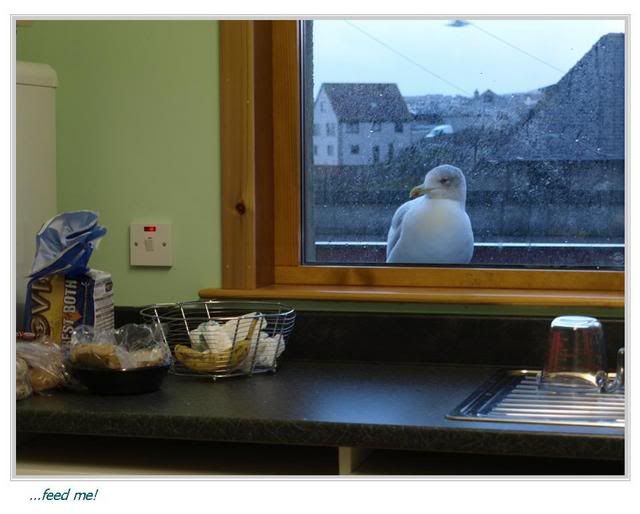
Sunday morning found our visitor back, looking for breakfast. It’s not easy eating porridge under that watchful eye……


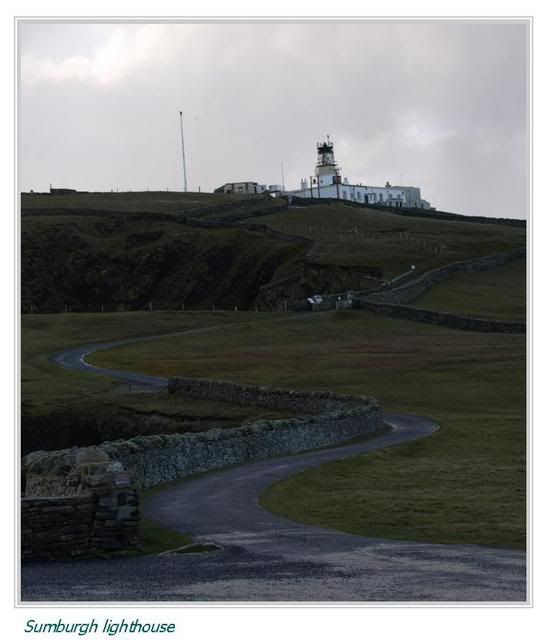
South today, all the way down to Sumburgh. The main airport for Shetland is set in a low-lying, soggy and sandy flatland below the rise of Sumburgh Head. To reach the very south of the island, you have to drive across the end of one of the runways – interesting. Especially when a plane comes over your head…
The airport electronics also had a weird effect on the car – fortunately we were stopped at the time – the engine cut out, the trip meter reset itself…baffled, we paused at Grutness, where the ferry to Fair Isle departs (and there are some fond memories there!), in a squall. The locals didn’t seem too impressed with the weather either…..


No further interruptions to the running of the car, and we head up towards the lighthouse. The car park is below the lighthouse itself, with a clear drop to the sea just over the wall. The sea is rough, snow squalls are followed by bursts of bright sunshine, and the wind harries the fulmars and gannets along at a great rate.


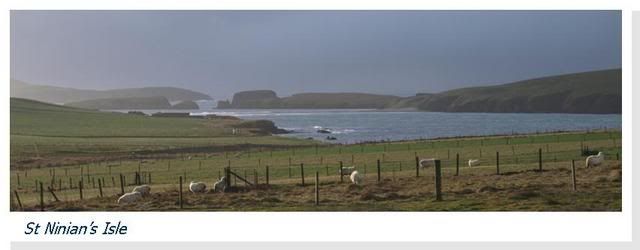
The lighthouse, in spring and autumn, is a wonderful place to see migrating birds and the seabird cities that fill the cliffs of the Head, but in winter, there is little around and we head north again, via the dune lochs of Virkie and Spiggie, the mill at Quendale (shut for the winter) and the western coastal route to St Ninian’s Isle. The island is joined to Mainland by a tombolo – a thin sand spit caused by tide and current. The waves run along the sandbar, breaking tops white and misty, whipped by the wind.


We stop for lunch near Maywick, and look up from divvying up the sandwiches to see a wall of whiteness coming up the road towards us; in a moment we are engulfed in a hailstorm, pellets of ice bouncing off the bonnet of the car and hammering on the roof until we can barely hear. Moments later it has gone as fast as it came, heading southwards. The old line is true – ‘if you don’t like the weather, wait a couple of minutes and it’ll change.’


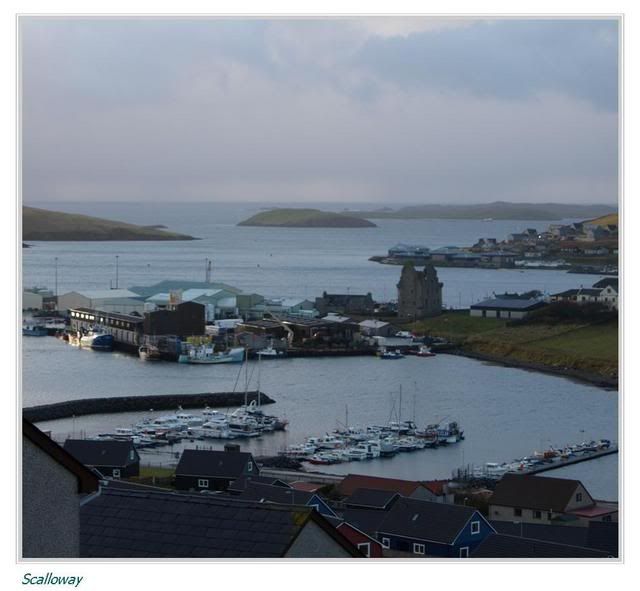
We spend the afternoon investigating the small, causeway-linked islands of Burra, and the end of today’s trip takes us to Scalloway, the second town of Shetland, home of the maritime college and the wartime ‘Shetland Bus.’


The light is fading fast, and we head back to Lerwick.

Saturday, 15 December 2007

Shetland Sojourn I

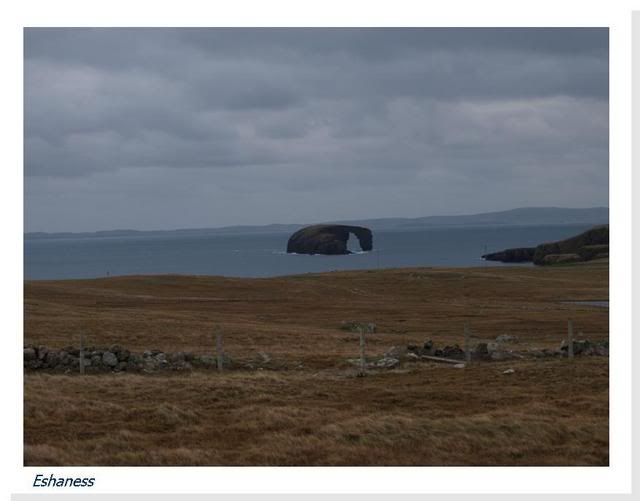
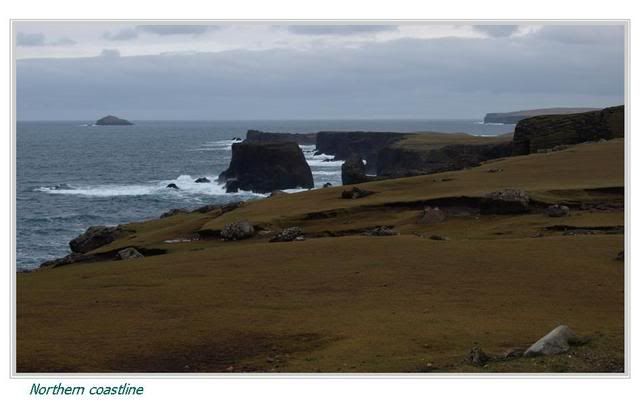
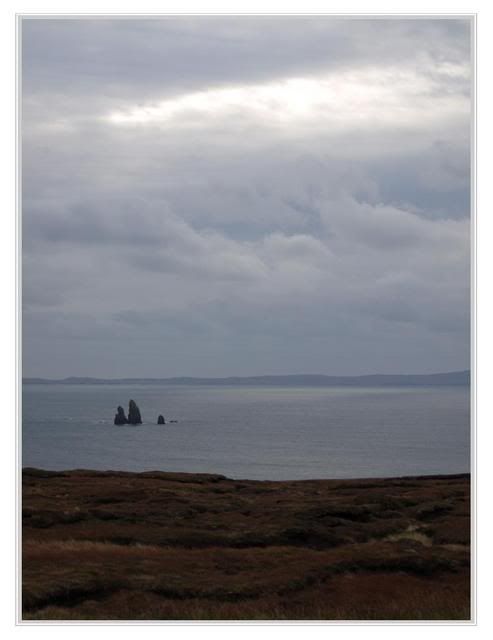
Saturday morning we scraped the snow off the car, and headed north, to the top left-hand corner of Shetland Mainland, to Eshaness, where the geology meets the sea. Literally. Here the sea has cut through the flank of an ancient volcano, different types of lava flow stacked up like a layer cake, a cross section of an explosive past. There are gas bubbles, ash and volcanic bombs, the fine grained flows of runny lavas, the blobby agglomerations of the stickier stuff. Different hardnesses of rock give way to the sea at different speeds – in places the cliffs are like giant’s staircases, in others, arches and needles rise from the Atlantic rollers like the teeth of a fossilised monster.


The power of the sea is evident. Rocks lie along the cliff-top, thrown up by storm and tide, to be swept off by other waves reaching 40 metres above the sea, and the waters offshore are littered with wrecks. Yet people have lived here for many thousands of years, their presence recorded in the stone age cairns, Pictish brochs and in the remnants of pre-clearance villages.


The wind is bitter. As I step from the car to take photos, my eyes immediately stream, and the cold slices into my bones. It’s not a day to hang around.

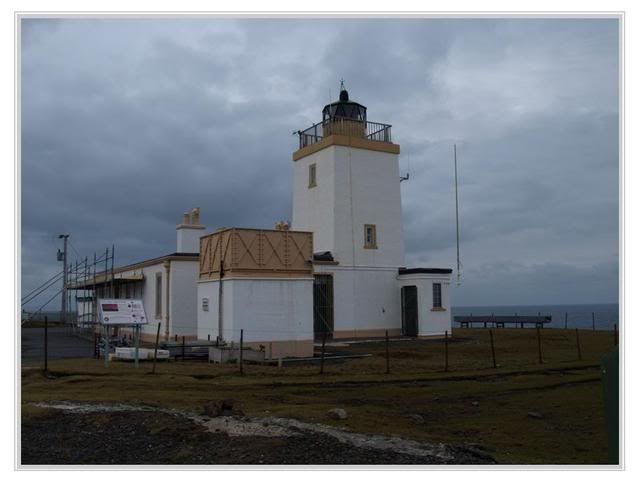
Eshaness Lighthouse – now a private house (lucky people!) – is one of the few that has a square tower. It stands foursquare against the wind and weather, staring out across the Atlantic. I snapped the picture and dived back into the warmth of the car.


We head back towards Sullom Voe, where the tankers discharge and fill their tanks with the oil from the hostile fields in the seas between Shetland and Norway. It’s actually not that imposing – the Flotta terminal in Orkney is more obvious, and the St Fergus terminal at home, with its huge flares of burning gas, more dramatic. Nearby is Mavis Grind (pronounced, I think, with a short ‘i’) which is designated the shortest distance between the Atlantic and the North Sea - a mere stone’s throw (if you have a small stone and a very strong arm!) We head to the northern ferry terminal at Toft, where the inter-island ferries head out to the low-lying, peat-covered island of Yell. No, we’re not going to Yell, but there is purpose in our trip.

Years ago, on Fetlar, we were chatting with a local gentleman about the likelihood of seeing otters. Go to the ferry terminals, he said, it’s almost guaranteed – they like the disturbed water where the ferries come and go, it stirs up the fish.

He was right, as we’ve discovered on numerous occasions since that conversation.

We sat and ate our sandwiches, watching the ferry load up and the seabirds go back and forth. Ferry terminals are also a good place to find well-maintained public toilets, so we took advantage, and I was just getting back into the car, when Mum noticed a disturbance offshore.

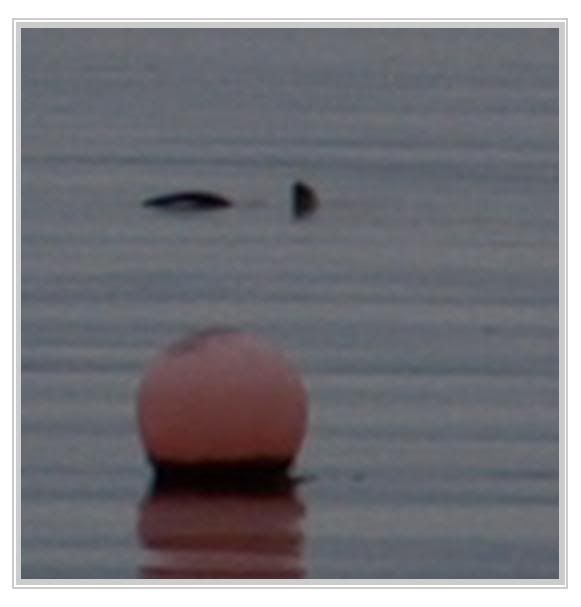
Binoculars snap to attention, and with delight we spot two otters, fishing in the bay. They roll around each other, diving and splashing, and then separate. They are some distance off the beach, but I take a picture anyway - honest, this IS an otter! While we watch, it catches a butterfish and, gripping it firmly between its paws, happily chomps it in front of us.


The light is fading rapidly – twilight comes at around 3 p.m. - so we head back towards our base, and our warm and cosy apartment.

Sunday, 9 December 2007

Northern Exposure

So how on Earth did we come to be lugging drainpipe and old curtains to Shetland, and why was Mum wrapped around a lamp-post in Lerwick?

Well…..

Some time ago, I won a ferry ride for two plus car to Shetland, through a prize draw associated with the annual Beach Clean-up. (Thanks to Northlink Ferries and the East Grampian Coastal Partnership) Yippee! Mum and I hadn’t been to Shetland for years, so it was a really nice treat…the only caveat on this enterprise being that the trip had to be taken before March 2008. Given our winter weather, it seemed vaguely sensible to take it sooner rather than later, and as my friend Tracey was heading up that way to deliver a teacher training course on school grounds (something we’re both involved in) it made a kind of sense to tie it in and give her a hand. So we booked a self-catering apartment in Lerwick, and all three of us headed north in early November, the car laden down with all the gear for the course (this is where the drainpipe and curtains comes in).

Now I have to say, the weather in November isn’t always kind. We’d been watching the forecast for several days before we went, and it was holding true to form, so we were quite relieved that the Wednesday ferry was scheduled to sail as normal. We duly checked in and boarded, and soon found our cabins. It’s a reassuringly large ferry, very clean and polished, with friendly staff, and is very comfortable; the trip takes around 12 hours overnight, so we headed for the restaurant for dinner, before the trip really began.


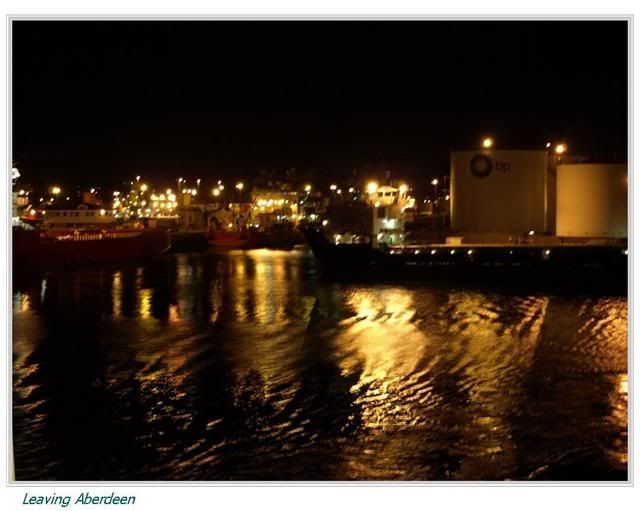
We watched the lights of Aberdeen fade behind us, went over the details of the course we were delivering in the morning, and, as the ship began to rock and roll in the worsening weather, headed for our cabins.

There’s a very good reason why the bunks on our old friend ‘Leader’ run fore and aft. In a bunk that runs from side to side, (as on the ferry), as the ship rolls, you slide. First towards your head, and then towards your feet. Gentle rolling from side to side is OK, sliding up and down until your head hits the bulkhead is less entertaining. Sleep was a long time coming…..

Overnight the weather got gradually worse. As daylight broke through the window on Thursday morning, we were relieved to see the island of Bressay, and a choppy sea in the approaches to Lerwick harbour.

We rolled thankfully ashore, and went to sight out the terrain – we couldn’t get into the apartment until lunchtime (Mum’s task, to check in and set up camp) and Tracey and I were due to be at school until about 3 pm. So we unloaded our cargo of drainpipes, curtains and other stuff at school, dropped Mum down at the centre of town and went back to work. As the day went on, we saw the weather deteriorate rapidly as blizzards whipped through, and the walls of the school hut we were in flexed dramatically. We had to reduce the amount of actual outdoor activity we were originally planning, in case we lost a teacher or two over the nearest horizon. The southbound ferry was cancelled, all the inter-island ferries tied up, and Shetland battened down in the teeth of a storm-force wind.

Meanwhile, Mum had discovered the local museum , and had spent a happy couple of hours wandering around. On emerging, she found waves breaking over the seafront, and by the time she got to the road, had to cling desperately to a lamp-post to prevent herself being blown over. Fortunately, a nice local lady (thank you whoever you are!) in a 4x4 stopped, rescued her, and gave her a lift to the apartment, where we all met up later, to swap tales of wind and weather.

I can thoroughly recommend the place we stayed. Warm, comfortable, and with all the bits and pieces we needed. Plus a nosy neighbour, who visited each day to see if we had any spare food.


On Friday, Tracey and I went back to school to deliver another day’s training, followed by her departure – on the fortunately reinstated ferry – back to Aberdeen, family, and the joys of moving house. Mum and I stayed on over the weekend to rediscover Shetland, which will be the subject of the next entry in this blog.

Watch this space.

Sunday, 18 March 2007

Happy Mother’s Day

‘You have got to admit,’ I say to Mum, as we peer out into the gloom through the windscreen, ‘there are not many mothers that get to celebrate Mother’s Day like this.’
‘Hmmm.’ she sounds singularly unimpressed.

It’s 5.30 in the morning, in the dark, and there is a howling gale blowing from the north-west. Somewhere out in the dark, there are geese….. yes, it’s counting time again, and here we are, waiting for take-off!

A harsh rattle of sleet hits the back of the car, and the sky grows a bit lighter, lowering stratus clouds flying away above us, dumping their load of precipitation as they pass. At about 6.00 a.m. a few geese can be made out struggling through the murk, fighting a strong head wind that blows them straight back to the loch, where they give up and land again. The rooks and jackdaws are enjoying the wildness, tumbling and diving in the wind, but little else seems to be happy about it. Three roe deer cross the field, pausing to check out the car parked in the middle before springing easily over the fence and heading for the shelter of the Badger Wood. The wind rocks the car, and a gusting veil of snow reduces the visibility to a few hundred metres. I wipe the condensation from the windscreen and crack open the side-window a few millimetres. The howl of the gale is too loud to hear what is happening among the geese that I know are out there, but cannot see. I put the window back up. We spread a blanket across our knees to try and stay warm, burrowing into our fleece jackets and pulling woolly hats low on our heads. In a gap between snow-showers, a few more geese try to make their escape, wheeling around overhead only to be blown back again. One or two groups of very determined birds actually manage to make it, heading out to forage.

The snow has built up on the window on Mum’s side of the car, blocking her view. We slide down the window to clear it, and a small drift falls in, onto her lap. A car pulls up behind us.
‘This is ridiculous!’ Vicky sticks her head in through the rear door ‘we’re abandoning it for today. Breakfast back at the farmhouse!’
We are not sorry to retreat.

Later, after bacon butties, we go over to the visitor centre to see if we can see anything. The field to the left of the centre is full of geese, packed in tight, heads tucked down into feathers or feeding in a desultory manner on the grass. Fortunately, the winter has been so mild (until today!) that it hasn’t stopped growing, and they can find a decent meal. The few ducks visible are tucked well in under the banks and in the reeds. There’s no sign of the visiting sea eagle; it’s either sensibly tucked down somewhere out of the storm, or – if it’s tried to fly – is probably halfway to Norway by now.

Before we finally go home, we call in at Kinnaird Head to watch the gannets wheeling and diving offshore. The sea is a mass of white-marbled slate green, foam whipping off every ripple and crest, breaking over the rocks, spume flying through the air. A couple of scoter duck, black against the whiteness, battle their way rounds the point. An eider rides the surge, white on grey. As we drive round the harbour, a large bull grey seal bobs up in the sheltered water, safe in his refuge. We take the hint, and go home.

Wednesday, 24 January 2007

Count the legs and divide by two.

Seven-thirty on a cold Sunday morning and there’s no sign of the sun.
The sky is starting to shade to deep blue, the fields around the car are a featureless mass, and there is a distinct aroma from the large pile of manure to the right. A chill breeze blows through the window, and my companion rubs his hands briskly, and peers through his binoculars into the gloom.
‘I think I can hear them.’
I stick my head out of the window. It’s hard to tell where the sound is coming from - definitely from in front of us, but there are elements that may be behind and overhead.
‘I think you’re right - they’re on the move.’
We stare hard into the darkness.
A flicker of movement? Yes - a darker mass moving against the sky, only visible in the reflected light from the sea.
‘Damn! Something’s put them up!’ I clamp my binoculars to my eyes and grab my click-counter. From the hollow to the right they come, a great streaming, clamorous flock, dark shapes stringing out, shifting, coming together and then moving apart, shouting reveille to the brightening sky.

Pink-footed geese, heading out from their overnight roost to feed.

So why am I sat in the cold next to the dung-heap?

It’s the monthly Wetland Bird Census. All over the country, hardy souls are out looking at lakes and lochs, estuaries and mudflats, counting geese, ducks and waders as part of a long-term survey designed to see what’s around, where it is, how many are there, and how the numbers are changing. Our ‘patch’ is the local nature reserve, and today there are five of us looking it over; one at the north end checking the beach, the estuary, and the grazing fields, one south, counting birds on the main body of the loch, one at the top end of the loch, checking amongst the reedbeds, and two of us on the western side, where the majority of the geese head out from the low wetlands into the surrounding countryside. It’s an unglamorous location, in the entrance to a stubble field on a low rise of ground, beside the aforementioned manure pile (awaiting the attentions of the muck-spreader). At least this time it’s to one side - last year the farmer piled it straight in front of where I usually park the car, completely blocking the view! I have counted geese from this place for years; sometimes from the car, occasionally from the reserve truck, and on one memorable occasion stood in a snowstorm in the lee of a large fencepost.

Today the geese are leaving practically in the dark, which makes the counting a little more awkward than usual. I swear they look for new ways to confuse me; flying low along the hollows in the land to suddenly pop up, or all taking off at once in a mass resembling an explosion in a bedding factory (we call this ‘feather-bedding’), or sitting tight and stretching the count (and my bladder-control) out for hours and hours!

I peer into the patch of sky between the manure heap and the rookery wood, where the flocks are just visible, black shapes heading westward. As they pass in front of my binoculars, I count them. At the other side of the car, I can hear Angus doing the same, the steady click of his counter as he tallies the flocks leaving to the northwest. There is little in the way of a break today, the geese seem determined to get to their feeding areas as soon as possible and as the light grows, we can make out more and more of them rising from the low ground in flocks of anything up to six hundred birds. We get some warning of large take-offs - the constant background noise builds to a cacophony of calls as they wheel into the air. Occasionally there are groups of whooper swans, huge and elegant, white wings beating steadily, small family parties with their greyish youngsters, or wheeling flocks of lapwings and golden plover in their thousands.

So how do we count them? It’s a question I’m often asked, and I’m often tempted to give the reply shown above… Actually, if they are in small groups, they can be counted individually. Skeins can be counted in groups of five, hitting the clicker every time you get to twenty. For bigger flocks, where the individual geese can generally be made out, count in groups of twenty (see how big a group is and then ‘size up’) - and as the flock gets bigger and more densely packed, work in fifties or hundreds. Or use combinations of these methods. You get better with practice! It’s not utterly accurate, but accurate enough for the census, and with the same people doing the count each time there is a type of standardisation. What they don’t tend to factor into the equations is the co-efficient of frozen fingers, steamed-up binoculars and windows, or random clicks of the counter caused by shivering!

It’s a dull, grey morning, with the sun hidden behind a dense layer of cloud. Inland there is snow, although it’s clear at the reserve with occasional sleet. A fox, thick winter coat fluffed up against the cold, trots across a distant field with the remains of a goose carcass; it’s nearly the end of the shooting season, so he’ll have to work harder for his breakfast next month. A buzzard calls from somewhere above us, a high mewing cry, and in the field beside us a large group of partridges fusses about amongst the remains of the crop, small bustling brown bodies popping up amongst the dry grasses and taking to the air in an explosion of wings.

The stream of geese slowly winds down, the last few family groups taking to the air, and we head back to the visitor centre to thaw out and count the ducks and waders on the ponds there. Afterwards, we tally up the numbers over bacon sandwiches in the kitchen. Around 20,000 geese in all - about twice the norm for this time of year, probably driven in by the bad weather further south.

Not a bad morning’s work, and next month, we'll do it all again.

Tuesday, 31 October 2006

Climate Control

The weather is being peculiar. Here at the end of October, it’s been ludicrously warm, interspersed with high winds and lashing rain. All of which conspires to give me a problem: windscreen fogging. The warmth means that as soon as it rains, and the outside temperature plummets, the residual warm air in the car (and this is with the heater on cool) hits the cold glass and - POW! - instant loss of visibility. Usual response - to put the blower on the windscreen - fails miserably, only causing more fogging. I try turning the heat up, as I do in winter - it just gets worse.

I try to approach this logically.

Fogging is caused by condensation - warm, moisture laden air passing over a cold surface, the water condenses out onto the surface. It’s meteorological.

I need to equalise the temperature somehow.
To clear the rear window, you put the inbuilt heating element on - this heats up the glass and stops the condensation. Heating up the windscreen - by using the hot air blower - does not have the same effect. It doesn’t prevent the condensation, it makes it worse, except for a thin strip at the bottom, which clears a bit. Hmmm. OK - so there’s even more moisture in the air now, with it being warmer. (And I’m melting…) So I need to take the moisture out of the air - dry it out. I stick on the air conditioning and the air recycling, whizzing the moist warm air through the drier, in effect, and not letting any new damp stuff in. This isn’t very effective, but does reach halfway up the windscreen. Something is working, I’m just not sure what.

SO - if heating up the screen fails, try the opposite! Cool the air down.

Turn down the heater, and blow cold air across the screen. This still fails to give me visibility. Take it down a notch - I stick on the air conditioning, turn up the blower, and wheee! The screen clears almost immediately. I freeze, but I can now see where I’m going.

So the answer, at least in warm-ish weather, is to cool down the air that’s actually hitting the windscreen - effectively putting a thin layer of icy air between the screen and the moist air. Now that’s quite logical, but given the meteorology involved, it leaves me with one question. When the moist warm air hits the icy layer, why doesn’t it condense out? My guess is that the cold air is moving too much - but I still wanna know - why aren’t there clouds forming just above my head?

Vehiculonimbus!

Thursday, 28 September 2006

Aliens in the Undergrowth

Damp mornings, heavy with dew. Cobwebs - or to give it the local name, slammach, - hangs wet on the gorse bushes like pieces of cloud ripped off and caught up in the spines. Cows loom out of the fog, strange in the half-light. And in the undergrowth, something odd is appearing. Overnight, they have appeared, aliens from another world. They troop through the woodlands, small trolls transfixed by daylight, or raise their strange heads through the grass of suburban lawns. One or two are breaking through the pavement in the village. Others emerge from the bark of trees, or cluster in whispering congregations as the rain drips from the leaves on their heads, raising small clouds of fine dust to be carried away on the slightest breeze. They are friends, killers, and clean-up merchants.

Fungi.

It’s a great time of year for them, and after the warm summer, this damp autumn has brought them out in their hundreds. Much misunderstood, coveted by some and reviled by others, it’s time they had a proper place in our everyday lives. In fact they do - we just aren’t aware of it most of the time.
So, some years ago, a group of us got together to develop a programme for schools which looks at the wonderful weirdnesses that are fungi, to help children understand how they grow, and their place in the natural and unnatural world around us.

This week has seen ‘The Good, the Bad and the Fungi, 2006’. (Yes, I know! Groan!!) We have discovered spores and how they travel, how they grow into fungi, the mystical world of mycelium, how fairy rings develop, how the fungus got its spots. We have come face to face with a wide variety of the real thing - the red and white fly agaric waiting for the fairytale to begin: white-weeping ugly milk caps: the solid shelf of the birch polypore: clusters of yellow sulphur tuft: the delicate glistening white of porcelain fungus, high above our heads on the dead branch of a beech tree: the blotches of tar spot, breaking down the fallen sycamore leaves, and a host of others. We have discovered how fungi help trees and other plants to grow by exchanging mineral salts for food, how they break down dead material, and how some can kill through parasitism. We’ve considered how this fits into the environment, how dead wood provides food and shelter for other creatures and how fungi fit into food webs. We’ve played parachute games, blown up balloons, made badges, discovered the small beasties that appear when you leave fungi to rot - and we’ve had to clean up some of the aftermath too!

And we’ve learned to look very carefully into the undergrowth.

Equinox Days

Swallows improvise
A coda to the summer
On telephone wires

The opening bars
herald autumn’s symphony,
a fanfare of geese.

I’ve been doing a bit of time travelling over the past couple of weeks - my own personal TARDIS being a combination of my car and the road between North East Scotland and East Yorkshire. Unexpected necessity means I have been up and down twice in three weeks - eight hours each way gives time to observe the passing landscape.

It’s a bit of a contest between summer and autumn - which is further advanced? Earlier in the year, as the harvest was being gathered in, south was well ahead of north - now, with the turning of the season and the rapidly shortening days, it has swapped over, and the north has the autumnal ascendancy. Travelling up and down, I find myself moving between the seasons. Here in the North, the leaves are already falling, crisp brown and yellow, filling the guttering and clogging the drains. The autumn fogs lie heavy, hiding the hills and clinging in the river valleys, clammy in the residual warmth. Wearing a jacket keeps out the wet, but is too warm yet for comfort.

South, in the one short week between my visits to Mum’s place, her Virginia creeper changed colour from green to crimson, scarlet and orange, burning up the side of the house in one last defiant outburst. The leaves there haven’t fallen yet, but will soon lie in brilliant drifts along the driveway, waiting for the garden vacuum and the collection bags where they will lie through the winter, turning into rich leaf-mould for the garden. The hedgehog leaves tracks in the heavy dew on the lawn, but we haven’t seen her recently - too busy with motherhood, we suspect. The hedgehog box will be installed soon, to provide a snug retreat for her winter hibernation.

The country seems to have been split; south of the border the summer lingers with sunshine days and kick-off-the-duvet nights. Driving through it reveals ploughed fields and stubble, and the last calves of the year with their mothers. As the evening descends, straw bales rise like ancient monoliths, black against deepening blue. North of the divide, there is rain. The sky hangs low, like a grubby wet dishcloth, spray and rain mingling on the roads. Safety lies only in the dim gleam of red tail-lights, for little else can be seen through the mist. Returning home, I wonder if there has been a power cut - even the flares from the gas terminal are invisible in the thickness of the murk - only the occasional glow of houses as I pass reassures me that there is still a world beyond my windscreen.

Evening’s fading light
shows monsters in the hedgerows.
Gorse becoming ghoul.

In my eye’s corner
tree becomes giant, stone wall
turns to crocodile.


Sunlight cannot show
this hidden face of the land
only dusk reveals.

Wednesday, 2 August 2006

Life’s Little Mysteries (3)

The weather, never settled for long, has changed again. After baking heat - always welcome when venturing into the city to shop (aye, right!) - Saturday night brought heavy rain. Driving home late, I became aware that things were moving in the headlights’ beam. Frogs. Lots of frogs. They’ve spent the hot spell hidden under the dry stone walls or in deep undergrowth, until the rain came. Then it’s way-hay! Look chaps - puddles! Which made driving the back roads rather more akin to a slalom course, avoiding frogicide.

Arriving home, we unpacked the car; another slalom session as we avoided the snails sliding happily across the path. With rain dripping down my neck from the tailgate of the car, I turned and noticed around fifteen on the end wall of the house, all heading upwards. One slid purposefully up the edge of the gable; all seemed bent on reaching the roof, or even the chimneystack. Those on the path made their slow and stately way to the wall, and proceeded upwards. I couldn’t see anything up there that might attract their attention, no algae, no moss, no tempting plants at all.
Were they trying to tell me that flood were expected? Is there a snail nightclub somewhere on my roof? Do they gather up there in the first rain after the last full moon in July for some esoteric snail ritual? Baffled, I took the last of the shopping indoors and went to dry off.
In the morning there were no snails to be seen. And none that night on the window pane. I began to wonder if some silent interstellar space-shell had descended in the damp night and taken them away, to report on their observations of Earth life.

Wherever they went, it was a short trip - five were back last night. Of course, it was ‘Mastermind’ and ‘University Challenge’ on the TV. How else can interstellar snails learn?

Friday, 21 July 2006

Haar, Haar

So here I am, back home. While the rest of the UK has baked in record temperatures and relentless sunshine, my little corner of Scotland has remained cool and green. Driving north is like stepping back a few weeks in time; the tired greens of the trees perk up, the crisp brown lawns turn green, and the wildflowers rewind. The crops, being harvested at the beginning of my journey, are barely turning golden. Sometimes, if I travel up and down enough, I can end up with two springs, or two autumns.

Waking to cool grey daylight after two weeks of heat comes as a bit of a shock. Stepping out into a damp, foggy morning is like walking into middle of a pearl - a gentle luminescent glow as the sun tries to penetrate the mist. (Hmm - that image leaves me as the grit in the oyster - ah well!) As I drive inland to work the mist thins, becoming a fairly bright and sunny day.
It’s been a feature of this area as long as I can remember. Waking to the bull roar of the foghorn, leaving home in dank dimness, only to find that ten miles inland has been basking in sunshine. It’s the haar. The sea fog. It lies along this coast like a grey veil for most of the summer.

So why do we have the dubious privilege of this phenomenon?

When the air gets warmed up by the sun, as happens in the summer, it can hold a lot more moisture. When this is suddenly cooled, the moisture condenses out. Pass warm air over a cool surface such as the sea, and this happens; and the North Sea is cold. Believe me, I’ve been in it, it’s cold.
So fog forms. Add an on-shore breeze, and the fog is pushed inland, covering town and countryside indiscriminately. Now although the land is warmer, and this clears the fog, the breeze pushes more inland to take over - where I used to live, you could watch it ebbing and flowing like the tide, making its way up the fields, sneaking along the hedges until it was beaten back by the land’s warmth. So there’s a band of land along the coast that stays foggy. With a stronger breeze, or if the land is cooler, it can travel a long way inland, tracing cold clammy fingers up the rivers and glens.
Sometimes the sun is strong enough to warm the land; it burns through and the haar clears. Sometimes it doesn’t, and we spend our days in a strange shadowless brightness.

And the name? Haar - I’m not sure where it comes from. The word has a Scandinavian feel to it. South of the border, it’s called a sea fret, and locally in Yorkshire a sea roak. (Bird-watching one day at the seashore, someone commented that there was a sea roak. After a short while, a visiting birder enquired what was the difference between that and a normal rook….)

It’s a feature of the east coast, and is why the land stays greener, and the inhabitants paler, than elsewhere. And why we shout at the radio, when the newsreader talks of heat-waves.

Sunday, 2 July 2006

Sneeze or Freeze...

The colours are changing again - yellow hangs on tenaciously in the form of fields thick with buttercups, and in the vast, almost indefineable range of dandeliony-things (OK, I know I'm supposed to know what they all are but a summer idleness creeps in - hawkweeds, cat's ears, hawksbits, coltfoot, and dandelions are just some of the range to select from), the white is there in the form of ox-eye daisies, but is slowly changing; the 'palest-maiden's-blush-to-hot-flush' pinks of dog roses, tall spikes of foxgloves in every shade from white to carmine, red campion, vibrant scarlet of field poppies, the red haze of grasses... it's glorious, but somewhere in it all is a lurking hay-fever trigger.

Driving whilst sneezing is a hazardous occupation. And driving for over 400 miles whilst sneezing is not conducive to road safety. Fortunately, the car has air conditioning, which comes complete with - fanfare - pollen filters! Which saved the day, but revealed a slight downside - you need to keep it switched on. Which is all very well when the sun is shining and its 20 degrees or so, but when it starts to rain and the temperature drops, being in the car becomes rather like stepping inside one of those big freezers in the supermarket. There is a likelihood of frostbite. But what is the alternative?

So this summer, if you see someone, on the hottest of days, driving around with the windows closed, wearing woolly gloves, hat and scarf... it could be me, avoiding hayfever.

Sunday, 25 June 2006

All the Fun of the (School) Fair

Did you know it is practically impossible to paint the face of a child who is eating popcorn?

Or that rubber ducks can fly higher that teddies when indulging in 'Extreme Sports for Soft Toys'?

And why is it that middle-aged men always think they know the best way to put a tent up - and almost invariably get it wrong?

All these interesting facts and questions were demonstrated yesterday, when I was inveigled into helping out at a friend's PTA fair. Strange how people believe implicitly that, if you can paint on paper or canvas, the wriggling surface of a child's face should be no trouble at all! So there I was, bespoke butterflies and gruesome monsters to order, as the rain pelted down outside the tent. The bouncy castle was awash, the 'How far can you throw a Welly Boot' stall was utilising the missiles as they had been originally intended, and the aforesaid airborne ducks and bears needed umbrellas rather than parachutes!

Still, everybody seemed to have a good time (well, we're in Scotland - nothing stops for the weather!) and we raised a decent amount for school funds.

...and of course, as soon as the packing-up began, the sun came out!

Thursday, 22 June 2006

SPLAT!

splat. a fat raindrop
falls from wet honeysuckle
down dry back of neck.


Hmm. I guess I should trim the greenery round the front door, but it's growing so well!

Yesterday was a splatty sort of day. The song says 'sometimes you're the windshield, sometimes you're the bug' - but why, with around one-and-a-half square metres of windshield, does the bug always splat right where I look out of it most of the time? And why, if there are a lot of bugs, is it always the biggest, juiciest, most messy bug that splats in this position?
Why is it that if I am behind a lorry, it's nearly always one carrying wet gravel (splat - dirty wet mud all over the front of the car) or a refrigerated fish wagon (splat - salty fishy water all over the front of the car)??
And this is the point where I discover that the washer bottle has now run dry, after bug removal. Deep joy.

And then there was the gull that whitewashed my windscreen on a roundabout in Great Yarmouth...but that's another story.

Summer is definitely here - that harbinger of the season, 'unfeasibly extensive roadworks', is seen in the land.......


Red light. More roadworks.
Lots of men doing nothing.
A two mile tail-back.