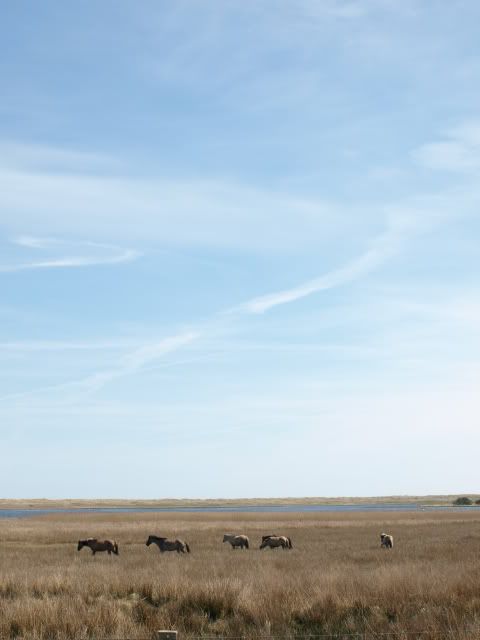
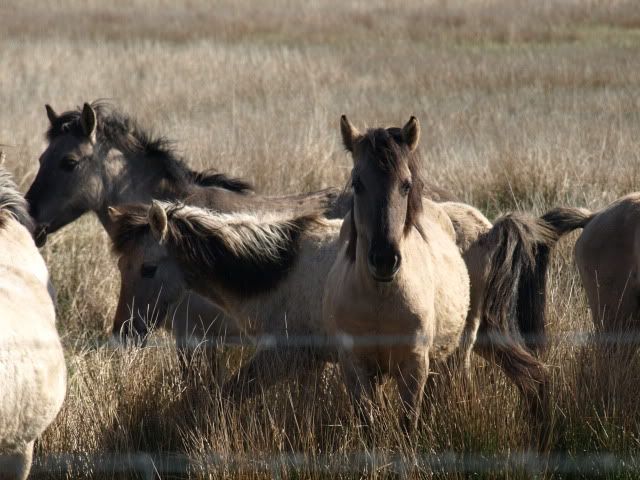
We have ponies! Well, the RSPB has them really, but we all feel quite proprietorial about them. They are Konik horses, strictly speaking, brought in to help manage the rough grazing in the marshes and improve conditions for breeding waders. They are quite a long way from the Visitor Centre, and are rather elusive, seeming to like hiding amongst the gorse bushes, so when we got the opportunity to go to see them (after a very early start on the last goose count) we clambered into the reserve truck and bounced off over the fields.
There are eight, four fillies and four geldings, and they are quite young, and still in their fluffy winter coats. They were basking in the sun, and seemed less than impressed at the disturbance, but posed nicely before heading off into the marsh to continue the hard work of eating.
Showing posts with label mammals. Show all posts
Saturday, 7 May 2011
Saturday, 22 November 2008
Loch & Awe
Autumn, changing colours and the hint of oncoming winter.... what do you do? Sounds like a good time to take a break, relax and go on holiday, which is what Mum and I did in October. Some years ago we went to a Forestry Commission site at Loch Awe, which got sold off - this year we found that some of the cabins were again for rent - (have a look here) - so we decided to go back, and so glad we did!
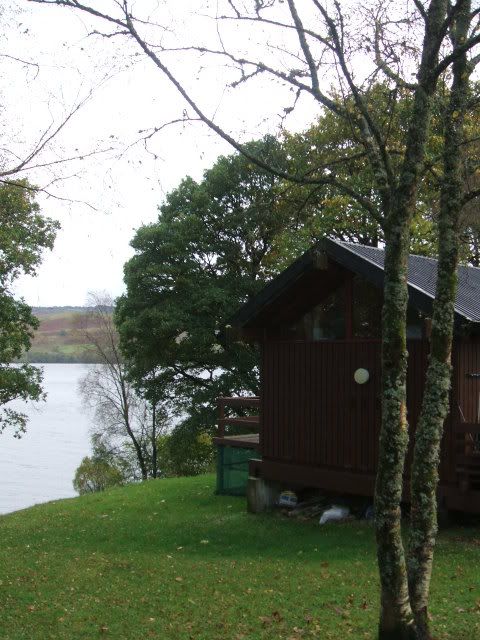
This is the cabin, overlooking the loch....

It's compact, cosy, very reasonably priced, and fully heated!
We didn't expect the weather to be good - and were not disappointed - it chucked it down on a regular basis - when we woke up, the loch was usually calm and still, the wind picked up during the day becoming quite fierce by nightfall. Nevertheless, one morning I woke to the sound of thunder so loud that I thought it was blasting at a nearby quarry - the blast reverberated through me as I lay in my bunk, and the sound of the rain on the roof was deafening! But the cabin was snug, and we had a great deal of pleasure just watching the rain, and the loch rising...at least a foot during the week...
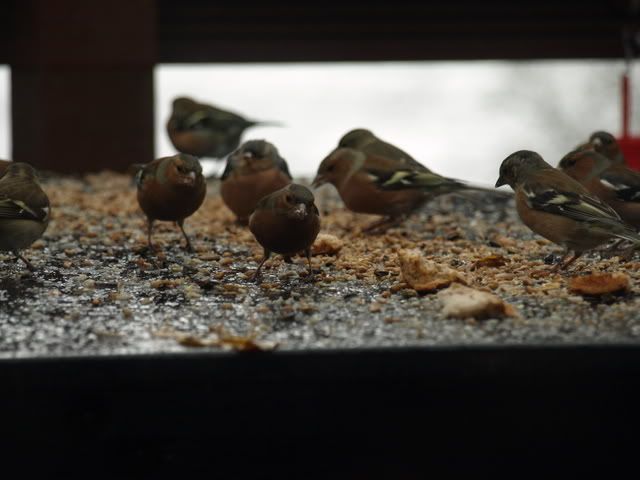
We put out bird-feeders, as we'd done in the past, (and had on one visit attracted a pine marten)and were soon discovered by the locals - I don't think I've ever seen so many coal tits, chaffinches, great tits, and blue tits - who soon proceeded to eat us out of house and home....

There were also siskins, a wren, and a robin who appeared to be the only vegetarian robin I've ever encountered - we got in some mealworms for him which were studiously ignored in favour of breadcrumbs..
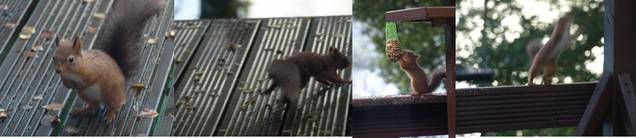
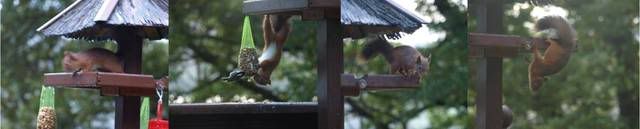
The most striking visitor to the feeders was a red squirrel, who appeared on the second day, and then came back every day - several times a day on occasion. The peanuts were the main focus of his attention, but he paid visits to the sunflower seeds, and checked out the whole deck in case he'd missed something.


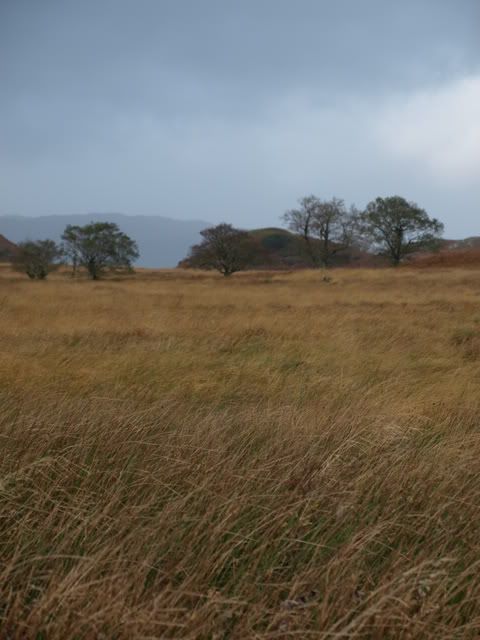
The weather meant we stayed in the cabin quite a lot - which was excellent, as it meant we got to see all the visitors - but we still managed to get out and about on a few occasions - through Kilmartin Glen with its standing stones and burial mounds (the ancient heart of the kingdom of Dalriada) down to Crinan - across the Moine Mhor (Great Bog) Nature Reserve

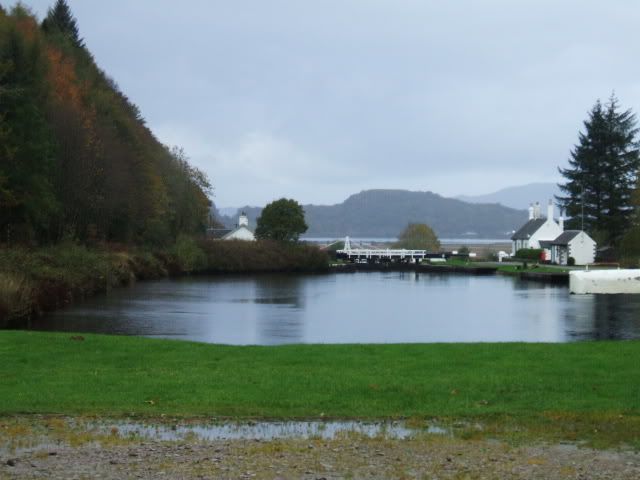
...and the Canal itself, with the huge locks that connect the inner loch to the sea and formed the basis for much of the trade in the early part of the 20th century - the heart of 'Para Handy' country.

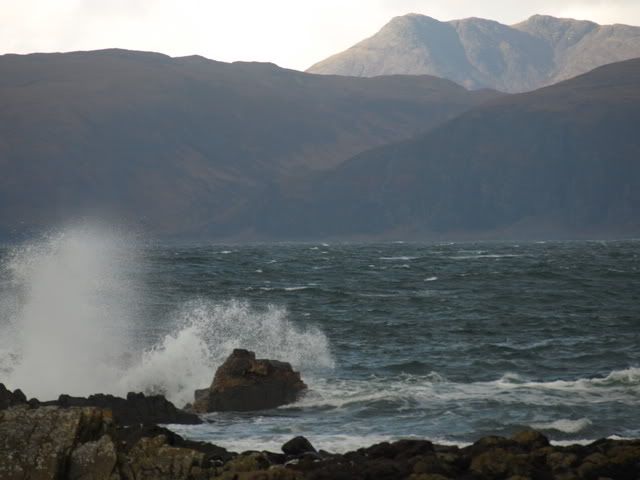
We went down through the islands to Seil and Easdale (and managed to flatten the car battery by leaving the lights on whilst having lunch!)where the wind was whipping the sea up.

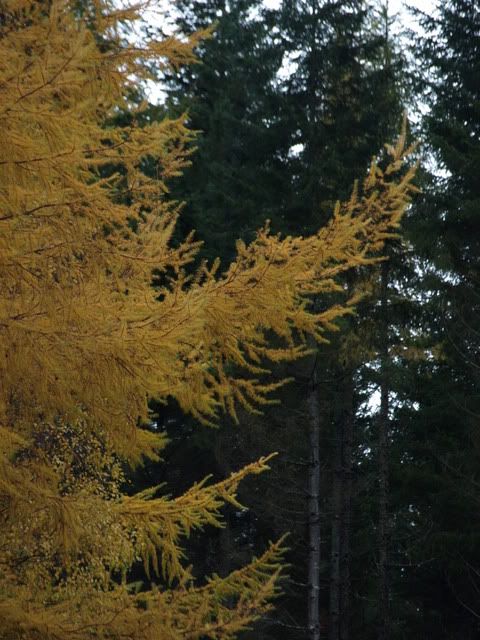
We stayed at the cabin for a week - utterly relaxing, quite enchanting, and rather soggy! Wet, mossy forests, sudden storms, and the glorious reds, golds and bronzes of autumn bracken and leaves. We came home through some of the wettest weather - floods in Oban and the higher end of Speyside round Laggan, where the autumn colours were still developing.

The trees were thick with lichen - a good indicator of clean air, and strange in its own right...

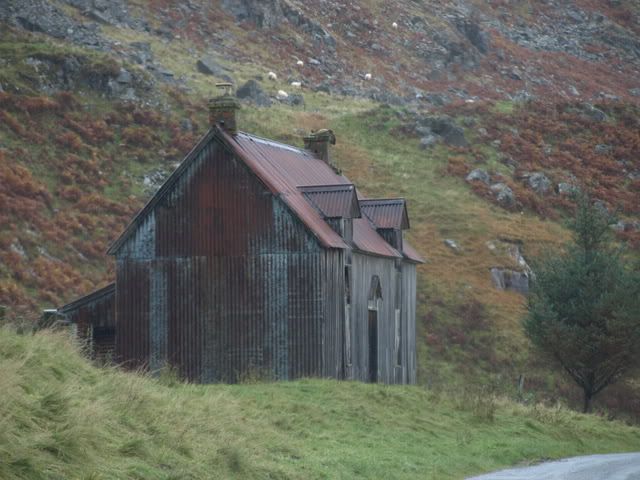
We side-tracked towards the headwaters of the Spey (defeated by floods) but paused at this old house, before finally heading for home, and fish and chips.

Loch Awe....Wet it may have been, but I'd utterly recommend it as an out-of-the way spot for relaxation!
This is the cabin, overlooking the loch....
It's compact, cosy, very reasonably priced, and fully heated!
We didn't expect the weather to be good - and were not disappointed - it chucked it down on a regular basis - when we woke up, the loch was usually calm and still, the wind picked up during the day becoming quite fierce by nightfall. Nevertheless, one morning I woke to the sound of thunder so loud that I thought it was blasting at a nearby quarry - the blast reverberated through me as I lay in my bunk, and the sound of the rain on the roof was deafening! But the cabin was snug, and we had a great deal of pleasure just watching the rain, and the loch rising...at least a foot during the week...
We put out bird-feeders, as we'd done in the past, (and had on one visit attracted a pine marten)and were soon discovered by the locals - I don't think I've ever seen so many coal tits, chaffinches, great tits, and blue tits - who soon proceeded to eat us out of house and home....
There were also siskins, a wren, and a robin who appeared to be the only vegetarian robin I've ever encountered - we got in some mealworms for him which were studiously ignored in favour of breadcrumbs..
The most striking visitor to the feeders was a red squirrel, who appeared on the second day, and then came back every day - several times a day on occasion. The peanuts were the main focus of his attention, but he paid visits to the sunflower seeds, and checked out the whole deck in case he'd missed something.
The weather meant we stayed in the cabin quite a lot - which was excellent, as it meant we got to see all the visitors - but we still managed to get out and about on a few occasions - through Kilmartin Glen with its standing stones and burial mounds (the ancient heart of the kingdom of Dalriada) down to Crinan - across the Moine Mhor (Great Bog) Nature Reserve
...and the Canal itself, with the huge locks that connect the inner loch to the sea and formed the basis for much of the trade in the early part of the 20th century - the heart of 'Para Handy' country.
We went down through the islands to Seil and Easdale (and managed to flatten the car battery by leaving the lights on whilst having lunch!)where the wind was whipping the sea up.
We stayed at the cabin for a week - utterly relaxing, quite enchanting, and rather soggy! Wet, mossy forests, sudden storms, and the glorious reds, golds and bronzes of autumn bracken and leaves. We came home through some of the wettest weather - floods in Oban and the higher end of Speyside round Laggan, where the autumn colours were still developing.
The trees were thick with lichen - a good indicator of clean air, and strange in its own right...
We side-tracked towards the headwaters of the Spey (defeated by floods) but paused at this old house, before finally heading for home, and fish and chips.
Loch Awe....Wet it may have been, but I'd utterly recommend it as an out-of-the way spot for relaxation!
Saturday, 26 January 2008
Waters of Philorth
First public even of the year, and a chilly afternoon on the estuary. We’re doing a joint bird-watching thing, between the Council Rangers, RSPB and my own organisation, looking at what is on the estuary and beach to the west of my village. I guess it’s pretty good, having two nature reserves nearby – this is the ‘lesser’ one, the Local Nature Reserve(LNR). LNRs are a way the local Council can protect anything interesting, and help prevent the constant degradation of habitat that seems to be a feature of our world.
So we set out in a chill wind, enough to bring tears to the eyes. I (being of limited mobility) took up post on the river, to check on whatever turned up on the inland section, while the rest headed over the dunes to the beach and the mouth of the river, braving the wind-whipped sand and sea spray.
It’s a place where people come to walk their dogs, and they were present in abundance – from small jovial terriers to aloof lurchers, juvenile retrievers that growled at me as a ‘new & therefore weird’ person, springer spaniels that leapt into the river with a joyful bark and a constantly wagging tail, senior sheepdogs that try to round everyone else up – the prevalent smell in the cars heading homeward must be ‘wet dog’…
Some of the owners are responsible, cleaning up the mess after their pooches dump last night’s dinner. But many don’t seem to feel it’s a problem – you would think that, coming here day after day, they would notice the build up of dog crap around the site, but they seem to have selective vision. Indeed, a local councillor has been reported as saying ‘Well, the bin isn’t near where my dog does its business.’ Good example, guys.
So the place is pretty much a ‘watch where you walk’ endeavour, and even the responsible owners aren’t entirely blameless – I watched a guy with three dogs on leads and three running loose… the ones on leads he cleaned up after…the others had done their thing before he got to where I was standing, and of course he didn’t know they had dumped by then…I do wish people would be aware of what their animals were doing when not under their immediate control, as this would prevent a lot of confrontation between visitors and managers of sites…
Sigh. Enough of crap. Literally. Just clear it up, that’s my view.
There weren’t too many birds around – gulls, crows, jackdaws – last year, we did this walk a month later and there were quite a lot of waders – but this could have been a factor of the tide.
Today was the day after a high spring tide, and coupled with a lot of recent rain, the estuary was pretty full. You expect the tide to fill, hit the top – slack – and then retreat, but it seems this isn’t the way it goes. Watching the water come and go, using a fence post and several clumps of grass as markers, it became evident that there was much more to it.
The water seemed to go up and down several times, the grass islands flooding and emerging as I watched. What drew my attention to the changes was that I noticed a small mammal making its way across the flow to one of the islands, and then staying there - hiding in plain sight as several dogs went past.
The water slowly rose – eventually there was no more island, and the beastie (which I believe(though I wouldn’t bet my life on it!) was a was a water vole –a rarity these days) made its way to the ‘mainland’- chin up and doggy-paddle, determinedly – to the bank.
While I watched, (being interested in the relatively rare sighting) I became aware that the water levels were rising and falling, almost as if the river and the sea were breathing in and out as it hit the top of the tide…the post in the water emerged, snagged trailing debris and then disappeared, releasing the raft of reeds to drift away downstream. Then it appeared again, my attention drawn that way by the loud ‘plop’ of a little grebe making its way downstream on the tide and diving as it went. Up and down. Islands emerging and drowning. Tides are a much more complex thing than they seem, written down in the black and white of tables.
We all met up again, to swap sightings and comments on the weather. The wind whispered in the reeds, dry stems rattling, and a blue tit foraged amongst the foliage for insects and seeds. A flock of jackdaws took wing over our heads, and, distant and clear, the call of pink-footed geese rang clear on the air. Grey skies and cold winds, and the edge of a rain shower, brought an end to our survey.
Saturday, 15 December 2007
Shetland Sojourn I
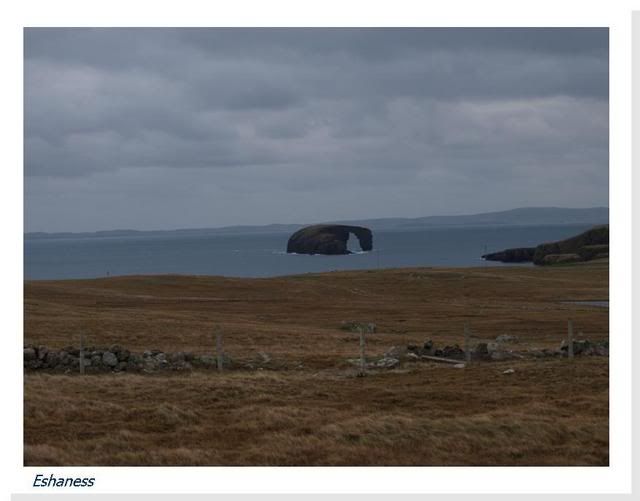
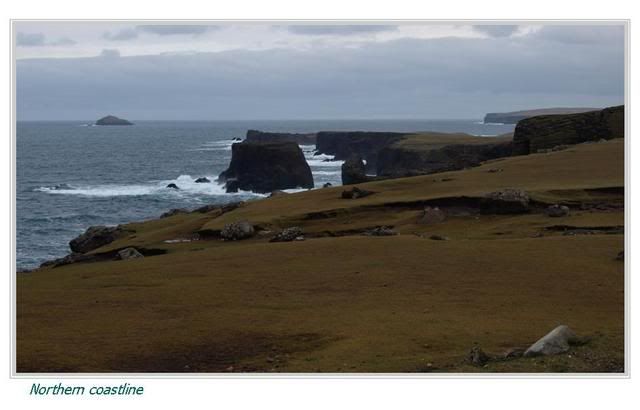
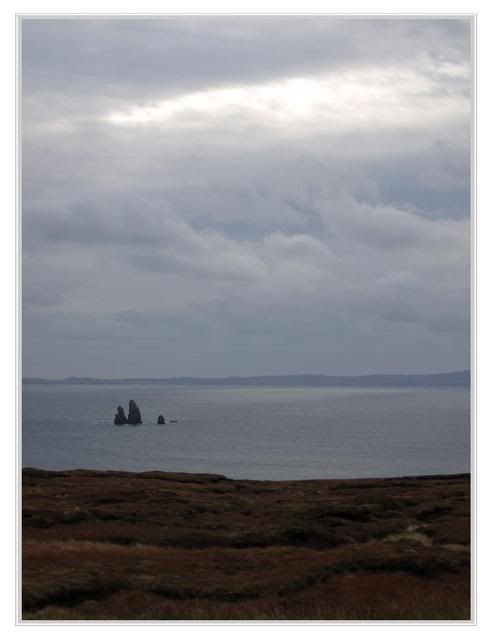
Saturday morning we scraped the snow off the car, and headed north, to the top left-hand corner of Shetland Mainland, to Eshaness, where the geology meets the sea. Literally. Here the sea has cut through the flank of an ancient volcano, different types of lava flow stacked up like a layer cake, a cross section of an explosive past. There are gas bubbles, ash and volcanic bombs, the fine grained flows of runny lavas, the blobby agglomerations of the stickier stuff. Different hardnesses of rock give way to the sea at different speeds – in places the cliffs are like giant’s staircases, in others, arches and needles rise from the Atlantic rollers like the teeth of a fossilised monster.


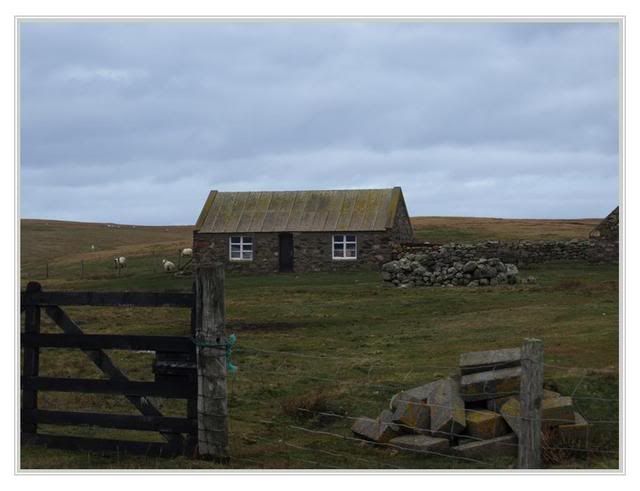
The power of the sea is evident. Rocks lie along the cliff-top, thrown up by storm and tide, to be swept off by other waves reaching 40 metres above the sea, and the waters offshore are littered with wrecks. Yet people have lived here for many thousands of years, their presence recorded in the stone age cairns, Pictish brochs and in the remnants of pre-clearance villages.

The wind is bitter. As I step from the car to take photos, my eyes immediately stream, and the cold slices into my bones. It’s not a day to hang around.
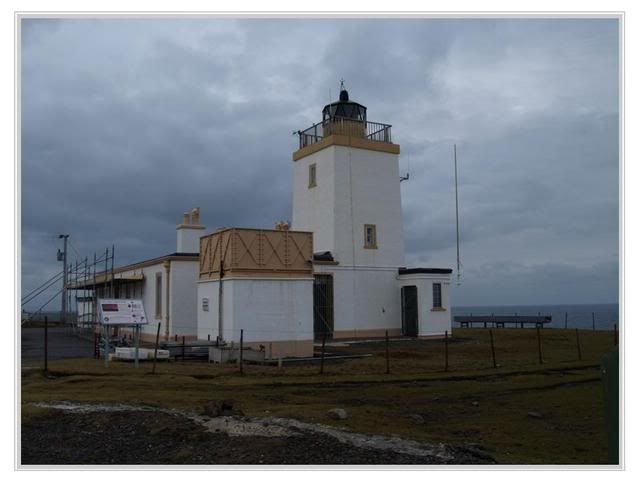
Eshaness Lighthouse – now a private house (lucky people!) – is one of the few that has a square tower. It stands foursquare against the wind and weather, staring out across the Atlantic. I snapped the picture and dived back into the warmth of the car.

We head back towards Sullom Voe, where the tankers discharge and fill their tanks with the oil from the hostile fields in the seas between Shetland and Norway. It’s actually not that imposing – the Flotta terminal in Orkney is more obvious, and the St Fergus terminal at home, with its huge flares of burning gas, more dramatic. Nearby is Mavis Grind (pronounced, I think, with a short ‘i’) which is designated the shortest distance between the Atlantic and the North Sea - a mere stone’s throw (if you have a small stone and a very strong arm!) We head to the northern ferry terminal at Toft, where the inter-island ferries head out to the low-lying, peat-covered island of Yell. No, we’re not going to Yell, but there is purpose in our trip.
Years ago, on Fetlar, we were chatting with a local gentleman about the likelihood of seeing otters. Go to the ferry terminals, he said, it’s almost guaranteed – they like the disturbed water where the ferries come and go, it stirs up the fish.
He was right, as we’ve discovered on numerous occasions since that conversation.
We sat and ate our sandwiches, watching the ferry load up and the seabirds go back and forth. Ferry terminals are also a good place to find well-maintained public toilets, so we took advantage, and I was just getting back into the car, when Mum noticed a disturbance offshore.
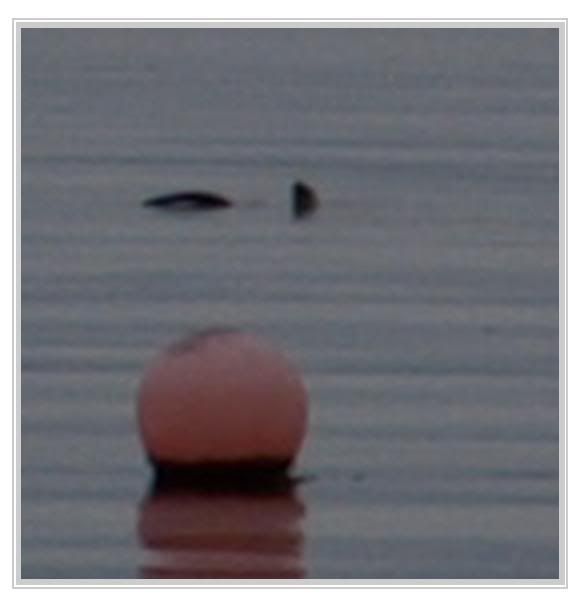
Binoculars snap to attention, and with delight we spot two otters, fishing in the bay. They roll around each other, diving and splashing, and then separate. They are some distance off the beach, but I take a picture anyway - honest, this IS an otter! While we watch, it catches a butterfish and, gripping it firmly between its paws, happily chomps it in front of us.

The light is fading rapidly – twilight comes at around 3 p.m. - so we head back towards our base, and our warm and cosy apartment.
The power of the sea is evident. Rocks lie along the cliff-top, thrown up by storm and tide, to be swept off by other waves reaching 40 metres above the sea, and the waters offshore are littered with wrecks. Yet people have lived here for many thousands of years, their presence recorded in the stone age cairns, Pictish brochs and in the remnants of pre-clearance villages.
The wind is bitter. As I step from the car to take photos, my eyes immediately stream, and the cold slices into my bones. It’s not a day to hang around.
Eshaness Lighthouse – now a private house (lucky people!) – is one of the few that has a square tower. It stands foursquare against the wind and weather, staring out across the Atlantic. I snapped the picture and dived back into the warmth of the car.
We head back towards Sullom Voe, where the tankers discharge and fill their tanks with the oil from the hostile fields in the seas between Shetland and Norway. It’s actually not that imposing – the Flotta terminal in Orkney is more obvious, and the St Fergus terminal at home, with its huge flares of burning gas, more dramatic. Nearby is Mavis Grind (pronounced, I think, with a short ‘i’) which is designated the shortest distance between the Atlantic and the North Sea - a mere stone’s throw (if you have a small stone and a very strong arm!) We head to the northern ferry terminal at Toft, where the inter-island ferries head out to the low-lying, peat-covered island of Yell. No, we’re not going to Yell, but there is purpose in our trip.
Years ago, on Fetlar, we were chatting with a local gentleman about the likelihood of seeing otters. Go to the ferry terminals, he said, it’s almost guaranteed – they like the disturbed water where the ferries come and go, it stirs up the fish.
He was right, as we’ve discovered on numerous occasions since that conversation.
We sat and ate our sandwiches, watching the ferry load up and the seabirds go back and forth. Ferry terminals are also a good place to find well-maintained public toilets, so we took advantage, and I was just getting back into the car, when Mum noticed a disturbance offshore.
Binoculars snap to attention, and with delight we spot two otters, fishing in the bay. They roll around each other, diving and splashing, and then separate. They are some distance off the beach, but I take a picture anyway - honest, this IS an otter! While we watch, it catches a butterfish and, gripping it firmly between its paws, happily chomps it in front of us.
The light is fading rapidly – twilight comes at around 3 p.m. - so we head back towards our base, and our warm and cosy apartment.
Tuesday, 7 August 2007
Whale Tale
I was just getting the paints sorted out for the next section of the picture I’m doing for the RSPB reserve, when the Reserve Manager appeared at the door.
‘There’s a minke whale in the harbour at Fraserburgh.’
What could I do but down tools and go see…..?
You may well have seen this in the national news – young minke whale followed a fishing boat into the harbour and got stuck. (If you were looking closely (hi Sue!!), you may even have seen me on the evening news report, one of the many watchers on the quayside.) I was in two minds about going to see it – these things nearly always end up in tears, and I didn’t want to be a voyeur on a sad tale. On the other hand, I did want to see it – I didn’t believe that it could actually be in the harbour itself. But it was.
Standing on the quay, we watched as the whale circled the harbour pool, coming up to breathe every four minutes or so. It didn’t seem too stressed, though there would be no food for it. There were no ship movements as the big pelagic trawlers were tied up, though this may have confused the sonar picture. Why couldn’t it find the gap and the way out to sea?
One of the gang went off to find out what was happening. Apparently, on the entry to the Balaclava Basin (the bit of the harbour in question), there is a concrete ‘lip’ – at low water there is about 3 metres of water over this, and chances are the whale’s sonar was bouncing back off the lip and making it think there was no way out. To make matters worse, if it got over the lip, the harbour wall was straight ahead, leading off left at an angle towards the open sea, but a sonar picture could well seem to show no exit.
The whale circled. A couple of grey seals wandered in, to see what all the fuss was about – they sometimes get fed from the quayside, so possibly thought their luck was in. They made their way out with no problem, but the whale kept going round and round. I had a real sinking feeling about this. I perched on a set of steps by one of the fish warehouses, and felt slightly sick.
Nothing to be done. High water wasn’t until mid-afternoon, and there would be attempts to lure it out then. So I went back to painting rushes, reeds and reflections, and kept an ear on the news. One of our regulars reported sighting larger whales feeding off Rattray Head.
The first attempt failed. I watched familiar faces crop up on the news reports, explaining the plans to help. The whale started to look weary – the dorsal fin started to droop. I began to think this would go the way of so many recent whale encounters in Britain.
Thankfully, I was wrong.
It took several days and a lot of effort, but as you’ll probably know, the whale escaped safely to sea. What wasn’t on the news was that I paid for my prurient curiosity – in perching on the steps of the warehouse, I got at least ten ant bites. That’ll teach me.
Sunday, 24 September 2006
Brief Encounter – Eigg Anchorage
So we’d sailed over from Barra, and at the end of the day, dropped anchor on the south side of Eigg harbour. A shore party had been exploring the island, we’d had dinner, and were enjoying a glass of wine and some music on deck when a passing prawn boat gave our cook a notion for next day’s lunch. After a short discussion, the skipper and two of the female members of the party set off in the dinghy, and returned with a huge bucket of langoustines and some smaller prawns, traded, in best nautical fashion, for cans of lager. OK- it may be stereotypical, or even sexist, to send the bosun to bat her eyelashes at the fishermen, but it works!
It was a strangely calm night – strange, because the forecast had sternly said ‘Force 8 Northerly gale, imminent’, which was why we anchored where we did, sheltered from the oncoming winds. It never materialised, though they kept warning us about it! A few stars were showing through broken cloud, their numbers growing as the sky cleared. Out here, free of the intrusive lights of towns and cities, the sky seems immense – a swathe of brilliance curving from horizon to horizon, some stars seeming close enough to become tangled in the rigging, others as far away across time as to be nothing but a distant memory of something that once was.
The last few night-owls were loafing on deck, idly chatting and finishing up the wine, when there was a faint splash from the starboard side. We look at each other, and go to the rail to see. There’s something in the water, sliding quite quickly along beside the hull. ‘A seal’ says someone. I’m not so sure, and flick my torch briefly into the darkness. Not a seal. A long body and tail, broad flat head with a short nose, thick fur. The otter turns his head to look up at us, powerful tail driving him through the water. He’s about five feet long, or so it seems, and unconcerned by our presence. He swims alongside, vanishing under the overhang of the stern, before reappearing briefly, then diving with a hint of a splash. Bubbles trail away in the torchlight, heading for the prawn boat. It’s obvious where his interests lie.
Next morning, we tell Mum. She turns an interesting shade of green.
Monday, 11 September 2006
Dolphin Days - August 2006
OK, so I haven’t been around much recently. Like most people involved with schools, summer is the time to take off on holiday, lay back and relax, and watch the world go by. At this point in my life, this has become inextricably bound up with sailing off the west coast.
Travelling as the wind and tide dictates, watching the weather come in off the Atlantic and the changing light on the water, you see the land from the outside, a different, older face of Scotland. This is the road the Vikings took, and the lost stragglers of the Armada, the way of the Lords of the Isles, the main highway of the early settlers and traders, the lifeline for the isolated communities up and down the fringe of the land. It bustled with fishing fleets and small ferries and steam puffers plying their trade from the Clyde to the Summer Isles.
Now it’s left mostly to the tourists, and the trade is carried on the red and black liveried Cal-Mac ferries, the scatter of small fishing boats is outweighed by the cages of fish farms, and, far out in the Minch, the low-slung forms of tankers head for the northern terminal of Flotta, or beyond, their potential for environmental disaster a thin rust-clad steel wall away from actuality.
It’s still a wonderful place for wildlife.
Previous trips have brought contact with sea eagles, porpoises and whales, and great gatherings of basking sharks, sifting the waters north of Canna for plankton. Phosphorescent plankton danced in Loch Dunvegan, an underwater firework ballet glowing green under midnight skies. Gatherings of seals have watched us sweat on the halyards, or haul up the anchor from remote bays. There’s always something different to look forward to.
This year, our first encounter is the resident seal in Mallaig harbour, idly watching us load up the boat and refuel. It’s an Atlantic grey seal, the larger of the two species found regularly round our coasts, and it views us regally down the length of its long Roman nose.
The next couple of days see us heading out past Rum and Canna, across the Minch towards the Outer Hebridean islands, Uist, Benbecula and Barra. Porpoises slide past us, small and dark, and the ‘phooff!’ of their exhalations recalls one of their old local names – “puffin’ pigs”. They roll along as if they are wheels, with little splashing, and they don’t stay long. A small pod of common dolphins dashes past on their way to somewhere, slapping the water with their tails as if revelling in their speed and grace – and leave us trailing in their wake. Heading towards Castlebay on Barra, I’m at the wheel, holding 110 tonnes of ship with over 3000 square feet of sail on a course for the evening’s anchorage, when I notice a flock of birds away off to starboard. I squint against the light, and can just make out something large in the water, so I call it out to the rest of the crew. At this point it launches itself into the air – a minke whale, breaching. It drops back with a flurry of white water, and vanishes into the depths, as everyone rushes to the rail to try and see it.
The following day, as we head back towards Eigg from Barra, after a night of ceilidh music and dancing on the deck, (and there are a few sore heads this morning!) we spot a gathering of gannets. Plunge-diving in large numbers, they mark another shoal of fish, a bait-ball, and a magnet for predators, both above and below water.
Out of the grey water to starboard comes another pod of dolphins, around twelve of them, including one small calf. This group aren’t playing today, and head straight into the bait-ball, chasing the fish back and forth, until we can see the splashes as they leap clear of the water. More dolphins come from the port side, another fifteen or so, and five of them break off to join us, riding our bow wave for the next few minutes before turning back to join the feeding frenzy. It’s exhilarating to watch them sliding effortlessly from side to side of the bowsprit, a stream of bubbles rising from each blowhole as they come to the surface, the arched back and sharp fins cutting through the water. Dolphins are very sensual creatures and these are, in fact, indulging themselves in full-body pleasure; the pressure waves from our progress and the waves acting like a natural version of something bought in an Ann Summers shop. The skipper grins at me as we explain what’s happening to the others. “Dirty wee divvels!”
There are more seals, more porpoises, ravens and red deer, skuas and shearwaters, before the voyage is over for this year.
Sail Training Vessel ‘Leader’
Trinity Sailing
(All photos courtesy of my brother!)
Labels:
holidays,
mammals,
sailing,
sea,
travelling,
Western Isles
Tuesday, 11 July 2006
Take Your Partner for the Hedgehog Waltz.
The hedgehog situation grows more complex.
Tonight, our small visitor turns up for her mealworms as usual, only to be joined after about ten minutes by another, larger, hedgehog.
He is slightly lighter coloured, and a bit scruffier - designer stubble? He feeds his face briefly, before his mind turns to other things.
He begins to snuffle at 'our' hedgehog, and they begin a long slow dance around the lawn. He snuffles his way towards her back end, she backs away, and they gradually go round in a series of small spirals, orbitting around the end of her nose. She sits down firmly, making a point; he snuffles along her side, she gets up and backs away, he changes direction - is he getting dizzy by now? - they swing like a small binary star across the lawn and under the azaleas. The bushes shake. The pair emerge, rotating back across to the rockery, and back once more to the azaleas. Is she really not interested or is she merely being coy? She certainly doesn't take the opportunity to escape when he briefly backs off.
They vanish again, and the bushes tremble. It's getting hard to see what's going on, and to be honest I'm beginning to feel a little voyeuristic. Mum peers out of the back door and comes in to report that they are sitting side by side under the arch that leads to the lawn, under a rainbow of clematis. Hmm. Has she succumbed to his rough charms? No - merely a brief break in the dance - they head off in front of the garage, still circling.
It's a long slow courtship, with hedgehogs. And a very careful one.
Wednesday, 5 July 2006
The Visitors
Hummingbird Hawk Moth – 3 Jul 06
Waiting for the bus, conveniently outside the house, we’re inspecting the shrubs that grow over the wall, debating how far they need to be trimmed back to prevent decapitation of passing pavement cyclists, and how high they need to be cut back off the ground to prevent dogs using the convenient cover as – well, a 'convenience' – when we notice something strange in the honeysuckle.
A hummingbird hawkmoth. Flashing subliminal terracotta red hindwings, soft beige and black-and-white-striped body, hovering beside the flowers, extending its long proboscis like a refuelling probe on a fighter aircraft connecting with the tanker, it moves with delicate precision.
Is this an indicator of warmer summers? We haven’t seen one here for over 20 years. We watch it working over the flowers, until it vanishes with speed somewhere over the garden wall, and the bus arrives.
Hedgehog – 4 Jul 06
Mum peers out of the back window, and whispers.
‘She’s here.’
It looks like someone has left an old coconut on the lawn. Snuffling about, minutely inspecting each blade of grass, each small patch of the lawn for the dried mealworms my mother leaves out. Heat and hard ground mean fewer worms and beetles, so every little helps. Almost every night she comes – Mrs Tiggywinkle in person - around 9.30 to 10 pm. Sometimes she lingers, but mostly she stays for about 20 minutes. Well, we don’t really know if she is really a ‘she’, but we make an educated guess. She’s small and neat, light brown fur edging a tidy bristle-cut hair-do, black-eyed and black-nosed. She has surprisingly long legs, moving with a rolling sailor’s gait. Trundling about like a small clockwork toy, leaving a trail through the grass, she disappears into the undergrowth of the flowerbeds, to reappear and cross the path before vanishing into the gathering darkness under the hawthorn tree at the bottom of the garden.
‘Think I’d better get some more mealworms,’ says Mum.
Subscribe to:
Posts (Atom)