The far side drifts in and out, grey veils of misty rain swirling across the still water. The robin darts onto the deck, grabs a piece of something from the birdfood scattered on the railings and vanishes again, only to return in a flurry of wings to send an inquisitive chaffinch packing. Falling leaves look like small birds flying to the ground; as the rain grows heavier, the drops hit the remaining foliage, drawing the eye – was that another bird?
No, just a bouncing leaf.
A bedraggled great tit, feathers askew, lands on the bird table and tucks into the birdcake, caution and hunger in equal measure as the bird looks over its shoulder for predators then returns to its feast. More arrive, great tits, blue tits and the occasional coal tit. For a while it looks like a game of feathery billiards, each bird that lands on a feeder sending the previous incumbent bouncing off in another direction, to the table, or the hanging coconut shell, or the debris scattered below on the decking, none willing to share their position. Gradually they settle down and seem to become more tolerant, and even the robin slacks off his sentry duty.
A flash of yellow catches my eye and makes me look twice at the bird that's just arrived. Smaller than the chaffiches, with a deeper notch in the tail - female siskin. Another joins her, and finally a male arrives, smart in black, green and yellow.
The loch slowly reappears, punctuated by a small group of cormorants, their flight low and purposeful, heading southwest. Mallards squabble at the water's edge. The far side emerges as the rain eases off, a tapestry of green and brown and russet. The trees are beginning to turn colour; as if someone is tweaking the hue and intensity settings.
For a brief half-hour, the skies clear, and the birds, strange to relate, vanish.
Then the drizzle returns, and the far side starts to disappear once more.
Showing posts with label autumn. Show all posts
Showing posts with label autumn. Show all posts
Saturday, 30 October 2010

Tuesday, 12 October 2010
Eye to the Telescope
Where did summer go? The last few swallows - late fledgelings of the last broods - are gathering themselves together, eating as much as they can before the long haul south. The geese have been arriving, dropping in in large numbers, whiffling down from the north to land in their old familiar fields. The rain continues to encourage the snails in my garden...
At this rate it'll be next year before I can blog this year.... so I've decided to do things out of order.
It's fifty years since someone had the bright idea of counting the geese, to see how many pass through and overwinter, and to find out how well they are breeding. 0545 on Sunday morning found Mum and me lurking on the edge of our usual field, waiting for the sun to come up, and the flocks to head out to feed. Naturally, things didn't go according to plan. It was about an hour before we could see more than the vague outline of the landscape, and the geese decided to have a Sunday morning lie-in, which left us feeling rather envious. By about 1000, only about seven thousand had left, and the rest were hanging about on the fields.
Which means taking a different approach to counting.
Back to the Visitor Centre, and set up with a telescope trained on the dense mass of grey-feathered bodies packed in 'tight as ticks on a hedgehog' on the Low Ground marsh, and in the grazing fields beyond. Counting is in clumps of five, rather than strings of twenty, and can only be a 'best guess' - how do you account for the rise and fall of the land, or the awkward geese that hide behind the gorse bushes?
I entertain thoughts of air traffic control - 'All geese in field 59 please proceed to the runway, take off and circle before landing again.' They are so much easier to count in the air!
My eyes ache by the time I'm done, and the traditional goose-count egg-and-bacon sandwich is very welcome as we tally up the count.
It's looking like a funny year. Although there were a lot of geese to begin with, most seem to have gone further south, with only 16-17,000 remaining at what is usually the peak time. Signs and portents? Or just geese being awkward?
Ah well. See what next month brings!
At this rate it'll be next year before I can blog this year.... so I've decided to do things out of order.
It's fifty years since someone had the bright idea of counting the geese, to see how many pass through and overwinter, and to find out how well they are breeding. 0545 on Sunday morning found Mum and me lurking on the edge of our usual field, waiting for the sun to come up, and the flocks to head out to feed. Naturally, things didn't go according to plan. It was about an hour before we could see more than the vague outline of the landscape, and the geese decided to have a Sunday morning lie-in, which left us feeling rather envious. By about 1000, only about seven thousand had left, and the rest were hanging about on the fields.
Which means taking a different approach to counting.
Back to the Visitor Centre, and set up with a telescope trained on the dense mass of grey-feathered bodies packed in 'tight as ticks on a hedgehog' on the Low Ground marsh, and in the grazing fields beyond. Counting is in clumps of five, rather than strings of twenty, and can only be a 'best guess' - how do you account for the rise and fall of the land, or the awkward geese that hide behind the gorse bushes?
I entertain thoughts of air traffic control - 'All geese in field 59 please proceed to the runway, take off and circle before landing again.' They are so much easier to count in the air!
My eyes ache by the time I'm done, and the traditional goose-count egg-and-bacon sandwich is very welcome as we tally up the count.
It's looking like a funny year. Although there were a lot of geese to begin with, most seem to have gone further south, with only 16-17,000 remaining at what is usually the peak time. Signs and portents? Or just geese being awkward?
Ah well. See what next month brings!
Saturday, 22 November 2008
Loch & Awe
Autumn, changing colours and the hint of oncoming winter.... what do you do? Sounds like a good time to take a break, relax and go on holiday, which is what Mum and I did in October. Some years ago we went to a Forestry Commission site at Loch Awe, which got sold off - this year we found that some of the cabins were again for rent - (have a look here) - so we decided to go back, and so glad we did!
This is the cabin, overlooking the loch....

It's compact, cosy, very reasonably priced, and fully heated!
We didn't expect the weather to be good - and were not disappointed - it chucked it down on a regular basis - when we woke up, the loch was usually calm and still, the wind picked up during the day becoming quite fierce by nightfall. Nevertheless, one morning I woke to the sound of thunder so loud that I thought it was blasting at a nearby quarry - the blast reverberated through me as I lay in my bunk, and the sound of the rain on the roof was deafening! But the cabin was snug, and we had a great deal of pleasure just watching the rain, and the loch rising...at least a foot during the week...
We put out bird-feeders, as we'd done in the past, (and had on one visit attracted a pine marten)and were soon discovered by the locals - I don't think I've ever seen so many coal tits, chaffinches, great tits, and blue tits - who soon proceeded to eat us out of house and home....

There were also siskins, a wren, and a robin who appeared to be the only vegetarian robin I've ever encountered - we got in some mealworms for him which were studiously ignored in favour of breadcrumbs..
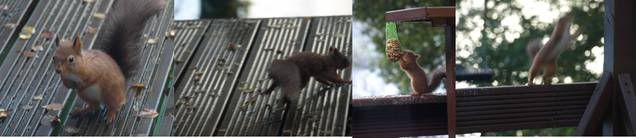
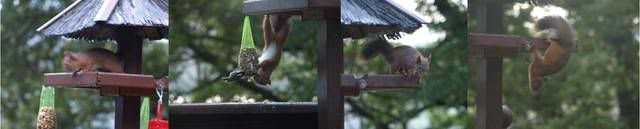
The most striking visitor to the feeders was a red squirrel, who appeared on the second day, and then came back every day - several times a day on occasion. The peanuts were the main focus of his attention, but he paid visits to the sunflower seeds, and checked out the whole deck in case he'd missed something.


The weather meant we stayed in the cabin quite a lot - which was excellent, as it meant we got to see all the visitors - but we still managed to get out and about on a few occasions - through Kilmartin Glen with its standing stones and burial mounds (the ancient heart of the kingdom of Dalriada) down to Crinan - across the Moine Mhor (Great Bog) Nature Reserve

...and the Canal itself, with the huge locks that connect the inner loch to the sea and formed the basis for much of the trade in the early part of the 20th century - the heart of 'Para Handy' country.

We went down through the islands to Seil and Easdale (and managed to flatten the car battery by leaving the lights on whilst having lunch!)where the wind was whipping the sea up.

We stayed at the cabin for a week - utterly relaxing, quite enchanting, and rather soggy! Wet, mossy forests, sudden storms, and the glorious reds, golds and bronzes of autumn bracken and leaves. We came home through some of the wettest weather - floods in Oban and the higher end of Speyside round Laggan, where the autumn colours were still developing.

The trees were thick with lichen - a good indicator of clean air, and strange in its own right...

We side-tracked towards the headwaters of the Spey (defeated by floods) but paused at this old house, before finally heading for home, and fish and chips.

Loch Awe....Wet it may have been, but I'd utterly recommend it as an out-of-the way spot for relaxation!
This is the cabin, overlooking the loch....
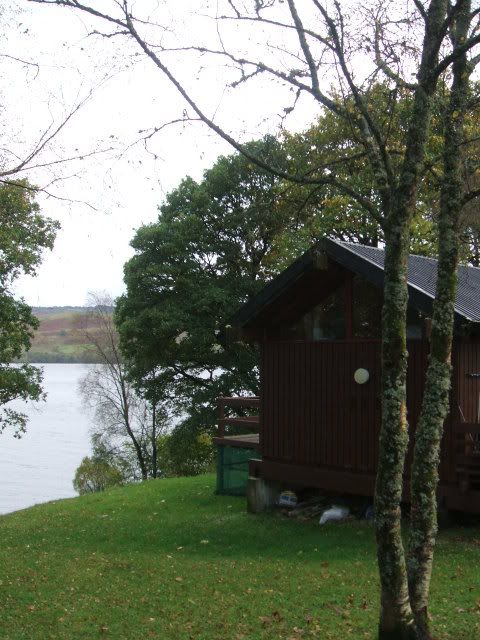
It's compact, cosy, very reasonably priced, and fully heated!
We didn't expect the weather to be good - and were not disappointed - it chucked it down on a regular basis - when we woke up, the loch was usually calm and still, the wind picked up during the day becoming quite fierce by nightfall. Nevertheless, one morning I woke to the sound of thunder so loud that I thought it was blasting at a nearby quarry - the blast reverberated through me as I lay in my bunk, and the sound of the rain on the roof was deafening! But the cabin was snug, and we had a great deal of pleasure just watching the rain, and the loch rising...at least a foot during the week...
We put out bird-feeders, as we'd done in the past, (and had on one visit attracted a pine marten)and were soon discovered by the locals - I don't think I've ever seen so many coal tits, chaffinches, great tits, and blue tits - who soon proceeded to eat us out of house and home....
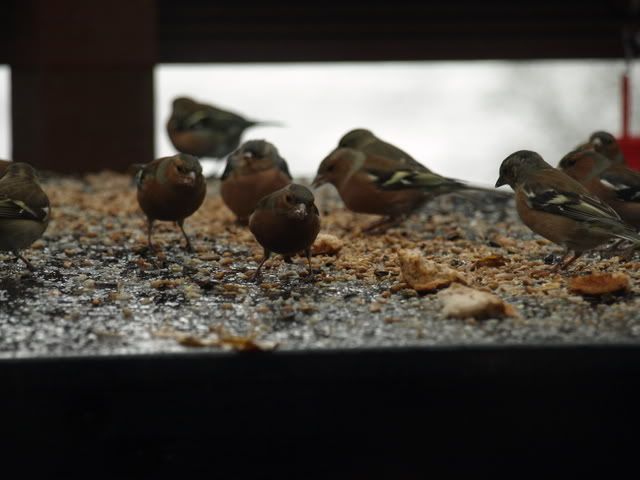
There were also siskins, a wren, and a robin who appeared to be the only vegetarian robin I've ever encountered - we got in some mealworms for him which were studiously ignored in favour of breadcrumbs..
The most striking visitor to the feeders was a red squirrel, who appeared on the second day, and then came back every day - several times a day on occasion. The peanuts were the main focus of his attention, but he paid visits to the sunflower seeds, and checked out the whole deck in case he'd missed something.

The weather meant we stayed in the cabin quite a lot - which was excellent, as it meant we got to see all the visitors - but we still managed to get out and about on a few occasions - through Kilmartin Glen with its standing stones and burial mounds (the ancient heart of the kingdom of Dalriada) down to Crinan - across the Moine Mhor (Great Bog) Nature Reserve
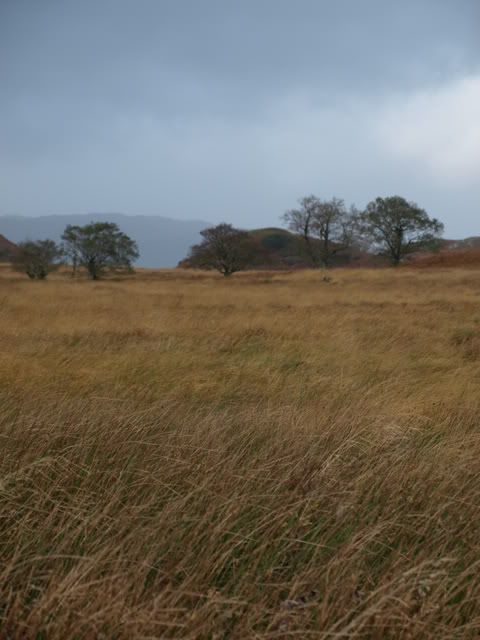
...and the Canal itself, with the huge locks that connect the inner loch to the sea and formed the basis for much of the trade in the early part of the 20th century - the heart of 'Para Handy' country.
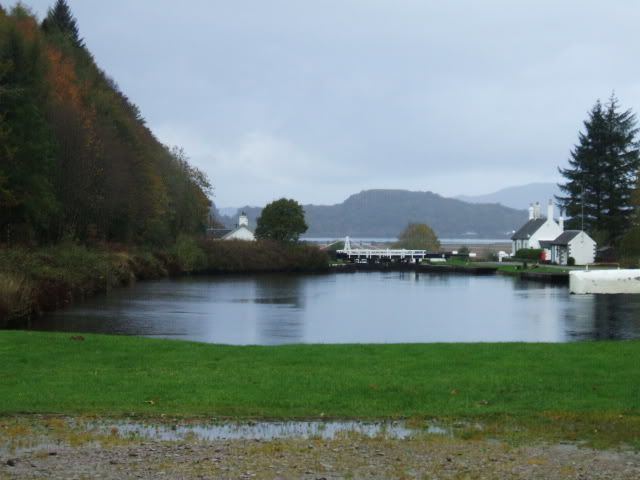
We went down through the islands to Seil and Easdale (and managed to flatten the car battery by leaving the lights on whilst having lunch!)where the wind was whipping the sea up.
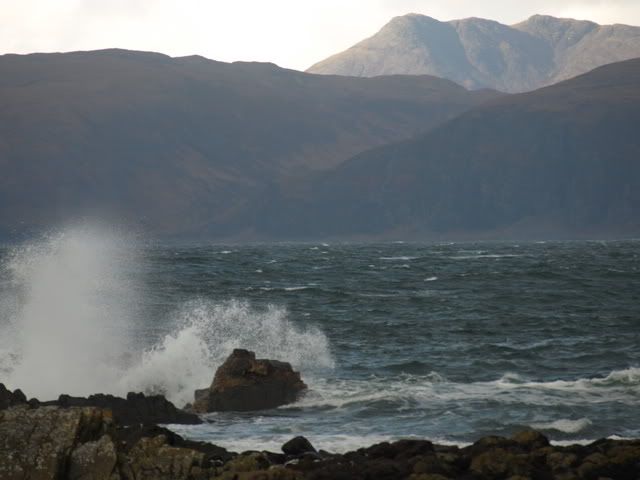
We stayed at the cabin for a week - utterly relaxing, quite enchanting, and rather soggy! Wet, mossy forests, sudden storms, and the glorious reds, golds and bronzes of autumn bracken and leaves. We came home through some of the wettest weather - floods in Oban and the higher end of Speyside round Laggan, where the autumn colours were still developing.
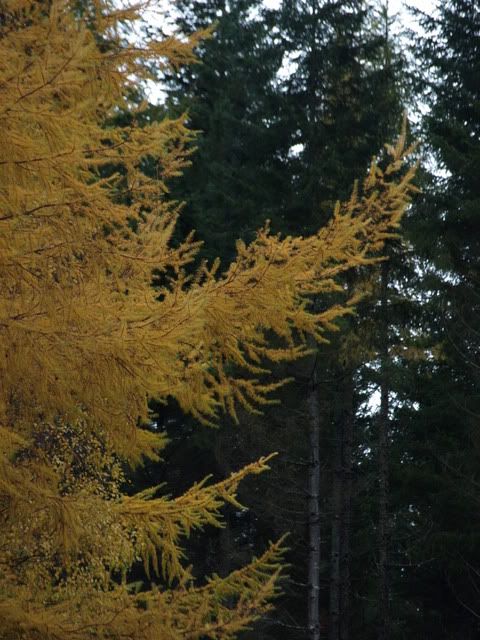
The trees were thick with lichen - a good indicator of clean air, and strange in its own right...

We side-tracked towards the headwaters of the Spey (defeated by floods) but paused at this old house, before finally heading for home, and fish and chips.
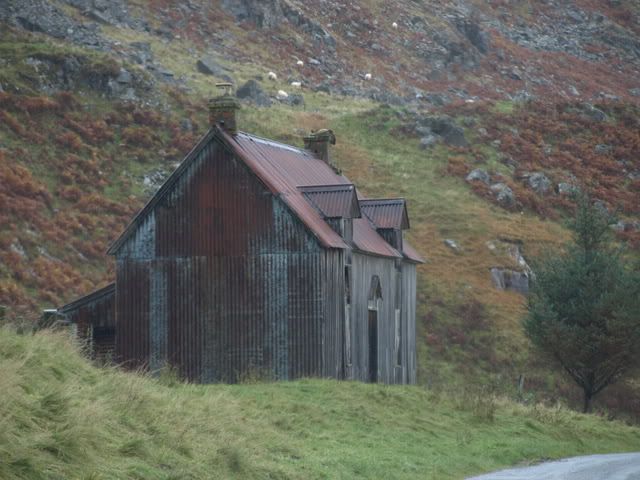
Loch Awe....Wet it may have been, but I'd utterly recommend it as an out-of-the way spot for relaxation!
Thursday, 28 September 2006
Aliens in the Undergrowth
Damp mornings, heavy with dew. Cobwebs - or to give it the local name, slammach, - hangs wet on the gorse bushes like pieces of cloud ripped off and caught up in the spines. Cows loom out of the fog, strange in the half-light. And in the undergrowth, something odd is appearing. Overnight, they have appeared, aliens from another world. They troop through the woodlands, small trolls transfixed by daylight, or raise their strange heads through the grass of suburban lawns. One or two are breaking through the pavement in the village. Others emerge from the bark of trees, or cluster in whispering congregations as the rain drips from the leaves on their heads, raising small clouds of fine dust to be carried away on the slightest breeze. They are friends, killers, and clean-up merchants.
Fungi.
It’s a great time of year for them, and after the warm summer, this damp autumn has brought them out in their hundreds. Much misunderstood, coveted by some and reviled by others, it’s time they had a proper place in our everyday lives. In fact they do - we just aren’t aware of it most of the time.
So, some years ago, a group of us got together to develop a programme for schools which looks at the wonderful weirdnesses that are fungi, to help children understand how they grow, and their place in the natural and unnatural world around us.
This week has seen ‘The Good, the Bad and the Fungi, 2006’. (Yes, I know! Groan!!) We have discovered spores and how they travel, how they grow into fungi, the mystical world of mycelium, how fairy rings develop, how the fungus got its spots. We have come face to face with a wide variety of the real thing - the red and white fly agaric waiting for the fairytale to begin: white-weeping ugly milk caps: the solid shelf of the birch polypore: clusters of yellow sulphur tuft: the delicate glistening white of porcelain fungus, high above our heads on the dead branch of a beech tree: the blotches of tar spot, breaking down the fallen sycamore leaves, and a host of others. We have discovered how fungi help trees and other plants to grow by exchanging mineral salts for food, how they break down dead material, and how some can kill through parasitism. We’ve considered how this fits into the environment, how dead wood provides food and shelter for other creatures and how fungi fit into food webs. We’ve played parachute games, blown up balloons, made badges, discovered the small beasties that appear when you leave fungi to rot - and we’ve had to clean up some of the aftermath too!
And we’ve learned to look very carefully into the undergrowth.
Fungi.
It’s a great time of year for them, and after the warm summer, this damp autumn has brought them out in their hundreds. Much misunderstood, coveted by some and reviled by others, it’s time they had a proper place in our everyday lives. In fact they do - we just aren’t aware of it most of the time.
So, some years ago, a group of us got together to develop a programme for schools which looks at the wonderful weirdnesses that are fungi, to help children understand how they grow, and their place in the natural and unnatural world around us.
This week has seen ‘The Good, the Bad and the Fungi, 2006’. (Yes, I know! Groan!!) We have discovered spores and how they travel, how they grow into fungi, the mystical world of mycelium, how fairy rings develop, how the fungus got its spots. We have come face to face with a wide variety of the real thing - the red and white fly agaric waiting for the fairytale to begin: white-weeping ugly milk caps: the solid shelf of the birch polypore: clusters of yellow sulphur tuft: the delicate glistening white of porcelain fungus, high above our heads on the dead branch of a beech tree: the blotches of tar spot, breaking down the fallen sycamore leaves, and a host of others. We have discovered how fungi help trees and other plants to grow by exchanging mineral salts for food, how they break down dead material, and how some can kill through parasitism. We’ve considered how this fits into the environment, how dead wood provides food and shelter for other creatures and how fungi fit into food webs. We’ve played parachute games, blown up balloons, made badges, discovered the small beasties that appear when you leave fungi to rot - and we’ve had to clean up some of the aftermath too!
And we’ve learned to look very carefully into the undergrowth.
Subscribe to:
Posts (Atom)
