Afflicted with cabin fever over Xmas and New Year, I have spent an inordinate time in the companyof the haunted goldfish tank, aka the TV. And the inevitable hoardes of adverts.
Which set me to thinking...what would any passing alien make of Earth, if this was what they picked up (and given the tedious repetition of much of it, it's probably more likely that they'd pick up the uncomfortable mix of Can-can and Heavy metal that was Why Mums Go to Iceland than something more intellectual).
In the run up to Xmas, the TV was populated by an inordinate number of sulky girls and moody men, wearing pouts that left them a hair's breadth short of becoming goldfish, glowering at each other, getting it on in lifts (and did the one who broke her Diamond necklace on behalf of Armani have to wait in line until the Beckhams finished?) or spilling flammable liquid across the floor and rolling about in it.
Obviously all this heavy breathing wore them out, one way or another, as the post Xmas schedules centred around replacing beds and sofas. Our passing aliens might wonder why these primitive Earthlings spent so much money in December, when the prices of nearly everything were immediately cut afterwards; why, they might ask, do they not do the Xmas thing at the end of January, when the sales have happened?
Wandering aimlessly through the supermarket (oh, how we spend our days!) another thing caught my eye. Seasonally-scented air fresheners/candles/electronic gizmos. Apart from wondering idly why anyone would want these things in the first place (they make me sneeze, for a start. Open a window, for goodnesss sake!) the sheer variety of 'scents' was astonishing. And in such combinations! Cinnamon and nutmeg. Cranberry and holly. Cotton and mulberry. Soft cashmere and vanilla... hang on a minute. Cashmere? Doesn't cashmere come from goats?
Can anyone explain why I would want my festivities seasoned with goat scented ice-cream?
Showing posts with label winter. Show all posts
Showing posts with label winter. Show all posts
Tuesday, 1 February 2011

Saturday, 4 December 2010
Snow Laughing Matter....
As usual, we are surprised by the British weather. This time, it's really caught us out, and there's not a thing we can do about it. However much grit we stocked up with, however much we polished up the snowploughs, traffic havoc was going to be the result when that much snow drops in that short a time. What bites now is how long it is taking to restore some semblance of order.

But it's pretty. It's like M*x F*ctor super-smooth foundation for the landscape - that fresh-as-a-daisy 24 hour slap advertised by some vapid bimbo. 'Get the Scotland Look'...
But I do want it to go away before Xmas.
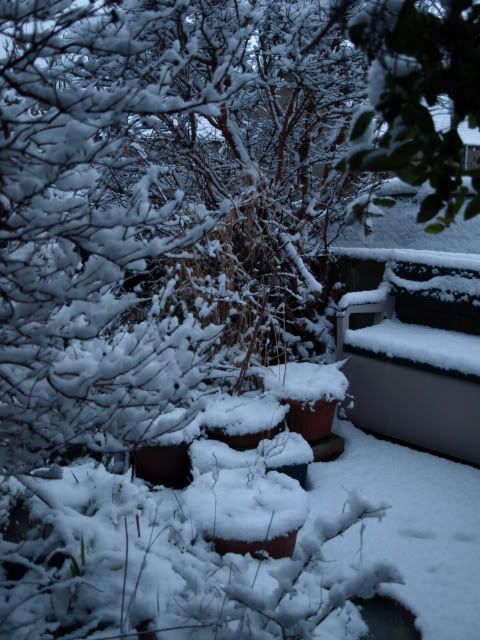
But it's pretty. It's like M*x F*ctor super-smooth foundation for the landscape - that fresh-as-a-daisy 24 hour slap advertised by some vapid bimbo. 'Get the Scotland Look'...
But I do want it to go away before Xmas.
Saturday, 26 January 2008
Waters of Philorth
First public even of the year, and a chilly afternoon on the estuary. We’re doing a joint bird-watching thing, between the Council Rangers, RSPB and my own organisation, looking at what is on the estuary and beach to the west of my village. I guess it’s pretty good, having two nature reserves nearby – this is the ‘lesser’ one, the Local Nature Reserve(LNR). LNRs are a way the local Council can protect anything interesting, and help prevent the constant degradation of habitat that seems to be a feature of our world.
So we set out in a chill wind, enough to bring tears to the eyes. I (being of limited mobility) took up post on the river, to check on whatever turned up on the inland section, while the rest headed over the dunes to the beach and the mouth of the river, braving the wind-whipped sand and sea spray.
It’s a place where people come to walk their dogs, and they were present in abundance – from small jovial terriers to aloof lurchers, juvenile retrievers that growled at me as a ‘new & therefore weird’ person, springer spaniels that leapt into the river with a joyful bark and a constantly wagging tail, senior sheepdogs that try to round everyone else up – the prevalent smell in the cars heading homeward must be ‘wet dog’…
Some of the owners are responsible, cleaning up the mess after their pooches dump last night’s dinner. But many don’t seem to feel it’s a problem – you would think that, coming here day after day, they would notice the build up of dog crap around the site, but they seem to have selective vision. Indeed, a local councillor has been reported as saying ‘Well, the bin isn’t near where my dog does its business.’ Good example, guys.
So the place is pretty much a ‘watch where you walk’ endeavour, and even the responsible owners aren’t entirely blameless – I watched a guy with three dogs on leads and three running loose… the ones on leads he cleaned up after…the others had done their thing before he got to where I was standing, and of course he didn’t know they had dumped by then…I do wish people would be aware of what their animals were doing when not under their immediate control, as this would prevent a lot of confrontation between visitors and managers of sites…
Sigh. Enough of crap. Literally. Just clear it up, that’s my view.
There weren’t too many birds around – gulls, crows, jackdaws – last year, we did this walk a month later and there were quite a lot of waders – but this could have been a factor of the tide.
Today was the day after a high spring tide, and coupled with a lot of recent rain, the estuary was pretty full. You expect the tide to fill, hit the top – slack – and then retreat, but it seems this isn’t the way it goes. Watching the water come and go, using a fence post and several clumps of grass as markers, it became evident that there was much more to it.
The water seemed to go up and down several times, the grass islands flooding and emerging as I watched. What drew my attention to the changes was that I noticed a small mammal making its way across the flow to one of the islands, and then staying there - hiding in plain sight as several dogs went past.
The water slowly rose – eventually there was no more island, and the beastie (which I believe(though I wouldn’t bet my life on it!) was a was a water vole –a rarity these days) made its way to the ‘mainland’- chin up and doggy-paddle, determinedly – to the bank.
While I watched, (being interested in the relatively rare sighting) I became aware that the water levels were rising and falling, almost as if the river and the sea were breathing in and out as it hit the top of the tide…the post in the water emerged, snagged trailing debris and then disappeared, releasing the raft of reeds to drift away downstream. Then it appeared again, my attention drawn that way by the loud ‘plop’ of a little grebe making its way downstream on the tide and diving as it went. Up and down. Islands emerging and drowning. Tides are a much more complex thing than they seem, written down in the black and white of tables.
We all met up again, to swap sightings and comments on the weather. The wind whispered in the reeds, dry stems rattling, and a blue tit foraged amongst the foliage for insects and seeds. A flock of jackdaws took wing over our heads, and, distant and clear, the call of pink-footed geese rang clear on the air. Grey skies and cold winds, and the edge of a rain shower, brought an end to our survey.
So we set out in a chill wind, enough to bring tears to the eyes. I (being of limited mobility) took up post on the river, to check on whatever turned up on the inland section, while the rest headed over the dunes to the beach and the mouth of the river, braving the wind-whipped sand and sea spray.
It’s a place where people come to walk their dogs, and they were present in abundance – from small jovial terriers to aloof lurchers, juvenile retrievers that growled at me as a ‘new & therefore weird’ person, springer spaniels that leapt into the river with a joyful bark and a constantly wagging tail, senior sheepdogs that try to round everyone else up – the prevalent smell in the cars heading homeward must be ‘wet dog’…
Some of the owners are responsible, cleaning up the mess after their pooches dump last night’s dinner. But many don’t seem to feel it’s a problem – you would think that, coming here day after day, they would notice the build up of dog crap around the site, but they seem to have selective vision. Indeed, a local councillor has been reported as saying ‘Well, the bin isn’t near where my dog does its business.’ Good example, guys.
So the place is pretty much a ‘watch where you walk’ endeavour, and even the responsible owners aren’t entirely blameless – I watched a guy with three dogs on leads and three running loose… the ones on leads he cleaned up after…the others had done their thing before he got to where I was standing, and of course he didn’t know they had dumped by then…I do wish people would be aware of what their animals were doing when not under their immediate control, as this would prevent a lot of confrontation between visitors and managers of sites…
Sigh. Enough of crap. Literally. Just clear it up, that’s my view.
There weren’t too many birds around – gulls, crows, jackdaws – last year, we did this walk a month later and there were quite a lot of waders – but this could have been a factor of the tide.
Today was the day after a high spring tide, and coupled with a lot of recent rain, the estuary was pretty full. You expect the tide to fill, hit the top – slack – and then retreat, but it seems this isn’t the way it goes. Watching the water come and go, using a fence post and several clumps of grass as markers, it became evident that there was much more to it.
The water seemed to go up and down several times, the grass islands flooding and emerging as I watched. What drew my attention to the changes was that I noticed a small mammal making its way across the flow to one of the islands, and then staying there - hiding in plain sight as several dogs went past.
The water slowly rose – eventually there was no more island, and the beastie (which I believe(though I wouldn’t bet my life on it!) was a was a water vole –a rarity these days) made its way to the ‘mainland’- chin up and doggy-paddle, determinedly – to the bank.
While I watched, (being interested in the relatively rare sighting) I became aware that the water levels were rising and falling, almost as if the river and the sea were breathing in and out as it hit the top of the tide…the post in the water emerged, snagged trailing debris and then disappeared, releasing the raft of reeds to drift away downstream. Then it appeared again, my attention drawn that way by the loud ‘plop’ of a little grebe making its way downstream on the tide and diving as it went. Up and down. Islands emerging and drowning. Tides are a much more complex thing than they seem, written down in the black and white of tables.
We all met up again, to swap sightings and comments on the weather. The wind whispered in the reeds, dry stems rattling, and a blue tit foraged amongst the foliage for insects and seeds. A flock of jackdaws took wing over our heads, and, distant and clear, the call of pink-footed geese rang clear on the air. Grey skies and cold winds, and the edge of a rain shower, brought an end to our survey.
Thursday, 3 January 2008
Swan Lake
Winter, for me, starts officially with the return of the whooper swans from Iceland.
One of the best places to see them is Welney, a Wildfowl and Wetlands Trust reserve on the Ouse Washes near Ely, so on a chilly, damp day in November ‘07, Mum and I headed down there to visit them; an afternoon feeding session guarantees a good turnout!
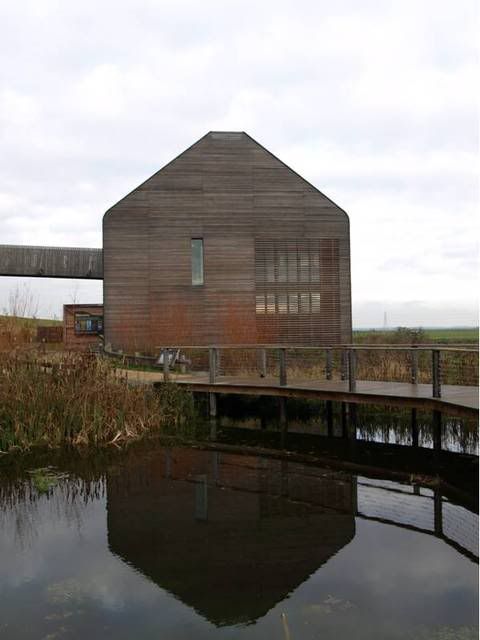
The Visitor Centre is new since the last time we were there – it’s very eco-friendly, with a reed-bed water-treatment system, and an excellent café.


Crossing the bridge, you reach the hide – well, I call it a hide, but it’s centrally heated and far more comfortable than any hide has a right to be. It looks out across the flooded Washes – watermeadows that take the brunt of the winter’s rainfall, and managed to provide an ideal habitat for the migrating wildfowl and for summer visitors in their turn. There are three types of swan here – mute swans, whoopers, and the smaller Bewick swans, although the latter don’t come in close, being kept off the grain feed by the other, bigger birds. (At the moment there is also a black swan, an escape from a local collection and rather unexpected!) As well as swans, there are any numbers of ducks. Most of the ones close-in are mallard (the usual village pond ducks) and pochard – these are the rather dapper grey and chestnut chaps.

Duck Fact: And they are nearly all chaps… the males leave the nesting grounds earlier than the females and young, and consequently take the northerly wintering sites, making the females go further south to Spain. (Hardship, girls!!) The males head back to the breeding grounds in Scandinavia at the start of the season, taking up territories ready for the arrival of the females who, of course, have further to come. The boys bustle around, jockeying for position to be in the right place when the warden comes with the grain barrow, prodding and pushing, diving down and popping up, often underneath an indignant swan, with a flurry of bubbles and a shuffle of feathers and a quick dash to avoid an indignant swan beak. The mallard don’t tend to dive, and have their females with them. They are more inclined to simply shove each other aside in the general melee.

As the light dims the swans start to arrive in greater numbers – up to 4,000 of them at the moment – and they start to parade back and forth in front of the hide, all competing for the right to be first at the food. Below us, the floodlights go on, and excitement builds amongst the birds. A sudden rush to the right alerts us to the warden with his barrow of grain; he makes his way along in front of us, casting scoops of grain into the water. All dignity amongst the swans is immediately lost, and the ducks become a feathered frenzy.

Twilight descends, and with it more swans, white shapes in the gloaming winging over our heads with a melodious and melancholy whooping song, slipping down the cold evening air onto the water, greeting each other with bobbing heads and touching beaks, small family groups – parents and this year’s ashy grey young – staying together amidst the growing flock. We stay until it is too dark to see any more, then take the road northwards, to home and bed.
Winter’s here.
One of the best places to see them is Welney, a Wildfowl and Wetlands Trust reserve on the Ouse Washes near Ely, so on a chilly, damp day in November ‘07, Mum and I headed down there to visit them; an afternoon feeding session guarantees a good turnout!
The Visitor Centre is new since the last time we were there – it’s very eco-friendly, with a reed-bed water-treatment system, and an excellent café.
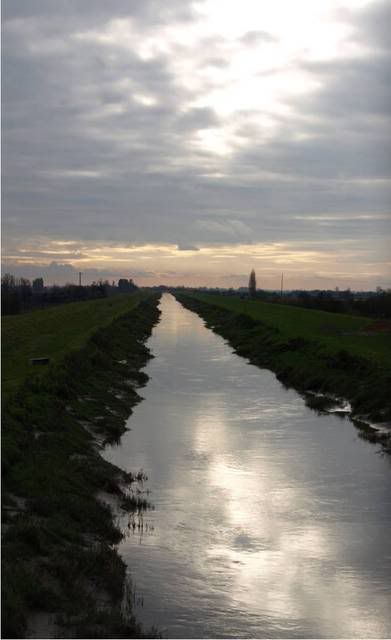
Crossing the bridge, you reach the hide – well, I call it a hide, but it’s centrally heated and far more comfortable than any hide has a right to be. It looks out across the flooded Washes – watermeadows that take the brunt of the winter’s rainfall, and managed to provide an ideal habitat for the migrating wildfowl and for summer visitors in their turn. There are three types of swan here – mute swans, whoopers, and the smaller Bewick swans, although the latter don’t come in close, being kept off the grain feed by the other, bigger birds. (At the moment there is also a black swan, an escape from a local collection and rather unexpected!) As well as swans, there are any numbers of ducks. Most of the ones close-in are mallard (the usual village pond ducks) and pochard – these are the rather dapper grey and chestnut chaps.
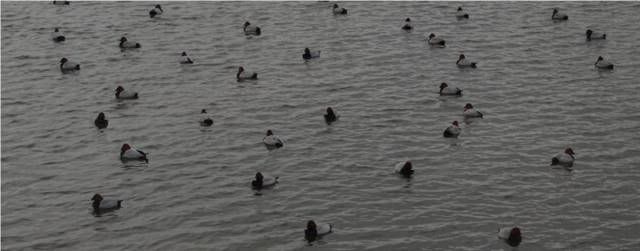
Duck Fact: And they are nearly all chaps… the males leave the nesting grounds earlier than the females and young, and consequently take the northerly wintering sites, making the females go further south to Spain. (Hardship, girls!!) The males head back to the breeding grounds in Scandinavia at the start of the season, taking up territories ready for the arrival of the females who, of course, have further to come. The boys bustle around, jockeying for position to be in the right place when the warden comes with the grain barrow, prodding and pushing, diving down and popping up, often underneath an indignant swan, with a flurry of bubbles and a shuffle of feathers and a quick dash to avoid an indignant swan beak. The mallard don’t tend to dive, and have their females with them. They are more inclined to simply shove each other aside in the general melee.
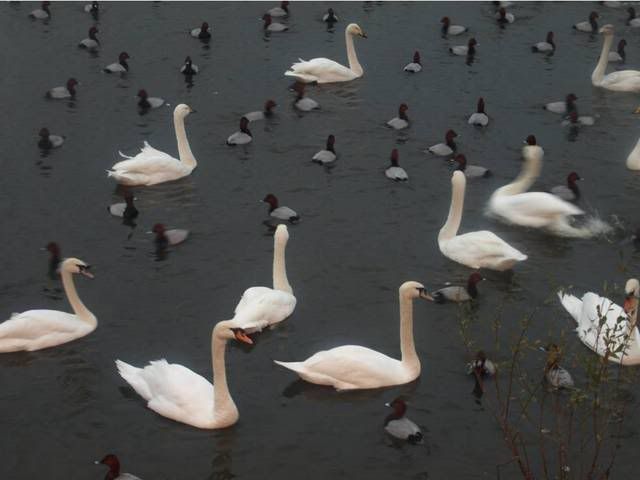
As the light dims the swans start to arrive in greater numbers – up to 4,000 of them at the moment – and they start to parade back and forth in front of the hide, all competing for the right to be first at the food. Below us, the floodlights go on, and excitement builds amongst the birds. A sudden rush to the right alerts us to the warden with his barrow of grain; he makes his way along in front of us, casting scoops of grain into the water. All dignity amongst the swans is immediately lost, and the ducks become a feathered frenzy.
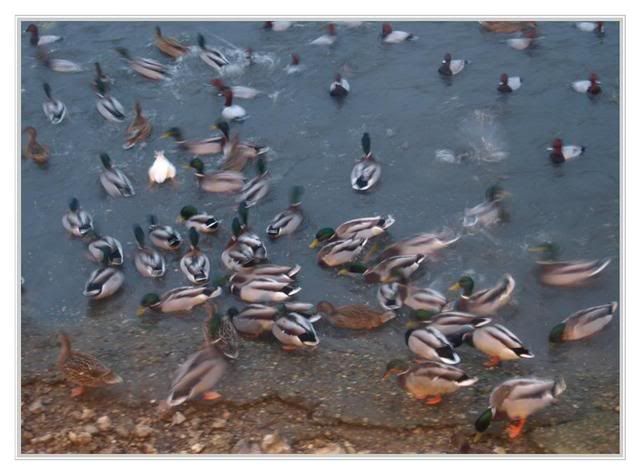
Twilight descends, and with it more swans, white shapes in the gloaming winging over our heads with a melodious and melancholy whooping song, slipping down the cold evening air onto the water, greeting each other with bobbing heads and touching beaks, small family groups – parents and this year’s ashy grey young – staying together amidst the growing flock. We stay until it is too dark to see any more, then take the road northwards, to home and bed.
Winter’s here.
Wednesday, 24 January 2007
Count the legs and divide by two.
Seven-thirty on a cold Sunday morning and there’s no sign of the sun.
The sky is starting to shade to deep blue, the fields around the car are a featureless mass, and there is a distinct aroma from the large pile of manure to the right. A chill breeze blows through the window, and my companion rubs his hands briskly, and peers through his binoculars into the gloom.
‘I think I can hear them.’
I stick my head out of the window. It’s hard to tell where the sound is coming from - definitely from in front of us, but there are elements that may be behind and overhead.
‘I think you’re right - they’re on the move.’
We stare hard into the darkness.
A flicker of movement? Yes - a darker mass moving against the sky, only visible in the reflected light from the sea.
‘Damn! Something’s put them up!’ I clamp my binoculars to my eyes and grab my click-counter. From the hollow to the right they come, a great streaming, clamorous flock, dark shapes stringing out, shifting, coming together and then moving apart, shouting reveille to the brightening sky.
Pink-footed geese, heading out from their overnight roost to feed.
So why am I sat in the cold next to the dung-heap?
It’s the monthly Wetland Bird Census. All over the country, hardy souls are out looking at lakes and lochs, estuaries and mudflats, counting geese, ducks and waders as part of a long-term survey designed to see what’s around, where it is, how many are there, and how the numbers are changing. Our ‘patch’ is the local nature reserve, and today there are five of us looking it over; one at the north end checking the beach, the estuary, and the grazing fields, one south, counting birds on the main body of the loch, one at the top end of the loch, checking amongst the reedbeds, and two of us on the western side, where the majority of the geese head out from the low wetlands into the surrounding countryside. It’s an unglamorous location, in the entrance to a stubble field on a low rise of ground, beside the aforementioned manure pile (awaiting the attentions of the muck-spreader). At least this time it’s to one side - last year the farmer piled it straight in front of where I usually park the car, completely blocking the view! I have counted geese from this place for years; sometimes from the car, occasionally from the reserve truck, and on one memorable occasion stood in a snowstorm in the lee of a large fencepost.
Today the geese are leaving practically in the dark, which makes the counting a little more awkward than usual. I swear they look for new ways to confuse me; flying low along the hollows in the land to suddenly pop up, or all taking off at once in a mass resembling an explosion in a bedding factory (we call this ‘feather-bedding’), or sitting tight and stretching the count (and my bladder-control) out for hours and hours!
I peer into the patch of sky between the manure heap and the rookery wood, where the flocks are just visible, black shapes heading westward. As they pass in front of my binoculars, I count them. At the other side of the car, I can hear Angus doing the same, the steady click of his counter as he tallies the flocks leaving to the northwest. There is little in the way of a break today, the geese seem determined to get to their feeding areas as soon as possible and as the light grows, we can make out more and more of them rising from the low ground in flocks of anything up to six hundred birds. We get some warning of large take-offs - the constant background noise builds to a cacophony of calls as they wheel into the air. Occasionally there are groups of whooper swans, huge and elegant, white wings beating steadily, small family parties with their greyish youngsters, or wheeling flocks of lapwings and golden plover in their thousands.
So how do we count them? It’s a question I’m often asked, and I’m often tempted to give the reply shown above… Actually, if they are in small groups, they can be counted individually. Skeins can be counted in groups of five, hitting the clicker every time you get to twenty. For bigger flocks, where the individual geese can generally be made out, count in groups of twenty (see how big a group is and then ‘size up’) - and as the flock gets bigger and more densely packed, work in fifties or hundreds. Or use combinations of these methods. You get better with practice! It’s not utterly accurate, but accurate enough for the census, and with the same people doing the count each time there is a type of standardisation. What they don’t tend to factor into the equations is the co-efficient of frozen fingers, steamed-up binoculars and windows, or random clicks of the counter caused by shivering!
It’s a dull, grey morning, with the sun hidden behind a dense layer of cloud. Inland there is snow, although it’s clear at the reserve with occasional sleet. A fox, thick winter coat fluffed up against the cold, trots across a distant field with the remains of a goose carcass; it’s nearly the end of the shooting season, so he’ll have to work harder for his breakfast next month. A buzzard calls from somewhere above us, a high mewing cry, and in the field beside us a large group of partridges fusses about amongst the remains of the crop, small bustling brown bodies popping up amongst the dry grasses and taking to the air in an explosion of wings.
The stream of geese slowly winds down, the last few family groups taking to the air, and we head back to the visitor centre to thaw out and count the ducks and waders on the ponds there. Afterwards, we tally up the numbers over bacon sandwiches in the kitchen. Around 20,000 geese in all - about twice the norm for this time of year, probably driven in by the bad weather further south.
Not a bad morning’s work, and next month, we'll do it all again.
The sky is starting to shade to deep blue, the fields around the car are a featureless mass, and there is a distinct aroma from the large pile of manure to the right. A chill breeze blows through the window, and my companion rubs his hands briskly, and peers through his binoculars into the gloom.
‘I think I can hear them.’
I stick my head out of the window. It’s hard to tell where the sound is coming from - definitely from in front of us, but there are elements that may be behind and overhead.
‘I think you’re right - they’re on the move.’
We stare hard into the darkness.
A flicker of movement? Yes - a darker mass moving against the sky, only visible in the reflected light from the sea.
‘Damn! Something’s put them up!’ I clamp my binoculars to my eyes and grab my click-counter. From the hollow to the right they come, a great streaming, clamorous flock, dark shapes stringing out, shifting, coming together and then moving apart, shouting reveille to the brightening sky.
Pink-footed geese, heading out from their overnight roost to feed.
So why am I sat in the cold next to the dung-heap?
It’s the monthly Wetland Bird Census. All over the country, hardy souls are out looking at lakes and lochs, estuaries and mudflats, counting geese, ducks and waders as part of a long-term survey designed to see what’s around, where it is, how many are there, and how the numbers are changing. Our ‘patch’ is the local nature reserve, and today there are five of us looking it over; one at the north end checking the beach, the estuary, and the grazing fields, one south, counting birds on the main body of the loch, one at the top end of the loch, checking amongst the reedbeds, and two of us on the western side, where the majority of the geese head out from the low wetlands into the surrounding countryside. It’s an unglamorous location, in the entrance to a stubble field on a low rise of ground, beside the aforementioned manure pile (awaiting the attentions of the muck-spreader). At least this time it’s to one side - last year the farmer piled it straight in front of where I usually park the car, completely blocking the view! I have counted geese from this place for years; sometimes from the car, occasionally from the reserve truck, and on one memorable occasion stood in a snowstorm in the lee of a large fencepost.
Today the geese are leaving practically in the dark, which makes the counting a little more awkward than usual. I swear they look for new ways to confuse me; flying low along the hollows in the land to suddenly pop up, or all taking off at once in a mass resembling an explosion in a bedding factory (we call this ‘feather-bedding’), or sitting tight and stretching the count (and my bladder-control) out for hours and hours!
I peer into the patch of sky between the manure heap and the rookery wood, where the flocks are just visible, black shapes heading westward. As they pass in front of my binoculars, I count them. At the other side of the car, I can hear Angus doing the same, the steady click of his counter as he tallies the flocks leaving to the northwest. There is little in the way of a break today, the geese seem determined to get to their feeding areas as soon as possible and as the light grows, we can make out more and more of them rising from the low ground in flocks of anything up to six hundred birds. We get some warning of large take-offs - the constant background noise builds to a cacophony of calls as they wheel into the air. Occasionally there are groups of whooper swans, huge and elegant, white wings beating steadily, small family parties with their greyish youngsters, or wheeling flocks of lapwings and golden plover in their thousands.
So how do we count them? It’s a question I’m often asked, and I’m often tempted to give the reply shown above… Actually, if they are in small groups, they can be counted individually. Skeins can be counted in groups of five, hitting the clicker every time you get to twenty. For bigger flocks, where the individual geese can generally be made out, count in groups of twenty (see how big a group is and then ‘size up’) - and as the flock gets bigger and more densely packed, work in fifties or hundreds. Or use combinations of these methods. You get better with practice! It’s not utterly accurate, but accurate enough for the census, and with the same people doing the count each time there is a type of standardisation. What they don’t tend to factor into the equations is the co-efficient of frozen fingers, steamed-up binoculars and windows, or random clicks of the counter caused by shivering!
It’s a dull, grey morning, with the sun hidden behind a dense layer of cloud. Inland there is snow, although it’s clear at the reserve with occasional sleet. A fox, thick winter coat fluffed up against the cold, trots across a distant field with the remains of a goose carcass; it’s nearly the end of the shooting season, so he’ll have to work harder for his breakfast next month. A buzzard calls from somewhere above us, a high mewing cry, and in the field beside us a large group of partridges fusses about amongst the remains of the crop, small bustling brown bodies popping up amongst the dry grasses and taking to the air in an explosion of wings.
The stream of geese slowly winds down, the last few family groups taking to the air, and we head back to the visitor centre to thaw out and count the ducks and waders on the ponds there. Afterwards, we tally up the numbers over bacon sandwiches in the kitchen. Around 20,000 geese in all - about twice the norm for this time of year, probably driven in by the bad weather further south.
Not a bad morning’s work, and next month, we'll do it all again.
Friday, 22 December 2006
Inferno Re-Visited
Dante was wrong. There are ten circles of Hell.
A foretaste of this last, and deepest, darkest circle, is vouchsafed to those who venture out at this time of year… From years of such observation, the full extent of the nightmare can finally be made known.
Beyond Limbo, beyond the city of
Above the door, an archaic sign reads ‘Lucifer, Asmodeus and Beelzebub, licensed purveyors of wines, spirits, beer, tobacco, despair and game. Abandon hope all ye who enter here.’
The Door is guarded by a demon, who does not try to keep out the poor damned souls clustering at the entryway; rather, it forces upon each a torturous device of metal, wheeled and cage-like, and hastens them through the portal. Barriers swing wide of their own account, drawing the damned deeper into that which lies beyond. A hot, burning wind blows over the damned souls as they enter, a foretaste of what is to come. Eyes wide, the souls behold a huge cavern, stretching on for eternity, and find in their hands a piece of parchment, a list of such length as to take almost forever to glean from the serried ranks of razor-edged shelves that line the endless aisles…
And thus they set out upon their futile quest – to gather everything on the list in their trembling hands. For if they succeed, and gain the FinalCheckOut, they will be released from this torment, and will forever rest in peace – or so they believe, for none has ever succeeded in escaping. For many are the trials and tribulations that lie ahead, and loud is the Infernal Muzack playing all around.
The wheeled devices go not where the damned direct them, but follow a path of their own that takes the soul not past the cool Havens of the Frozen Foods but onwards to the Sprouts of Doom. A cry of woe rings the Vegetable Department – for Lo, there are no leeks until Tuesday! The hot breath of the mighty Heaters increases. And the damned are forced to loose their collars, and sweat breaks out on each face. One soul reaches the Infinite Shelf of Baking Products, but alas – there are raisins, sultanas, dried apricots, dried apple flakes, sunflower seeds, self-raising flour, self-deflating flour, organic flour, inorganic flour, gluten-free flour, flour-free flour – but no chocolate chips. Perhaps they have been relocated?
The damned soul beseeches a passing imp, pallid and be-spotted, which calls to its brood mate, ‘
The imp Sharon scratches the tips of her horns with her tail, tilting the festive baubles hung thereon, and responds, ‘Aisle 134,237,901, with the biscuits. Been there since the new EU regulations came in.’
The soul sinks its head in its hands and weeps.
In Seasonal Goods, a fight breaks out as one damned soul pounces on the last roll of wrapping paper and bears it off in triumph.
They cannot leave until their list is fulfilled, precisely As It Is Writ, with no substitutions or alternative manufacturers, for Our Dad will only eat a certain brand of beans. Which are currently out of stock. And no item shall be Past Its Sell By Date, for this renders it invalid. Should a persistent soul, after many millennia crawling the aisles, finally see ahead the haven of the FinalCheckOut, it is certain that the queue will stretch to the rear of the Great Cavern, beyond even the Bread Counter. And it will not proceed, for there will be those who try to substitute items, or who have forgotten the frozen peas. Or have cartons of milk that have split. And if by some chance the damned soul finds itself at the end of the eternally halted conveyor belt, the demon at the till will close the checkout as the soul starts to empty the trolley’s contents onto the conveyor. And there will be a wailing and a gnashing of teeth.
And ‘Mistletoe and Wine’ will begin again on the loudspeakers…
Subscribe to:
Posts (Atom)
