The weather has been - to say the least - changeable recently, with places that ten days ago had four inches of snow now basking in temperatures in the high 20s...yesterday we had the same temperature here in the north-east corner of Scotland as in Darwin, Australia.
Which meant that, for once, our spring beach clean-up wasn't a total washout! Eight valiant volunteers, armed with litter-pickers and rubbish bags, set about doing a wee bit of tidying up at Fraserburgh. I was in charge of refreshments, explaining what we were doing to the bemused general public, and recording all the various items found : in two and a half hours, we got at least 990 individual items, including 13 disposable barbecues. Two-thirds of what was collected was 'visitor related' rubbish (i.e. not thrown-overboard/fishing waste/sewage-related...you get the idea).
It was also a great opportunity for a spot of people watching... The sudden shock of the sunshine must go straight to the brains of folks up here, immediately disabling all thoughts of sensible clothing and sunscreen - the skimmed-milk skin of the average punter is immediately exposed to the UV rays to the greatest extent possible. Which results in a preponderance of lobster-pinkness as the pallid flesh is rapidly grilled to the broiling-point. I found myself wincing at the thought of how they would feel tomorrow, and slightly self-satisfied that I had blathered on the new Factor 30, half-price and supposedly with a 'golden sheen'. Being of a pallid persuasion, I need all the help I can get.
Crowds (well, in our terms "crowds" - at least 100 people!) made their way to the beach, with all the accoutremonts of the British holidaymaker - windbreaks, buckets and spades, frisbees and beach games tumbling out of overpacked bags, trolley-loads of beer and barbecue equipment (I feel our clean-up efforts will be un-noticeable by tomorrow morning), and over-excited children. There was a background soundtrack of screams as said children ran into the sea, to suddenly halt as the water reached a critical level and yelp 'IT'S COLD!!!!' before running back to the beach, where their doting parents pointed them back at the water to repeat the exercise. They breed them tough up here. This is the North Sea, after all, and it's only May.
The cafe did a roaring trade. An idiot on a jet ski roared from one end of the bay to the other. Offshore, the crab boats went about their business, followed by hopeful gulls. Soggy, sandy, barefoot children trailed after harrassed parents back to the car park.
I recorded the next sheet of findings on the laptop, looked at my arms to check I wasn't burning and made a Horrible Discovery.
Far from a 'golden sheen,' the damn sunscreen makes your skin sparkle. I mean, really glitter. Like disco gel. Like a freakin' cut-price vampire.... I retreated into the deep shade of the van, and prayed for clouds....
Showing posts with label seashore. Show all posts
Showing posts with label seashore. Show all posts
Sunday, 27 May 2012

Saturday, 26 January 2008
Waters of Philorth
First public even of the year, and a chilly afternoon on the estuary. We’re doing a joint bird-watching thing, between the Council Rangers, RSPB and my own organisation, looking at what is on the estuary and beach to the west of my village. I guess it’s pretty good, having two nature reserves nearby – this is the ‘lesser’ one, the Local Nature Reserve(LNR). LNRs are a way the local Council can protect anything interesting, and help prevent the constant degradation of habitat that seems to be a feature of our world.
So we set out in a chill wind, enough to bring tears to the eyes. I (being of limited mobility) took up post on the river, to check on whatever turned up on the inland section, while the rest headed over the dunes to the beach and the mouth of the river, braving the wind-whipped sand and sea spray.
It’s a place where people come to walk their dogs, and they were present in abundance – from small jovial terriers to aloof lurchers, juvenile retrievers that growled at me as a ‘new & therefore weird’ person, springer spaniels that leapt into the river with a joyful bark and a constantly wagging tail, senior sheepdogs that try to round everyone else up – the prevalent smell in the cars heading homeward must be ‘wet dog’…
Some of the owners are responsible, cleaning up the mess after their pooches dump last night’s dinner. But many don’t seem to feel it’s a problem – you would think that, coming here day after day, they would notice the build up of dog crap around the site, but they seem to have selective vision. Indeed, a local councillor has been reported as saying ‘Well, the bin isn’t near where my dog does its business.’ Good example, guys.
So the place is pretty much a ‘watch where you walk’ endeavour, and even the responsible owners aren’t entirely blameless – I watched a guy with three dogs on leads and three running loose… the ones on leads he cleaned up after…the others had done their thing before he got to where I was standing, and of course he didn’t know they had dumped by then…I do wish people would be aware of what their animals were doing when not under their immediate control, as this would prevent a lot of confrontation between visitors and managers of sites…
Sigh. Enough of crap. Literally. Just clear it up, that’s my view.
There weren’t too many birds around – gulls, crows, jackdaws – last year, we did this walk a month later and there were quite a lot of waders – but this could have been a factor of the tide.
Today was the day after a high spring tide, and coupled with a lot of recent rain, the estuary was pretty full. You expect the tide to fill, hit the top – slack – and then retreat, but it seems this isn’t the way it goes. Watching the water come and go, using a fence post and several clumps of grass as markers, it became evident that there was much more to it.
The water seemed to go up and down several times, the grass islands flooding and emerging as I watched. What drew my attention to the changes was that I noticed a small mammal making its way across the flow to one of the islands, and then staying there - hiding in plain sight as several dogs went past.
The water slowly rose – eventually there was no more island, and the beastie (which I believe(though I wouldn’t bet my life on it!) was a was a water vole –a rarity these days) made its way to the ‘mainland’- chin up and doggy-paddle, determinedly – to the bank.
While I watched, (being interested in the relatively rare sighting) I became aware that the water levels were rising and falling, almost as if the river and the sea were breathing in and out as it hit the top of the tide…the post in the water emerged, snagged trailing debris and then disappeared, releasing the raft of reeds to drift away downstream. Then it appeared again, my attention drawn that way by the loud ‘plop’ of a little grebe making its way downstream on the tide and diving as it went. Up and down. Islands emerging and drowning. Tides are a much more complex thing than they seem, written down in the black and white of tables.
We all met up again, to swap sightings and comments on the weather. The wind whispered in the reeds, dry stems rattling, and a blue tit foraged amongst the foliage for insects and seeds. A flock of jackdaws took wing over our heads, and, distant and clear, the call of pink-footed geese rang clear on the air. Grey skies and cold winds, and the edge of a rain shower, brought an end to our survey.
Sunday, 30 December 2007
Shetland Sojourn III
Our last day in the islands. We pack, feed ourselves and the gull, tidy up and haul all the gear into the car, bidding a fond farewell to our temporary home.
North-east this time, to Vidlin, Delting and Lunning, the Whalsay ferry terminal (no otters this time – but no ferry around) and an almost Scandinavian landscape of painted wooden houses and boats on the firths. The weather has improved, which bodes well for our trip back to Aberdeen tonight.

Shetland sheep come in a variety of colours….


Heading down the coast we stop to check out the seals on the rocks north of Gletness, and spot something else in the water – another otter! It catches an eel, and hauls out onto the rocks to eat it, but the distance- and the activity of the otter – make the photos awkward. We miss the otter, but do manage to catch a few seals, basking like sausages on the smallest of rocks.

We have lunch (very nice, highly recommended if you are ever there!) back at the Shetland Museum, with no need of lamp-posts this time. It’s a beautiful place, very new, nicely laid out, and covering all aspects of the islands’ history.

There are some weird art installations, too. The one on the left is Mum….

Time for a bit of shopping in the Lerwick rush hour – warm woolly Shetland knit hats from Jamieson’s, and some bits from the Shetland Soap Company.

There is just time to take a few twilight pictures before we are due to check in at the ferry terminal. Clickimin Broch lies close to the heart of town, an ancient tower-dwelling in the heart of modern housing, beside the leisure centre and within sight of the supermarket.

The ferry to Bressay runs back and forth all day, taking commuters to and from homes on the neighbouring island and Lerwick. It’s time for us to catch our own ferry.

Well, I say ‘time’ but after check in we have to wait almost an hour while the heavy goods containers are loaded (I have to wonder why they don’t get these aboard in advance of the passenger load!) and we eventually find ourselves driving aboard down a narrow canyon between container wagons. It feels rather risky, a view that isn’t helped as the ‘Norröna’ ferry (Bergen to Tórshavn) limps into Lerwick, having managed to hole itself on a stabliser, the hold cargo shifting so that a container fell onto some cars, (flat!)and a total of 80 cars damaged….
Fortunately, we have no such drama, and spend a comfortable night. We arrive back in Aberdeen at about 7.00 am, the lights of the city coming up rapidly along to starboard. It’s still too early, so we take a short trip up to Torry Battery to watch the dawn come up, before finally heading down to Tracey’s for breakfast, and to sort out all the heap of gear in the car.

Saturday, 15 July 2006
Humber Mud
To the south and east, there is water.
South is the Humber Estuary, a slow brown ooze; East, the cold grey blue of the North Sea. Where these meet, a long crooked finger of almost-land juts out into the tide, an ever-changing desolation of sand and shingle and mud. Each winter brings a realignment, a chance to breaking away from the mainland, and is followed by the need to rebuild the road that straggles to the end of this impudent finger.
South is the Humber Estuary, a slow brown ooze; East, the cold grey blue of the North Sea. Where these meet, a long crooked finger of almost-land juts out into the tide, an ever-changing desolation of sand and shingle and mud. Each winter brings a realignment, a chance to breaking away from the mainland, and is followed by the need to rebuild the road that straggles to the end of this impudent finger.
 The road itself is a patchwork of concrete slabs, some inlaid with old railway lines, and odd strips of interlocking blocks which can be dug up and re-laid, at least where there is sufficient land to put them. A single track, with occasional passing places and lay-bys, it connects the isolated lifeboat station and coastguard to the rest of the world. To leave the road surface is to risk grounding, and becoming stuck in deep, soft sand. High banks, covered in bramble, leathery grey-green sea buckthorn and spiny marram grass both protect the roadway and threaten to engulf it. Convolvulus twines through the scrub, turning striped trumpet flowers towards today’s blue sky. It’s not always so welcoming.
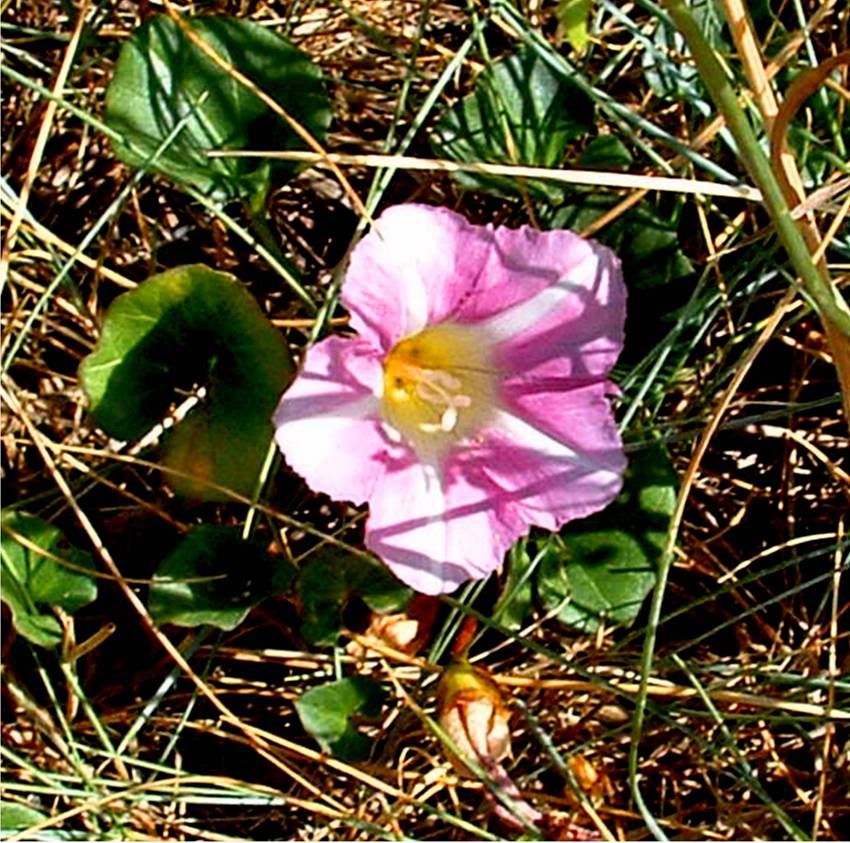
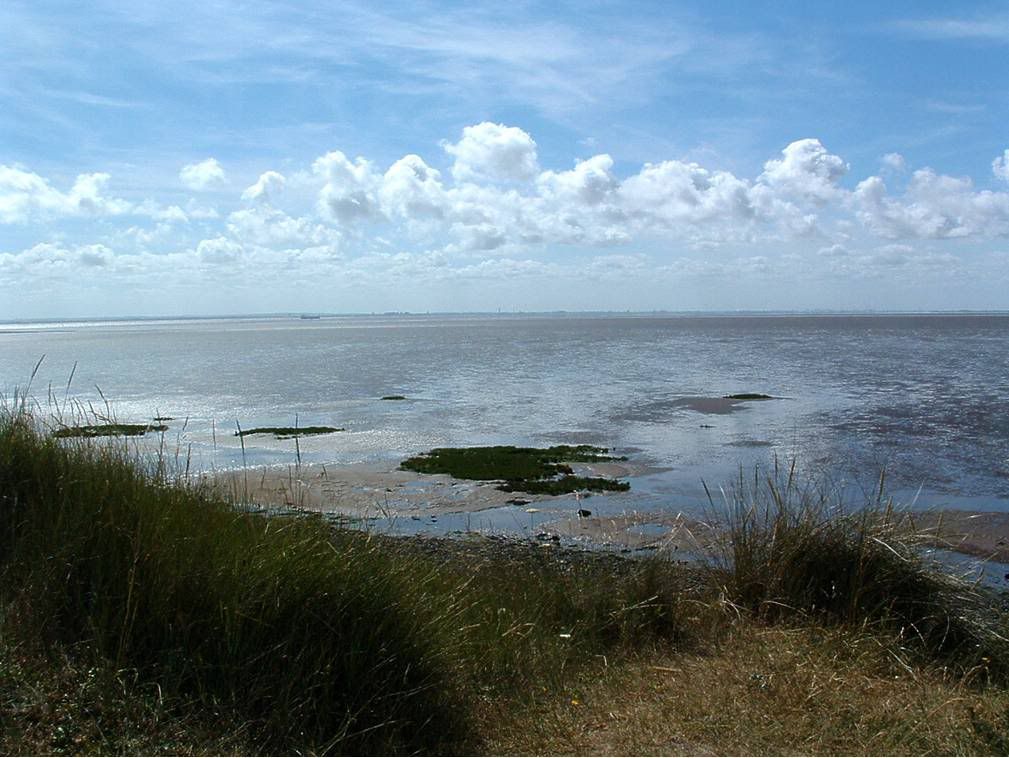
On the seaward side lies the beach, lined with scattered concrete blocks – tank barriers – like children’s toys left out and weathered in a forgotten corner.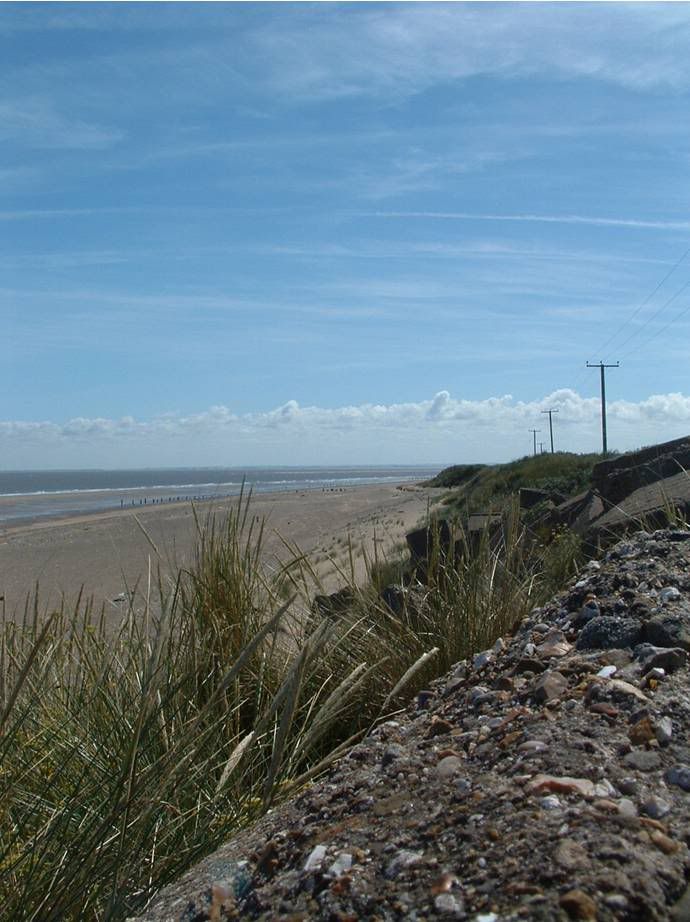
At the end of the land lies the small community of Spurn – houses, for the lifeboat men permanently stationed here; the road is too risky to rely on its being passable during a storm when they might be needed. The old lighthouse and landward tower now are home only to pigeons.
Wending our way back along the track, we come across a patch of sea holly, crisp silver grey-green, flowers tinged with electric blue. A survivor, like Spurn itself.
Wednesday, 14 June 2006
Clout Casting
As the saying goes - 'Never cast a clout 'til May is out'.
Apparently, it means 'may blossom', not the month of May - up here in the North-East of Scotland, it isn't too confusing in this year of weird weather, as the may blossom ( aka hawthorn, Crataegus monogyna unless someone has changed its name while I wasn't looking) didn't appear until last weekend, so both May the month was out and so was the blossom - all at once.
And oh boy, is it out - I wondered for a moment if there had been a major whitewash explosion over one hedgerow - the trees are absolutely covered with thick white blossom, and the bumblebees are loving it.
Butterflies seem to have emerged at last - there have been a few painted ladies and this morning a red admiral flew over the beach and (rather appropriately) headed out to sea...
This morning saw the last beach session of the summer term, and with the tide well out, we found a lot of stranded jellyfish, both moon jelly (Aurita aurita) and the metallic blue Cyanea lamarki, which caused excitement amongst the kids (0nce they'd finished digging holes, of course). Bucketloads of wobbly jelly were brought for identification - 'can it sting?' 'can I pick it up?' and of course 'can I keep it?' (The brief panic that passes over the teacher-in-charge's face at this point is priceless!)
As to clout casting - well, it's the first day I could leave my jacket in the car, so I guess it counts!
Tuesday, 13 June 2006
Riddle of the Sand
OK - I take it back - working outside AND a beautiful day! Doesn't often happen.
What I want to know is - what is the deal with kids and sand? All that space on the beach, all the interesting stuff to beachcomb, and what do they do?
Dig holes.
Huge holes. It's as if there's a primeval urge to get to Australia. And then when the holes fill up with water, it's the most exciting thing that ever happened. But why is it that, with this crazy love for sand, they want to take bucketloads home but hate it in their wellies?
Kids. Go figure.
Subscribe to:
Posts (Atom)
